The story of Adam and Eve is more than just a tale from the beginning of time. It is the foundation of the human story as told in the Bible. It speaks to who we are, why the world can be so difficult, and what God originally intended for humanity.
If you have ever searched for a “bible verse of adam and eve,” you likely know that their story isn’t confined to a single line. It is a rich, layered narrative that spans the first few chapters of Genesis. This guide will walk you through every part of that story. We will look at the key verses, break down their meaning, and explore why this ancient text still matters today.
Think of this as your friendly guide to the very first family. We will keep things simple, clear, and engaging. Whether you are new to the Bible or have read it many times, my goal is to help you see this story with fresh eyes.
Let’s turn the page back to the very beginning.
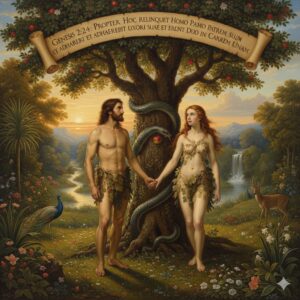
Where to Find the Story: The Book of Genesis
Before we dive into the specific verses, it is helpful to know where this story lives. You will find the entire account of Adam and Eve in the first book of the Bible, called Genesis.
The name “Genesis” means “beginnings” or “origins,” which makes it the perfect place for their story. The narrative is primarily found in two key chapters:
-
Genesis Chapter 1: This chapter provides the big-picture view of creation. It describes the entire universe being formed in six days. Here, we see the creation of mankind as the final, crowning act.
-
Genesis Chapter 2: This chapter offers a more detailed, close-up view. It zooms in on the creation of the first man, Adam, the planting of the Garden of Eden, and the creation of the first woman, Eve.
-
Genesis Chapter 3: This is perhaps the most pivotal chapter in the entire Bible. It tells the story of the serpent’s temptation, the decision to eat the forbidden fruit, and the heartbreaking consequences that followed.
So, when you look for a “bible verse of adam and eve,” you are almost always looking at a verse from Genesis 1, 2, or 3.
The Creation of Adam: Formed from the Dust
The story of Adam is unique. He wasn’t born; he was formed. Genesis gives us a beautiful, intimate picture of this moment.
Key Verse: Genesis 2:7
“Then the Lord God formed a man from the dust of the ground and breathed into his nostrils the breath of life, and the man became a living being.”
This verse is incredibly powerful. It shows two distinct actions by God.
First, there is the forming. The Hebrew word used here is often used for a potter shaping clay. It suggests care, intention, and skill. God got his hands dirty, so to speak, to create humanity. We are made from the earth, connecting us physically to the world around us.
Second, there is the breathing. This is the most intimate act imaginable. God doesn’t just speak Adam to life from a distance. He draws close and breathes his own life into the man. This is what makes humanity special. We are physical beings made from dust, but we are also spiritual beings animated by the very breath of God.
This one verse sets the stage for everything that follows. It tells us we are deeply connected to God and to the earth.
The Garden of Eden: A Perfect Home
God didn’t just create Adam and leave him alone. He prepared a special place for him to live. This place was the Garden of Eden. The Bible describes it as a paradise.
Key Verse: Genesis 2:8-9
“Now the Lord God had planted a garden in the east, in Eden; and there he put the man he had formed. The Lord God made all kinds of trees grow out of the ground—trees that were pleasing to the eye and good for food. In the middle of the garden were the tree of life and the tree of the knowledge of good and evil.”
The Garden of Eden was abundant. It was filled with beautiful things and delicious food. It was a place of provision and delight. God placed Adam in this perfect environment.
But notice the detail about the two special trees in the middle. Their presence is crucial. They meant that life in the Garden wasn’t about magic or automatic bliss. It was about relationship. Having these two trees—one that offered life and one that offered the knowledge of good and evil—gave Adam a choice. Would he trust God’s word and his goodness, or would he seek something else?
Adam’s First Job: Work in Paradise
God also gave Adam a purpose. Even in a perfect world, there was meaningful work to do.
Key Verse: Genesis 2:15
“The Lord God took the man and put him in the Garden of Eden to work it and take care of it.”
This is an important detail. Work was not a punishment. It was part of God’s original good plan. Adam was given the responsibility to tend the garden, to cultivate it, and to be its caretaker. He was God’s partner in looking after creation. This shows us that having a purpose and being productive is built into who we are.
The Creation of Eve: A Helper and a Partner
Despite the perfection of the garden, something was not yet complete. Adam was alone among the animals, and God declared this was not good.
Key Verse: Genesis 2:18
“The Lord God said, ‘It is not good for the man to be alone. I will make a helper suitable for him.'”
This is a profound statement. Before sin entered the world, before any problems, God identified that solitude was not ideal for humans. We are made for relationship.
God brought all the animals to Adam to name, but among them, no suitable partner was found. So, God performed the first surgery.
Key Verse: Genesis 2:21-22
“So the Lord God caused the man to fall into a deep sleep; and while he was sleeping, he took one of the man’s ribs and then closed up the place with flesh. Then the Lord God made a woman from the rib he had taken out of the man, and he brought her to the man.”
This is a beautiful picture. God doesn’t create Eve from new dust, but from Adam himself. This shows their fundamental unity. They are of the same essence.
Adam’s response is the first love poem in the Bible.
Key Verse: Genesis 2:23
“The man said, ‘This is now bone of my bones and flesh of my flesh; she shall be called ‘woman,’ for she was taken out of man.'”
This verse establishes the unique bond between a man and a woman in marriage. They are equal partners, united in a profound way.
The chapter ends with a simple, important summary of God’s design for marriage.
Key Verse: Genesis 2:24
“That is why a man leaves his father and mother and is united to his wife, and they become one flesh.”
And in their innocence, before shame and fear entered the world, we read: “Adam and his wife were both naked, and they felt no shame” (Genesis 2:25).
The Fall: The Serpent’s Deception and the First Sin
Sadly, the perfect harmony of the Garden did not last. A new character enters the story in Genesis 3: the serpent. The Bible describes him as more cunning than any other creature.
The serpent’s strategy is clever. He doesn’t start by directly denying God. He starts by questioning God’s word and his motives.
Key Verse: Genesis 3:1
“He said to the woman, ‘Did God really say, ‘You must not eat from any tree in the garden’?'”
Eve corrects the serpent. She explains they can eat from any tree except the one in the middle. She even adds that God said not to touch it, or they will die.
The serpent then directly contradicts God, calling him a liar.
Key Verse: Genesis 3:4-5
“‘You will not certainly die,’ the serpent said to the woman. ‘For God knows that when you eat from it your eyes will be opened, and you will be like God, knowing good and evil.'”
The temptation was a package deal. It promised:
-
Physical pleasure: The fruit was good for food.
-
Aesthetic beauty: It was pleasing to the eye.
-
Power and wisdom: It was desirable for gaining wisdom.
Eve saw this, made her choice, and ate. She then gave some to her husband, who was with her, and he ate too.
Important Note: Verse 6 says Adam was “with her.” He wasn’t deceived in the same way the serpent deceived Eve (as Paul later notes in 1 Timothy 2:14). Adam made a clear-eyed choice to join his wife in disobedience.
The Immediate Aftermath: Shame and Fear
The consequences were instant. The promise of the serpent came true in a way, but not as they expected. Their eyes were opened, and what they saw was their own vulnerability.
Key Verse: Genesis 3:7
“Then the eyes of both of them were opened, and they realized they were naked; so they sewed fig leaves together and made coverings for themselves.”
The innocence was gone, replaced by shame. Their perfect relationship with each other was broken.
Then, they heard God walking in the garden. The one who used to walk with them in the cool of the day had become a source of terror. They hid.
Key Verse: Genesis 3:9-10
“But the Lord God called to the man, ‘Where are you?’ He answered, ‘I heard you in the garden, and I was afraid because I was naked; so I hid.'”
God’s question, “Where are you?” isn’t because he didn’t know. It was an invitation for Adam to come out of hiding, to confess. Instead, Adam’s response shows the second broken relationship: his relationship with God is now defined by fear.
When God asks if he has eaten from the tree, Adam’s reply shows the third broken relationship.
Key Verse: Genesis 3:12
“The man said, ‘The woman you put here with me—she gave me some fruit from the tree, and I ate it.'”
Adam blames Eve. And indirectly, he even blames God (“the woman you put here with me”). The harmony of “bone of my bones” is shattered, replaced by blame and accusation. Eve, in turn, blames the serpent.
The Consequences: The Curse and the Promise
God then pronounces judgment, but it is important to see this as the natural consequence of their choice to step outside his good design, not arbitrary punishment. These verses are key to understanding the world we live in today.
The Curse on the Serpent
Key Verse: Genesis 3:14-15
“So the Lord God said to the serpent, ‘…Cursed are you above all livestock… I will put enmity between you and the woman, and between your offspring and hers; he will crush your head, and you will strike his heel.'”
This is a pivotal moment. Verse 15 is often called the “Protoevangelium,” which means the “first gospel” or first good news. It is the first hint of a coming rescue. It speaks of a future offspring of the woman who will one day defeat the serpent. For Christians, this is a prophecy pointing to Jesus Christ, who would defeat sin and death (the serpent’s power), though it would cost him his life (a strike to the heel).
The Curse on the Woman
Key Verse: Genesis 3:16
“To the woman he said, ‘I will make your pains in childbearing very severe; with painful labor you will give birth to children. Your desire will be for your husband, and he will rule over you.'”
This verse describes the breakdown of relationships in two key areas of a woman’s life: her family and her marriage. Childbirth, which was meant to be the joyful act of cooperating with God in creation, would now be accompanied by pain. The harmony in marriage would be replaced by a struggle for dominance—a “desire” to control or overcome her husband, met with his potential to “rule” over her.
The Curse on the Man
Key Verse: Genesis 3:17-19
“To Adam he said, ‘…Cursed is the ground because of you; through painful toil you will eat food from it all the days of your life. It will produce thorns and thistles for you… By the sweat of your brow you will eat your food until you return to the ground, since from it you were taken; for dust you are and to dust you will return.'”
For Adam, the breakdown happens in his work and his relationship with the earth. The ground itself, which he was meant to tend with joy, now resists him. Work becomes “painful toil,” filled with frustration and “thorns and thistles.” And finally, the ultimate consequence of being separated from the Tree of Life: physical death. The dust from which he came would one day claim him again.
The Expulsion from the Garden
The story concludes with a sad, but merciful, departure from Eden.
Key Verse: Genesis 3:21
“The Lord God made garments of skin for Adam and his wife and clothed them.”
Even in judgment, there is grace. God covers their shame. To provide these skin garments, an animal had to die. This was the first sacrifice, a picture that covering sin requires a cost.
God then acknowledges that the man has “become like one of us, knowing good and evil.” To prevent them from eating from the Tree of Life and living forever in this broken, sinful state, he sends them out of the garden.
Key Verse: Genesis 3:23-24
“So the Lord God banished him from the Garden of Eden to work the ground from which he had been taken. After he drove the man out, he placed on the east side of the Garden of Eden cherubim and a flaming sword flashing back and forth to guard the way to the tree of life.”
The story that began in a perfect garden ends with humanity outside its gates, facing a hard world. But it is not the end of the story. It is the beginning of God’s long plan to bring his people back to himself.
Comparing the Two Creations
To help visualize the different perspectives in Genesis 1 and 2, here is a simple comparison.
| Feature | Genesis Chapter 1 | Genesis Chapter 2 |
|---|---|---|
| Perspective | Cosmic, wide-angle view of all creation. | Personal, close-up view of humanity. |
| Name for God | Elohim (God) | Yahweh Elohim (The Lord God) |
| Creation of Man | On Day 6, along with land animals. “Male and female he created them.” (v. 27) | Formed from the dust before plants and animals are specifically mentioned for the garden. |
| Focus | The power and order of the Creator. | The intimacy and relationship with the Creator. |
| Command | “Be fruitful and increase in number; fill the earth and subdue it.” (v. 28) | “You are free to eat from any tree… but you must not eat from the tree of the knowledge of good and evil.” (v. 16-17) |
Key Themes from the Verses of Adam and Eve
When you read through the “bible verse of adam and eve,” several big ideas stand out. These themes run through the entire Bible.
-
God as Creator: The story establishes God as the sovereign, intentional creator of everything, including human life.
-
The Goodness of Creation: Before the Fall, everything God made was “good.” The physical world, the human body, work, and relationships were all part of God’s perfect design.
-
Humanity’s Unique Place: Made in God’s “image” (Genesis 1:26-27) and given breath directly from God, humans have a unique dignity and responsibility.
-
The Importance of Choice and Obedience: The tree in the garden shows that love and relationship with God require a choice. Blind obedience without a choice is not a loving relationship.
-
The Reality of Temptation and Sin: The story honestly depicts how temptation works—through doubting God’s word, his goodness, and promising something he doesn’t want us to have. Sin is the choice to go our own way.
-
Broken Relationships: Sin’s immediate effect is brokenness: brokenness with God (fear and hiding), with each other (blame), with ourselves (shame), and with creation (thorns and toil).
-
God’s Grace in Judgment: Even in the curses, God provides. He makes clothes for them, and he promises a future deliverer. He doesn’t abandon them completely.
Frequently Asked Questions (FAQ)
Here are some common questions people have about Adam and Eve.
1. Were Adam and Eve real people?
This is a question of faith. Many Christians and Jews believe they were literal, historical individuals, the first parents of all humanity. Others see them as literary figures in a powerful story that explains profound truths about God and human nature. Both views agree on the theological importance of the story.
2. What was the “forbidden fruit”?
The Bible simply calls it “fruit.” Popular culture often depicts it as an apple, but the text never specifies. The Latin word for “evil” (malum) is similar to the word for “apple” (malus), which may be why the tradition started. The point is not the type of fruit, but the act of disobedience.
3. Why did God put the tree there if he didn’t want them to eat from it?
This is a great question. The tree provided a choice. Without a real choice, Adam and Eve could not genuinely love and obey God. They would have been like robots. The tree gave them the freedom to either trust God’s definition of good and evil or to try and define it for themselves.
4. Did Adam and Eve go to heaven?
The Bible doesn’t explicitly say. However, we see God’s care for them even after they sinned (making them clothes). Hebrews 11, the “faith hall of fame,” doesn’t mention them, but it does mention Abel, their son. Many believe that because they responded to God’s judgment and apparently trusted his promise (Genesis 4:1, where Eve credits God for the birth of Cain), they were saved by faith, just as people are in later biblical accounts.
5. How long were Adam and Eve in the Garden before the Fall?
The Bible gives no timeline. It could have been a few days, a few years, or even longer. The story focuses on the event itself, not the duration of their innocence.
Additional Resources
If you would like to explore this topic further, here are a few helpful resources:
-
Read the Text Yourself: The best way to understand the story is to read it directly. You can find the Book of Genesis online or in any Bible. Try reading chapters 1-3 in a modern translation like the New International Version (NIV) or the English Standard Version (ESV).
-
Bible Project: Genesis 1-11: The Bible Project has created excellent animated videos that explain the structure and themes of the first part of Genesis. Their content is free and very insightful for visual learners.
-
Commentaries: For a deeper dive, you can look at commentaries on Genesis. The Genesis Account by Jonathan Sarfati offers a literal perspective, while Genesis: Interpretation by Walter Brueggemann provides a more theological and literary approach.
Conclusion
The story of Adam and Eve, found in the first chapters of Genesis, is far more than an ancient myth. It is a mirror held up to our own lives. We see our own desire for more, our struggles with temptation, and our tendency to hide and blame when things go wrong.
But more importantly, it introduces us to a God who creates with intention, walks in relationship with his people, and in the very moment of judgment, offers a promise of hope. From the dust of the ground to the breath of life, from the perfect garden to the broken world outside, the “bible verse of adam and eve” tells the foundational story of where we came from, what went wrong, and the first whisper of a plan to make it right again.