There is something incredibly comforting about the presence of animals. They are our companions, our source of food, our wonder, and often, a reflection of the natural world’s beauty and power. When we open the pages of the Bible, we find that animals are not just background details; they are woven into the very fabric of the story. From the serpent in the Garden of Eden to the four living creatures in Revelation, animals serve as symbols, teachers, and witnesses to God’s plan.
If you have ever searched for a “bible verse of animals,” you likely know there are hundreds. But finding the right verse for comfort, understanding, or study can be overwhelming. This guide is designed to be your comprehensive resource. We will walk through the most important passages, uncover their meanings, and explore what these ancient texts say about our relationship with the animal kingdom today.
Whether you are a pastor preparing a sermon, a student working on a project, or simply a curious soul looking for wisdom, this article will provide clarity and depth. Let’s embark on this journey together through the biblical wilderness.
The Significance of Animals in the Biblical Narrative
To truly appreciate the “bible verse of animals,” we must first understand why animals matter so much in Scripture. They are not incidental. They are part of the created order that God declared “good.”
Creatures of the Covenant
From the very beginning, animals are included in God’s covenants. After the flood, God establishes His covenant not only with Noah and his descendants but with “every living creature that is with you, the birds, the livestock, and every beast of the earth” (Genesis 9:10). The rainbow in the clouds is a sign of this covenant between God and all life on earth. This alone elevates animals beyond mere objects; they are partners in God’s promise.
Teachers of Wisdom
The Bible often points to the animal kingdom as a source of profound wisdom. In the book of Job, God himself uses animals to teach Job about His power and sovereignty. He asks:
“But ask the beasts, and they will teach you; the birds of the heavens, and they will tell you; or the bushes of the earth, and they will teach you; and the fish of the sea will declare to you.” (Job 12:7-8)
This perspective is humbling. It suggests that by observing nature—the ant’s diligence, the eagle’s strength, the lamb’s innocence—we can learn spiritual truths.
Old Testament: A Tapestry of Animals
The Old Testament is filled with references to animals, ranging from sacrificial systems to poetic imagery. Let’s break them down by category to make this easier to navigate.
Animals in the Law: Clean, Unclean, and Compassion
The books of Leviticus and Deuteronomy contain detailed laws regarding animals, primarily distinguishing between “clean” and “unclean” species. While these dietary laws are specific to the Israelites, the principles behind them reveal a God who cares about order and holiness.
Clean Animals (Kosher): These were animals that could be eaten and sacrificed. They generally had to have a split hoof and chew the cud (like cattle, sheep, goats, and deer). Fish needed to have fins and scales.
Unclean Animals: These were not to be eaten or touched. They included pigs, camels, rock badgers, rabbits, and birds of prey.
Beyond diet, the Law commands a remarkable level of compassion for animals.
-
Sabbath Rest: The commandment to rest on the seventh day explicitly includes working animals: “but on the seventh day you shall rest; that your ox and your donkey may have rest” (Exodus 23:12).
-
Helping a Fallen Enemy: The Law goes even further, instructing the Israelites to help even an enemy’s donkey if it has fallen under its burden (Exodus 23:5).
-
The Mother Bird: A beautiful law in Deuteronomy 22:6-7 instructs that if someone finds a bird’s nest with a mother and her young, they may take the young, but they must let the mother go free. This ensures the species can continue.
Poetic Books: Metaphors and Majesty
The Psalms and Proverbs are treasure troves for anyone looking for a “bible verse of animals.” They use animal imagery to describe God, humanity, and the nature of life.
-
The Lord is My Shepherd: Perhaps the most famous metaphor involving an animal is found in Psalm 23. “The Lord is my shepherd; I shall not want.” This compares God’s care for us to a shepherd’s gentle, guiding, and protective care for his sheep.
-
The Strength of the Eagle: Isaiah 40:31 promises that “they who wait for the Lord shall renew their strength; they shall mount up with wings like eagles.” The eagle symbolizes soaring above life’s troubles, empowered by God.
-
The Wisdom of the Ant: Proverbs 6:6-8 holds up the ant as a model of industriousness and foresight: “Go to the ant, O sluggard; consider her ways, and be wise. Without having any chief, officer, or ruler, she prepares her bread in summer and gathers her sustenance in harvest.”
The Prophets: Visions and Judgment
The prophetic books use animals to paint vivid pictures of judgment and restoration.
-
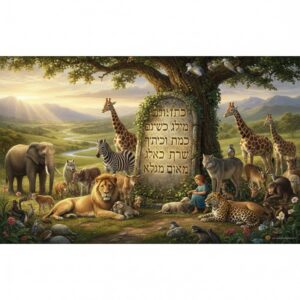
The Lion and the Lamb: Isaiah’s vision of the peaceable kingdom is one of the most powerful images in all of literature: “The wolf shall dwell with the lamb, and the leopard shall lie down with the young goat, and the calf and the lion and the fattened calf together; and a little child shall lead them.” (Isaiah 11:6). This speaks of a future time of perfect peace, when even natural predators live in harmony with their prey.
-
Ezekiel’s Creatures: In his vision of God’s glory, Ezekiel sees four living creatures that have the faces of a man, a lion, an ox, and an eagle (Ezekiel 1:10). These represent the pinnacle of God’s creation: humanity, wild royalty, domestic service, and the heavens.
New Testament: From Lambs to Lions
The New Testament continues this rich tradition, with animals playing key roles in the life of Jesus and the teachings of the apostles.
Jesus and the Animal World
Jesus, a master storyteller, frequently used animals in his parables to illustrate profound truths about the Kingdom of God.
-
The Good Shepherd: Building on the Old Testament imagery, Jesus calls himself the “good shepherd” who lays down his life for the sheep (John 10:11). This highlights his sacrificial love and protective nature.
-
Consider the Birds: In his teaching on worry, Jesus points to nature as an example of God’s provision. “Look at the birds of the air: they neither sow nor reap nor gather into barns, and yet your heavenly Father feeds them. Are you not of more value than they?” (Matthew 6:26). This is a powerful “bible verse of animals” for anyone struggling with anxiety.
-
The Lamb of God: Perhaps the most significant title for Jesus involving an animal is “The Lamb of God.” When John the Baptist sees Jesus, he declares, “Behold, the Lamb of God, who takes away the sin of the world!” (John 1:29). This connects Jesus directly to the Passover lamb, whose blood saved the Israelites, and the sacrificial system, portraying him as the ultimate and final sacrifice.
Animals in the Early Church
The book of Acts and the Epistles continue to use animal imagery to describe the new Christian community and its challenges.
-
Peter’s Vision: In Acts 10, Peter has a vision of a sheet descending from heaven containing all kinds of animals, both clean and unclean. A voice tells him to “kill and eat.” When Peter protests, the voice says, “What God has made clean, do not call common.” This vision was pivotal in opening the early church to Gentile believers, showing that the old dietary laws were no longer a barrier to fellowship.
-
Beware of Dogs: Paul, in Philippians 3:2, uses a stark animal metaphor to warn against false teachers: “Look out for the dogs, look out for the evildoers, look out for those who mutilate the flesh.” Here, “dogs” refers not to our beloved pets, but to the scavenger dogs of the ancient world, symbolizing impurity and aggression.
-
The Lion of the Tribe of Judah: In contrast to Jesus the Lamb, Revelation presents him as the conquering King: “Weep no more; behold, the Lion of the tribe of Judah, the Root of David, has conquered” (Revelation 5:5). This dual imagery of Jesus as both the sacrificial Lamb and the victorious Lion is central to Christian theology.
A Comparative Look: Animals as Symbols
To help you quickly navigate the most common animal symbols, here is a handy reference table. This is a useful tool when you are searching for a specific “bible verse of animals” and its meaning.
| Animal | Primary Symbolism | Key Bible Verse(s) | Explanation |
|---|---|---|---|
| Lamb | Innocence, Sacrifice, Jesus Christ | John 1:29; Isaiah 53:7 | Represents gentleness and the ultimate sacrifice for sin. |
| Lion | Royalty, Power, Judgment (both God and Satan) | Revelation 5:5 (Christ); 1 Peter 5:8 (Devil) | Can symbolize Christ’s conquering power or the devil’s predatory nature. |
| Dove | Peace, Holy Spirit, Purity | Genesis 8:11 (Olive leaf); Matthew 3:16 (Spirit descends) | The dove returning to Noah signaled the end of God’s judgment. It is the form the Holy Spirit took at Jesus’ baptism. |
| Serpent/Snake | Deception, Sin, Wisdom, Healing | Genesis 3:1 (Satan); Numbers 21:9 (Bronze serpent); Matthew 10:16 | Primarily represents Satan and temptation, but can also symbolize wisdom (“shrewd as serpents”) and, in the bronze serpent, a symbol of healing and salvation. |
| Eagle | Strength, Renewal, Vision, God’s Care | Isaiah 40:31; Exodus 19:4 | Symbolizes soaring above trials, renewing strength, and God’s protective care (“I bore you on eagles’ wings”). |
| Ox/Bull | Service, Sacrifice, Strength | Proverbs 14:4; 1 Corinthians 9:9 | Represents hard work, patience, and provision. Often used in the context of labor and sacrifice. |
| Goat/Sheep | The distinction between the righteous and the wicked | Matthew 25:32-33 | In judgment, Jesus separates people as a shepherd separates sheep (righteous) from goats (wicked). |
| Fish | Believers, Evangelism, Jesus | Matthew 4:19 (“Fishers of men”); the Ichthys symbol | The fish was an early secret symbol for Christianity. It represents the call to evangelize and the believers themselves. |
| Donkey | Peace, Humility, Service | Zechariah 9:9; Matthew 21:5 (Triumphal entry) | A king arriving on a donkey came in peace, not war. It signifies humility and service. |
Important Lessons: What the Bible Teaches Us About Our Relationship with Animals
After reviewing these verses, several clear principles emerge that are relevant for us today.
Note on Stewardship, Not Dominion
There is a common misconception that the Bible gives humanity free rein to exploit the earth. The key concept is actually “stewardship.” In Genesis 1:26, God gives humanity “dominion” over the fish, birds, and livestock. However, the Hebrew word radah implies a ruling that is caring and just, like a good king caring for his subjects. It is a delegated authority meant to reflect God’s own care for his creation. We are managers, not owners.
God’s Compassion Extends to All Creatures
Psalm 145:9 states, “The Lord is good to all, and his mercy is over all that he has made.” Jonah 4:11 even shows God expressing concern for the cattle in the great city of Nineveh. This shows that God’s compassion is not limited to humans; it encompasses the entire animal kingdom. This should shape how we view and treat animals today.
Animals as a Mirror for Humanity
Often, when the Bible describes animal behavior, it is holding up a mirror to our own.
-
Stubborn as a mule (Psalm 32:9) warns us against resisting God’s guidance.
-
Bold as a lion (Proverbs 28:1) describes the righteous who are fearless.
-
Harmless as doves (Matthew 10:16) instructs us on how to engage with a hostile world.
Practical Applications: How to Use This Guide
Finding the right “bible verse of animals” can be for different purposes. Here are some common scenarios and which verses might be most helpful.
For Comfort When Worried
If you are feeling anxious about provision or the future, turn to Matthew 6:26. If God feeds the birds, how much more will he care for you, his beloved child?
For Understanding Sacrifice
To grasp the core of the Gospel message, meditate on John 1:29, “Behold, the Lamb of God, who takes away the sin of the world!” This connects the Old Testament sacrificial system to the ultimate sacrifice of Jesus.
For Teaching Children About God’s Creation
The story of Noah’s Ark (Genesis 6-9) is a wonderful starting point. It is filled with animals and teaches lessons about God’s judgment, mercy, and promise. Pair it with Psalm 104, a beautiful poem celebrating God’s care for all his creatures, including the lions seeking their food from God (Psalm 104:21).
For a Sermon on Peace
The vision in Isaiah 11:6-9 of the wolf living with the lamb is the ultimate biblical image of peace and reconciliation, not just between humans and God, but within all of creation.
For Personal Reflection on Strength
If you feel weak or depleted, pray through Isaiah 40:31. Ask God to renew your strength like the eagle’s, enabling you to rise above your circumstances.
Frequently Asked Questions (FAQ)
1. What is the most famous bible verse about animals?
While there are many, Matthew 6:26 (“Look at the birds of the air…”) and the imagery of the “Lion and the Lamb” (from Isaiah 11 and Revelation 5) are arguably the most well-known.
2. Does the Bible say animals have souls?
This is a complex theological question. The Hebrew word nephesh, often translated as “soul” or “living being,” is used for both humans and animals in Genesis (e.g., Genesis 1:30 speaks of “every beast of the earth… everything that has the breath of life”). In this sense, animals are living, breathing souls. However, the Bible is less clear about whether animals share the same eternal destiny or self-awareness as humans.
3. Will there be animals in heaven?
The Bible doesn’t give a definitive “yes” or “no.” However, the vision of the new creation in Isaiah 11 and 65 includes animals living in peace. Revelation describes the new heaven and new earth, and it seems consistent with God’s character that his redeemed creation would include the animals he made and loved. While our pets are not explicitly mentioned, the God who cares for sparrows certainly has the power and love to include them in his eternal kingdom.
4. Why are there so many animal sacrifices in the Old Testament?
These sacrifices were a system instituted by God to teach his people about the seriousness of sin and the need for a substitute to die in their place. The animal’s death was a temporary covering for sin, pointing forward to the perfect and final sacrifice of Jesus, the “Lamb of God.”
5. What does the Bible say about being kind to animals?
The Bible is clear on this. Proverbs 12:10 states it plainly: “Whoever is righteous has regard for the life of his beast, but the mercy of the wicked is cruel.” This verse elevates animal welfare as a mark of a righteous person.
Additional Resource: Deepen Your Study
If you found this guide helpful and want to explore the topic further, we highly recommend a reputable online Bible study tool.
Resource Link: Bible Gateway
This is an excellent resource for reading different translations (like the ESV, NIV, or KJV) and performing keyword searches. You can look up every instance of the word “lion,” “lamb,” or “eagle” to see the full context of these verses for yourself.
Conclusion
From the first breath of life in Genesis to the final visions of a restored creation in Revelation, animals are an integral part of God’s story. The “bible verse of animals” is not a single verse but a vast and beautiful tapestry that teaches us about God’s power, provision, and peace. Whether we see ourselves as sheep in need of a shepherd, find strength in the wings of an eagle, or place our hope in the conquering Lion of Judah, the animal kingdom reflects divine truths back to us. By studying these scriptures, we not only learn about the creatures God made, but we also learn about ourselves and the heart of the Creator who cares for all he has made.