Throughout history, humanity has grappled with a profound sense of separation. We often feel disconnected—from our purpose, from each other, and most importantly, from our Creator. Across cultures, people have built altars, offered sacrifices, and followed intricate rituals, all in an attempt to reach a higher power. This universal search highlights a fundamental question: How can we, as flawed human beings, ever hope to connect with a perfect and holy God?
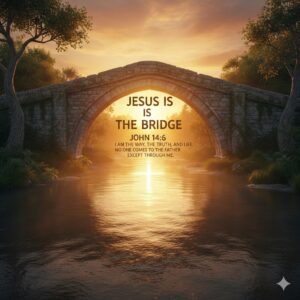
The Bible presents a clear and compelling answer to this dilemma. It teaches that the gap created by sin is too vast for us to cross on our own. We need a mediator. We need a bridge. This is where the core of the Christian faith comes into focus. The concept of “Jesus Is The Bridge” is not just a poetic metaphor; it is a profound theological truth woven throughout the entirety of Scripture.
This article will serve as your comprehensive guide to understanding the “Jesus Is The Bridge” Bible verse. We will explore the specific scriptures that illustrate this concept, unpack the problem that made the bridge necessary, and examine the life-changing implications of crossing over from separation to eternal connection with God.
The Great Divide: Understanding the Need for a Bridge
Before we can truly appreciate the solution, we must first understand the problem. The Bible is honest about the human condition. It doesn’t paint a picture of people who are basically good and just need a little help. Instead, it reveals a profound and insurmountable divide between humanity and God.
The Chasm of Sin
What is this divide? The Bible calls it sin. Sin is more than just a list of bad behaviors; it is a state of being. It is missing the mark of God’s perfect standard. It is rebellion, disobedience, and a self-centered nature that prioritizes our will over God’s.
Romans 3:23 puts it plainly: “For all have sinned and fall short of the glory of God.”
This verse is a great equalizer. It doesn’t matter if you are a philanthropist or a criminal; everyone, without exception, falls short. This “falling short” creates a separation. Imagine a canyon so wide that you cannot see the other side. Our sin creates a canyon of that magnitude between us and God. It’s not that God moved away; our sin has made us incapable of reaching Him.
God’s Holiness vs. Human Imperfection
To further complicate the matter, God is not just powerful or wise; He is holy. Holiness means He is completely separate from and uncontaminated by evil. He is pure light, and in Him, there is no darkness at all (1 John 1:5).
These two realities—a holy God and a sinful humanity—cannot coexist without a mediator. It is like trying to mix oil and water; they are fundamentally incompatible. In the Old Testament, this truth was graphically illustrated. When the prophet Isaiah encountered a vision of God in His holiness, his immediate reaction wasn’t comfort, but terror.
Isaiah 6:5 records his cry: “Woe to me! I am ruined! For I am a man of unclean lips, and I live among a people of unclean lips, and my eyes have seen the King, the Lord Almighty.”
Isaiah understood intuitively that his imperfection could not stand in the presence of absolute perfection. This is the great divide. Humanity, trapped on one side, cannot cross to God. And God, in His holiness, cannot simply ignore sin, as that would contradict His just and perfect nature. The situation seemed hopeless—unless someone could build a bridge.
The Old Testament Foreshadowing: A Bridge in the Distance
Long before Jesus walked the earth, God was already teaching His people about the need for a bridge and hinting at His plan to provide one. The entire system of worship in the Old Testament served as a shadow, a blueprint of the real solution to come.
The Tabernacle and the Veil
When God gave Moses the instructions for the Tabernacle (a portable temple), the design itself told a story. The Tabernacle was divided into two main rooms: the Holy Place and the Most Holy Place (or the Holy of Holies). Separating these two rooms was a massive, thick veil or curtain.
This veil was more than just a room divider. It was a symbolic representation of the separation between God and man. God’s presence dwelt in the Most Holy Place, above the Ark of the Covenant. No one was allowed to enter that sacred space except for one person, the High Priest, and only one day a year, Yom Kippur (the Day of Atonement). The veil was a constant, physical reminder: The way into God’s presence is not yet open.
The Role of the High Priest
The High Priest was a fascinating figure. He was a human being, chosen from among the people, to represent them before God. He acted as a mediator, a go-between. On the Day of Atonement, he would offer a blood sacrifice first for his own sins and then for the sins of the people. He would then pass through the veil, entering God’s presence to make atonement.
This entire ritual highlighted two things:
-
The need for a mediator. The people couldn’t go in themselves. They needed someone to go on their behalf.
-
The temporary and insufficient nature of the system. The priest had to do this every single year, proving that the sacrifice of animals could never permanently solve the problem of sin. It was a placeholder, a constant reminder of the gap that still existed.
Prophetic Promises of a Mediator
Throughout the Old Testament, prophets spoke of a coming figure who would change everything. They spoke of a Messiah (an Anointed One) who would establish a new covenant, not like the old one.
Jeremiah 31:34 prophesied: “No longer will they teach their neighbor, or say to one another, ‘Know the Lord,’ because they will all know me, from the least of them to the greatest… For I will forgive their wickedness and will remember their sins no more.”
Isaiah spoke of a “Suffering Servant” who would be pierced for our transgressions and crushed for our iniquities (Isaiah 53:5). The prophets were pointing toward a day when the temporary system would be replaced by a permanent solution. They were pointing toward the bridge.
The Cornerstone: The Primary “Jesus Is The Bridge” Bible Verse (1 Timothy 2:5)
While many verses contribute to the picture, one verse stands out as the most direct and concise statement of Jesus as the bridge. It serves as the cornerstone for this entire concept.
1 Timothy 2:5 (NIV): “For there is one God and one mediator between God and mankind, the man Christ Jesus.”
This single sentence is packed with profound theological meaning. It is the “Jesus Is The Bridge” Bible verse in its purest form.
Deconstructing 1 Timothy 2:5
Let’s break this verse down into its core components to fully grasp its significance.
-
“For there is one God…” This statement reaffirms the foundational truth of Judaism and Christianity: monotheism. There is only one true God, the Creator of the heavens and the earth. This isn’t a suggestion; it’s a declaration of reality. There is no pantheon of gods to choose from. There is only one ultimate source of life and being.
-
“…and one mediator…” This is the critical point. The word “mediator” (Greek: mesites) means a go-between, an intermediary, a negotiator, or an arbitrator. A mediator stands in the gap between two parties to bring them together. The verse doesn’t say there are many potential mediators—prophets, angels, saints, or religious leaders. It declares there is one. The bridge is singular.
-
“…between God and mankind…” This clarifies the two parties involved. On one side is the one holy God. On the other side is all of humanity. The separation is universal, and therefore the solution must be universally applicable. This mediator is for everyone, everywhere, throughout all time.
-
“…the man Christ Jesus.” This identifies the mediator. He is not just a divine being appearing in human form. He is the man Christ Jesus. This emphasizes His full humanity. He became one of us. He lived a human life, experienced human weakness, and faced human temptation. Because He is a man, He can represent us. And because He is also Christ (the Anointed One, the Messiah) and Jesus (God who saves), He can represent God. He is the unique God-Man, the perfect bridge.
The One Mediator
The power of 1 Timothy 2:5 lies in its exclusivity and its specificity. It doesn’t say Jesus is *a* bridge; it establishes Him as the bridge. It confirms that the separation described in the Old Testament has been addressed. The placeholder system of priests and sacrifices was pointing toward this one ultimate Mediator.
Just as a physical bridge must touch both sides of a chasm, Jesus, as the God-Man, touches both sides. His divinity connects Him to the Father. His humanity connects Him to us. He is the perfect meeting point, the one who can lay His hand on both parties and bring them together in peace.
The Construction of the Bridge: How Jesus Built the Crossing
Understanding that Jesus is the bridge is one thing. Understanding how He functions as the bridge is another. The Bible gives us the blueprints for how this incredible structure was built, spanning the divide we could never cross.
His Dual Nature: Fully God and Fully Man
This is the foundation of the bridge. For a bridge to be effective, its foundation on both sides of the chasm must be solid.
-
On the human side: Jesus was born of a woman, grew up, experienced hunger, thirst, tiredness, and sorrow. He was fully human. This qualifies Him to represent us. He understands our struggles from the inside. The book of Hebrews tells us He was “tempted in every way, just as we are—yet he did not sin” (Hebrews 4:15). Because He is human, His sacrifice has genuine human currency. A truly human life was lived and offered up.
-
On the divine side: Jesus was and is God. He is the eternal Word, through whom all things were made (John 1:1-3). Because He is God, His life has infinite value. A mere human, even a perfect one, could only atone for one human life. But because Jesus is God, His life and sacrifice are of infinite worth, capable of covering the sins of the entire world. He is the only one who can represent God to humanity because He is God.
The Cross: The Central Span
If Jesus’ dual nature is the foundation, the cross is the central span of the bridge—the part that actually covers the gap. The cross is where the work of mediation was accomplished.
On the cross, something remarkable happened. The sinless Son of God took upon Himself the sin of the world.
2 Corinthians 5:21 explains it beautifully: “God made him who had no sin to be sin for us, so that in him we might become the righteousness of God.”
This is the great exchange. Our sin was transferred to Him, and He bore the penalty that we deserved—which is spiritual death and separation from God. As He hung on the cross, He experienced the ultimate separation, crying out, “My God, my God, why have you forsaken me?” (Matthew 27:46). In that moment, the bridge was being built. He was absorbing the full weight of the chasm—the judgment and separation caused by sin—into Himself. He became the bridge by allowing Himself to be consumed by the divide.
The Resurrection: The Anchoring Point
A bridge is useless if it doesn’t lead to a solid destination. If Jesus had simply died and remained dead, we would have a bridge to nowhere. But the story doesn’t end at the cross.
Three days later, Jesus rose from the dead. His resurrection was God’s stamp of approval on the finished work of the cross. It proved that:
-
Sin was defeated. The penalty had been fully paid.
-
Death was conquered. Death, the ultimate consequence of sin, could not hold Him.
-
He is who He said He is. The resurrection confirmed His divinity and the truth of His claims.
The resurrection is the anchor point of the bridge on God’s side. It secures the bridge firmly in the reality of eternal life. By rising, Jesus opened up a path not just for spiritual connection in this life, but for our future resurrection and eternal life with God. The bridge leads to a new creation, a new heavens and a new earth, where we will live with Him forever.
Scripture Verses That Illuminate the Bridge Metaphor
The metaphor of Jesus as the bridge is a helpful way to visualize the truth taught in many scriptures. Let’s look at a few key passages that reinforce and expand upon this powerful image.
John 14:6: “I am the Way, the Truth, and the Life”
This is perhaps the most famous verse spoken by Jesus about His unique role.
John 14:6 (NIV): Jesus answered, “I am the way and the truth and the life. No one comes to the Father except through me.”
-
“I am the way” – This directly frames Jesus as the path, the road, the bridge. He doesn’t just show the way; He is the way. Access to the Father is not a set of teachings or a moral code; it is a person.
-
“and the truth” – He is the ultimate reality. All other paths are built on falsehood or incomplete knowledge. In Him, we find the true diagnosis of our problem (sin) and the true solution (His sacrifice).
-
“and the life” – The destination of the bridge is life—abundant life now and eternal life forever. He is the source of that life, and He imparts it to all who come to Him.
-
“No one comes to the Father except through me.” – This is the exclusive claim of the bridge. There is only one way across the canyon. While this can be a challenging statement in a pluralistic world, it is the consistent and clear teaching of the New Testament.
Hebrews 4:14-16: Our Great High Priest
The book of Hebrews was written to explain how Jesus fulfills and surpasses the Old Testament system. Here, it presents Him as the ultimate High Priest.
Hebrews 4:14-16 (NIV): “Therefore, since we have a great high priest who has ascended into heaven, Jesus the Son of God, let us hold firmly to the faith we profess. For we do not have a high priest who is unable to empathize with our weaknesses, but we have one who has been tempted in every way, just as we are—yet he did not sin. Let us then approach God’s throne of grace with confidence, so that we may receive mercy and find grace to help us in our time of need.”
Unlike the Old Testament high priests who had to offer sacrifices for themselves and enter God’s presence with fear and trembling once a year, Jesus is a different kind of priest. He is sinless, and His sacrifice was once for all. Because He is our mediator, we are invited to “approach God’s throne of grace with confidence.” The bridge allows us to walk right into the presence of the King and find help.
Hebrews 10:19-22: A New and Living Way
This passage builds on the imagery of the Tabernacle and the veil.
Hebrews 10:19-22 (NIV): “Therefore, brothers and sisters, since we have confidence to enter the Most Holy Place by the blood of Jesus, by a new and living way opened for us through the curtain, that is, his body, and since we have a great priest over the house of God, let us draw near to God with a sincere heart and with the full assurance that faith brings…”
This is breathtaking. The author explicitly connects Jesus’ body to the curtain of the Temple. Remember, the curtain was the barrier. When Jesus died on the cross, the gospel of Matthew tells us that the curtain of the Temple was torn in two from top to bottom (Matthew 27:51). God was signaling that the old barrier was gone. Jesus’ broken body became the new and living way into God’s presence. The bridge was officially open for traffic.
Ephesians 2:13-18: Breaking Down the Dividing Wall
Here, the Apostle Paul uses a similar metaphor, but in a different context. He is talking about the division between Jews and Gentiles.
Ephesians 2:13-14, 18 (NIV): “But now in Christ Jesus you who once were far away have been brought near by the blood of Christ. For he himself is our peace, who has made the two groups one and has destroyed the barrier, the dividing wall of hostility… For through him we both have access to the Father by one Spirit.”
Not only does Jesus bridge the gap between humanity and God, but He also bridges the gaps between different groups of people. By reconciling us all to God through the cross, He creates one new humanity. If the cross is powerful enough to unite us with a holy God, it is certainly powerful enough to tear down the walls we build between each other.
Romans 5:6-11: Reconciled Through His Death
Paul uses the legal term “reconciled” to describe what the bridge accomplishes.
Romans 5:8, 10-11 (NIV): “But God demonstrates his own love for us in this: While we were still sinners, Christ died for us… For if, while we were God’s enemies, we were reconciled to him through the death of his Son, how much more, having been reconciled, shall we be saved through his life! Not only is this so, but we also boast in God through our Lord Jesus Christ, through whom we have now received reconciliation.”
To be reconciled means to have a relationship restored after a period of enmity. We were enemies of God, not because God hated us, but because our sin was in active rebellion against His rule. Through the cross, Jesus absorbed that hostility and made peace possible. He changed our status from “enemy” to “reconciled.” The bridge doesn’t just allow us to see God from a distance; it allows us to embrace Him as our Father.
Life on the Other Side: The Benefits of Crossing the Bridge
So, what happens when a person stops standing on the edge of the canyon and actually steps onto the bridge—when they place their faith in Jesus as their mediator? The Bible describes a complete transformation. It’s not just about getting to heaven when you die; it’s about a new reality beginning the moment you cross.
Direct Access to God
This is the most immediate and profound benefit. The veil is torn. The waiting period is over.
Ephesians 3:12 (NIV): “In him and through faith in him we may approach God with freedom and confidence.”
This means you don’t need a human priest, a pastor, or a saint to talk to God for you. You can pray directly to your Father. You can confess your sins directly to Him, knowing that Jesus is your advocate (1 John 2:1). You can bring your joys, your fears, your questions, and your needs straight to the throne of grace. The bridge provides 24/7, unrestricted access.
Peace with God
Before crossing the bridge, there is an underlying tension. Whether we are conscious of it or not, we are at odds with our Creator. But through faith in Jesus, that war is over.
Romans 5:1 (NIV): “Therefore, since we have been justified through faith, we have peace with God through our Lord Jesus Christ.”
This is not just a feeling of calm; it is an objective, legal reality. The conflict has been resolved. God is no longer our judge, but our Father. This foundational peace changes everything. It provides a deep-seated security that allows us to face the storms of life without fear of condemnation.
Eternal Life and Assurance
The bridge doesn’t lead to a temporary fix; it leads to eternal life. This isn’t just living forever; it’s living forever in the unbroken, joyful presence of God.
John 3:16 (NIV): “For God so loved the world that he gave his one and only Son, that whoever believes in him shall not perish but have eternal life.”
John 5:24 (NIV): “Very truly I tell you, whoever hears my word and believes him who sent me has eternal life and will not be judged but has crossed over from death to life.”
Notice the tense in these verses. Jesus says the one who believes has eternal life. It’s a present possession, not a future hope. Crossing the bridge means you have already passed from the domain of death into the domain of life. You can have assurance, not based on your own performance, but on the finished work of the Bridge-Builder.
A New Identity and Purpose
Life on the other side of the bridge comes with a new set of clothes. You are no longer defined by your failures, your past, or the labels the world has given you.
2 Corinthians 5:17 (NIV): “Therefore, if anyone is in Christ, the new creation has come: The old has gone, the new is here!”
You are adopted into God’s family (Ephesians 1:5). You are a child of God (John 1:12). You are a co-heir with Christ (Romans 8:17). With this new identity comes a new purpose. You are now an ambassador for Christ (2 Corinthians 5:20), inviting others to cross the same bridge you have found. Your life becomes a signpost, pointing others to the Way.
Practical Steps: How to Cross the Bridge Today
Understanding the truth about the bridge is one thing, but the Bible calls for a response. It’s not enough to admire the bridge from a distance; you are invited to cross it. This is a personal decision, but it can be broken down into a few clear, biblical steps.
Acknowledging the Need
The first step is honesty. You must acknowledge that you are on the wrong side of the canyon. This is the step of repentance.
Repentance is not just feeling sorry for your mistakes; it’s a change of mind that leads to a change of direction. It is agreeing with God that your sin has separated you from Him and that you cannot save yourself. It’s turning away from your own path and your own efforts to reach God and admitting you need a Savior.
Acts 3:19 (NIV): “Repent, then, and turn to God, so that your sins may be wiped out, that times of refreshing may come from the Lord.”
Believing in the Bridge
The second step is faith. You must believe that Jesus is exactly who He said He is and that His work on the cross is sufficient to save you. This is more than intellectual agreement; it is trust. It’s like stepping onto a bridge. You can believe the blueprints are sound, but until you put your weight on it, you haven’t truly crossed. Faith is putting the full weight of your life and your eternal destiny on Jesus.
Acts 16:31 (NIV): “They replied, ‘Believe in the Lord Jesus, and you will be saved—you and your household.'”
Making the Decision
Faith is expressed. It finds its voice. The Bible often connects belief with a confession, a public declaration of your decision to follow Jesus. This can be as simple as a prayer from your heart, acknowledging your need and trusting in Him. It’s not the specific words that save you, but the heart of faith behind them.
A simple prayer of faith might sound like this:
“God, I acknowledge that I have sinned and fallen short of Your glory. I believe that Jesus is Your Son, that He died on the cross for my sins, and that You raised Him from the dead. I am turning from my old life and putting my trust in You alone to save me. Thank You for forgiving me and welcoming me into Your family. Amen.”
If you prayed that and meant it, the Bible says you have crossed the bridge. You are now in a relationship with God, not based on your goodness, but based on His grace.
Comparative Table: The Old Way vs. The New Way in Christ
This table summarizes the dramatic shift that took place when Jesus became the bridge, contrasting the system of the Old Covenant with the reality of the New Covenant in Christ.
| Feature | The Old Way (Under the Law) | The New Way (In Christ) |
|---|---|---|
| The Mediator | A human high priest, himself a sinner, who served temporarily. | Jesus Christ, the sinless Son of God, who serves eternally. (1 Timothy 2:5) |
| The Sacrifice | Repeated sacrifices of bulls and goats, which could never fully take away sins. | The one-time, perfect sacrifice of Jesus Christ, which completely removes sin. (Hebrews 10:10) |
| Access to God | Restricted. Only the High Priest could enter God’s presence, and only once a year, with fear. | Open to all. Every believer can enter God’s presence with confidence at any time. (Hebrews 4:16) |
| The Barrier | A thick veil in the Temple symbolized the separation between God and man. | The veil is torn. Jesus’ body is the new and living way into God’s presence. (Hebrews 10:20) |
| The Basis of Relationship | Based on adherence to the law. Failure brought curses and separation. | Based on grace through faith. Righteousness is a gift received by trusting in Christ. (Ephesians 2:8-9) |
| The Result | A system that pointed to a future hope but couldn’t perfect the conscience of the worshiper. | Complete forgiveness, peace with God, eternal life, and a cleansed conscience. (Hebrews 9:14) |
Important Note: Is the Bridge Really the Only Way?
This is the most challenging and important question surrounding the “Jesus Is The Bridge” concept. In a world with many religions and spiritual paths, the claim that Jesus is the only way can seem narrow and intolerant.
It is crucial to be honest about what the Bible teaches on this matter. It does not present Jesus as *a* way, but as the Way.
-
Jesus’ own words: As we saw in John 14:6, He explicitly stated, “No one comes to the Father except through me.” He did not leave room for multiple paths to God.
-
The Apostles’ teaching: Peter, filled with the Holy Spirit, declared before the religious leaders, “Salvation is found in no one else, for there is no other name under heaven given to mankind by which we must be saved” (Acts 4:12).
Why is the bridge exclusive? Because the problem is universal. The diagnosis is the same for everyone: we are all separated from God by sin. And the solution, therefore, must be universal as well. If there were multiple bridges, it would imply there were multiple ways to deal with the fundamental problem of sin and multiple ways to satisfy God’s perfect justice.
The bridge is exclusive in its identity (only Jesus is the God-Man), but it is universal in its invitation. The bridge is open to everyone. “Whoever believes in him shall not perish but have eternal life” (John 3:16). The gate is narrow, but the invitation is wide. It is not about excluding people; it is about providing a definite, secure, and reliable way for anyone and everyone to be saved. The bridge is for you.
Frequently Asked Questions (FAQ)
Here are some common questions people have about Jesus being the bridge to God.
1. I’ve made too many mistakes. Is it too late for me to cross the bridge?
Absolutely not. The power of the bridge is that it spans the entire canyon, no matter how far you have fallen. The thief on the cross, crucified next to Jesus, crossed the bridge in his final moments (Luke 23:39-43). It is never too late as long as there is breath in your lungs. God’s grace is greater than your worst sin.
2. Do I have to be good first before God will accept me?
This is a common misunderstanding. You don’t get your life cleaned up to come to Jesus; you come to Jesus to get your life cleaned up. The bridge exists precisely for those who are not good, who cannot make it on their own. Romans 5:8 says Christ died for us “while we were still sinners.” You come as you are.
3. What about people who have never heard of Jesus?
This is a deeply heartfelt question that has been debated by theologians for centuries. What we can say with certainty is that God is perfectly just, perfectly merciful, and the judge of all the earth will do what is right (Genesis 18:25). Our responsibility, as those who know the Bridge-Builder, is to lovingly and respectfully share the good news so that others can have the opportunity to cross.
4. How is Jesus different from other religious leaders like Muhammad, Buddha, or Moses?
Other religious leaders were teachers who pointed to a path or a set of principles to follow. They would say, “I will show you the way.” Only Jesus said, “I am the Way.” Other leaders were human beings who were born, lived, and died. Their tombs are occupied. Only Jesus Christ died, rose from the dead, and His tomb is empty. He is the only one who can be the bridge because He is the only one who has conquered death.
5. I’m not a “religious” person. Why do I need a bridge?
The bridge isn’t about religion; it’s about relationship. Religion is humanity’s failed attempt to reach God through rules and rituals. The bridge is God’s successful attempt to reach us. The need for a bridge isn’t based on how religious you feel, but on the reality of your separation from your Creator. It’s a fact, regardless of whether you acknowledge it. Ignoring the canyon doesn’t make it disappear.
Conclusion: Your Invitation to Cross
The message of the Bible can be summarized in this simple, powerful metaphor. We were on one side—lost, separated, and hopeless. God, in His infinite love, did not leave us there. He provided a way across. He built a bridge. That bridge is not a philosophy, a set of rules, or a religious institution. It is a person. His name is Jesus.
From the foreshadowing of the Tabernacle to the prophetic promises of a Messiah, the Old Testament laid the foundation. In the fullness of time, Jesus came—fully God and fully man—to span the impossible divide. On the cross, He became the central span, absorbing the judgment of our sin. In His resurrection, He anchored the bridge firmly in eternal life. Now, because of Him, the invitation stands.
You don’t have to live on the side of separation any longer. You don’t have to wonder if God hears you or if you are good enough. The work is done. The bridge is built. The only question that remains is: Will you cross it today?
Additional Resource
To continue your journey and explore this topic further, we recommend the following resource:
-
BibleGateway.com: This is an excellent online tool for reading and studying the Bible in multiple translations. You can use it to look up all the verses mentioned in this article and discover many more on your own. We recommend reading the book of John to get a fuller picture of who Jesus is and what He came to do.