There is a strange familiarity between the deck of cards you might use for a casual game of Poker or Solitaire and the ancient pages of the Bible. At first glance, they seem to be worlds apart. One is a tool for entertainment, gambling, and passing the time. The other is a sacred text, a foundation of faith for billions of people around the world.
However, for decades, a story has circulated—one that connects the 52 cards directly to the 52 weeks of the year, the four suits to the seasons, and even the Kings and Queens to figures of immense historical and religious significance.
This article explores the full “Deck Of Cards Meaning To Bible” connection. We will dive deep into the history of playing cards, analyze the symbolism attributed to them in Christian folklore, and dissect the famous “Deck of Cards” sermon and song that made this comparison famous.
Whether you are here out of curiosity, looking for sermon ideas, or just want to understand the legend, this guide will provide you with a realistic, honest, and detailed breakdown of this unique cultural intersection.
The Legendary Origin: The Soldier and the Deck of Cards
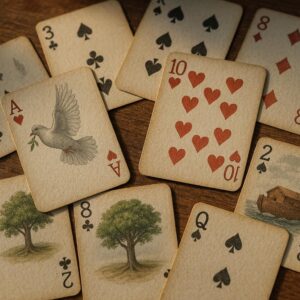
To understand the “Deck Of Cards Meaning To Bible,” we must start with the story that popularized it. You may have heard it as a country song (popularized by Wink Martindale and later Tex Ritter) or as a sermonette told in churches. The story goes something like this:
During a military service, a young soldier was spotted playing with a deck of cards during a church service or a sermon. After the service, he was confronted by a Sergeant or a Chaplain who accused him of being disrespectful and gambling during a holy time.
The soldier, often identified as a devout Christian, explained that he was not being disrespectful. Instead, he was using the deck of cards as a substitute for a Bible, a hymn book, and an almanac because he had been separated from his religious texts while at war.
He then proceeded to explain the meaning behind each card, turning a simple deck into a testament of his faith.
Is this story true?
It is important to be realistic. There is no historical evidence that this specific event happened. It is a piece of folklore, a legend, or a parable. However, like many parables, its truth lies not in the historical accuracy of the event, but in the moral and symbolic meaning it conveys. The story has been passed down for generations because it offers a comforting thought: that faith can be found anywhere, even in the most unlikely of objects.
Important Note: This article does not claim that playing cards are a replacement for the Bible, nor does it endorse gambling. Instead, it explores the allegorical connection that has been drawn by storytellers and believers for over a century.
Breaking Down the Symbolism: The Calendar in Your Hands
The core of the “Deck Of Cards Meaning To Bible” lies in numerology and the cycles of time. The soldier in the story uses the deck to explain the passage of time and the structure of the year, which in turn points to the order of God’s creation.
The Number 52: Weeks and Divine Order
The most striking parallel is the number 52. A standard deck (excluding Jokers) contains 52 cards. This corresponds directly to the 52 weeks in a year.
-
The Cycle of Life: Just as the year moves through seasons of planting, harvest, death (winter), and rebirth (spring), the deck represents a complete cycle. In the Bible, time is often viewed as a progression toward God’s plan (Ecclesiastes 3: “To everything there is a season”).
-
Sabbath Rest: In the story, the 52 cards remind the soldier that every year, we have 52 opportunities to start fresh, to work, and to rest in the Lord.
The Four Suits: The Seasons of the Year
The deck is divided into four suits: Hearts, Diamonds, Clubs, and Spades. In the allegory, these represent the four seasons.
| Suit | Symbolism in the Legend | Biblical/Seasonal Connection |
|---|---|---|
| Hearts | Spring | A time of love, renewal, and new life. Mirrors God’s love and the resurrection of Christ (Easter). |
| Diamonds | Summer | The light and heat of the sun. Represents the light of the world (Jesus) and the bright, fruitful days. |
| Clubs | Autumn (Fall) | Often associated with the harvest. The three-leaf clover shape can also symbolize the Trinity in some interpretations. |
| Spades | Winter | The digging of the earth or the cold winds. Represents the trials of life and the season of death, reminding us of our mortality. |
The Cards: A Journey Through Time
If the suits are the seasons, the cards themselves are the weeks and days. The soldier’s explanation continues:
-
The 13 Cards per Suit: There are 13 cards in each suit (Ace through 10, Jack, Queen, King). These represent the 13 lunar cycles or the 13 weeks in each season.
-
The 365 Days: If you add up the value of all the cards, a fascinating number emerges.
-
Count all the numbered cards (Ace as 1, 2 through 10).
-
Count the Jack as 11, Queen as 12, and King as 13.
-
The sum of all pips (symbols) on the cards totals 364.
-
Add the Joker (often counted as 1), and you get 365—the exact number of days in a year.
-
This mathematical “coincidence” is a cornerstone of the legend. It suggests that the deck inherently contains the measurement of a full year, which is a gift from God.
The Face Cards: Kings, Queens, and Great Leaders
The allegory doesn’t stop with numbers. The face cards are often given identities tied to biblical and historical figures. While these interpretations vary depending on the version of the story, the following is the most common breakdown found in the “Deck of Cards” sermon.
The Four Kings: Great Leaders of the Bible and History
In the deck, there are four Kings. The soldier in the legend often identifies them as male figures of great importance.
-
King of Hearts: Sometimes identified as Charlemagne (the great Holy Roman Emperor) or David (the King of Israel). In the context of the Bible, David is the most fitting, as he is the ancestor of Jesus and a man after God’s own heart.
-
King of Diamonds: Often identified as Augustus Caesar or Julius Caesar. While not biblical figures, they represent the earthly rulers in power during the time of Christ’s birth. Caesar Augustus issued the decree for the census that brought Mary and Joseph to Bethlehem.
-
King of Clubs: Frequently identified as Alexander the Great. He represents the Greek empire, which shaped the world in which the New Testament was written (the Koine Greek language).
-
King of Spades: Often identified as King David (if not used for Hearts) or Solomon. Solomon, David’s son, is renowned for his wisdom and for building the First Temple in Jerusalem.
The Four Queens: Matriarchs and Virtuous Women
The Queens are interpreted as important women from the Bible and history.
-
Queen of Spades: Often identified as Pallas Athena (Greek goddess of wisdom) in secular decks, but in the Christian allegory, she is sometimes seen as Martha (the sister of Mary, representing the busy servant) or simply as a symbol of Wisdom from the Proverbs.
-
Queen of Clubs: Sometimes called Argine (an anagram for regina, Latin for queen), but in the legend, she is often identified as Rachel (the beloved wife of Jacob) or another matriarch.
-
Queen of Hearts: The only Queen with a consistent historical identification. She is Judith (from the biblical Book of Judith, a heroic woman who saved her people) or, in some tellings, Esther (the queen who saved the Jews from destruction).
-
Queen of Diamonds: Commonly identified as Rachel or Rebecca, the wives of the patriarchs Isaac and Jacob, who were instrumental in God’s covenant.
The Jacks: Knights, Servants, and Warriors
The Jacks (originally called “Knaves”) are the servants or knights.
-
Jack of Clubs: Often associated with Judas Maccabeus (a hero of the Jewish resistance) or simply the loyal soldiers of Israel.
-
Jack of Spades: Associated with David as a young warrior before he was king, specifically when he slew Goliath.
-
Jack of Hearts: Linked to La Hire (a French warrior who fought alongside Joan of Arc) or, biblically, to figures like Joshua, the faithful servant of Moses and a great military leader.
-
Jack of Diamonds: Sometimes identified with Hector (the Trojan prince) or Abraham, the “friend of God.”
The Ace: The One God
In many versions of the story, the Ace is the most powerful card. It is higher than the King.
-
The Ace represents the One God. It reminds the soldier that above all earthly kings, queens, and rulers, there is only one true King: The Almighty.
The “Deck of Cards” Prayer: A Complete Breakdown
To give you a clearer picture, here is a paraphrased version of the classic monologue, showing exactly how the soldier interprets the deck as a religious tool.
“When I see the Ace, it reminds me that there is but one God.”
“When I see the Deuce (the Two), it reminds me of the Bible, which is divided into two parts: the Old and the New Testaments.”
“When I see the Trey (the Three), it reminds me of the Father, the Son, and the Holy Ghost—the Holy Trinity.”
“When I see the Four, it reminds me of the four Gospels: Matthew, Mark, Luke, and John.”
“When I see the Five, it reminds me of the five wise virgins who trimmed their lamps (the parable of the ten virgins). There were ten, but five were saved.”
“When I see the Six, it reminds me that in six days, the Lord made the heavens and the earth.”
“When I see the Seven, it reminds me that on the seventh day, God rested from His great work.”
“When I see the Eight, it reminds me of the eight righteous people who were saved on the ark: Noah, his wife, his three sons, and their wives.”
“When I see the Nine, it reminds me of the nine lepers who were cleansed but did not return to give thanks to Jesus. (Or, in some versions, the nine fruits of the Spirit).”
“When I see the Ten, it reminds me of the Ten Commandments, handed down by God to Moses on tablets of stone.”
“The King reminds me of the great King of all, the Lord Almighty.”
“The Queen reminds me of the Queen of Sheba, who came from the ends of the earth to hear the wisdom of Solomon.”
“And the Jack or Knave reminds me of the Devil, who is a knave, trying to trick us all.”
Finally, he counts the cards:
“There are fifty-two cards in a deck. That reminds me that there are fifty-two weeks in a year.”
“And if you count the tricks (the total value of the cards), you will find 365—the number of days in a year.”
The Great Controversy: Gambling vs. Faith
It is impossible to discuss the “Deck Of Cards Meaning To Bible” without addressing the elephant in the room: gambling. For many devout Christians, playing cards are associated with saloons, gambling dens, and sinful behavior.
This tension is what makes the soldier’s story so powerful. He takes an object considered by many to be a “tool of the devil” and re-contextualizes it as a tool for remembering God.
-
The Object is Neutral: The legend argues that an object itself is not evil. It is the use of the object that determines its morality. A deck of cards can be used to waste a paycheck in a poker game, or it can be used to meditate on the scriptures.
-
A Lesson in Judgment: The story also serves as a lesson against judging others by appearances. The Chaplain saw a soldier being disrespectful; the soldier was actually praying in a way that made sense for his situation.
Balanced Perspective: While this allegory is beautiful, it is crucial to remember that it is an allegory. The Bible does not mention playing cards, as they were invented centuries after the books of the Bible were written. This connection is a human invention—a creative way to find meaning and order in everyday life.
Historical Context: When Did This Connection Start?
To write a comprehensive guide, we must look at the history of the cards themselves.
-
Origin of Cards: Playing cards are believed to have originated in China during the Tang dynasty (9th century) and spread to Europe via the Islamic world by the 14th century.
-
Early European Decks: The first European decks were hand-painted and incredibly expensive, reserved for the wealthy.
-
The French Design: The standard “French” deck we use today (Hearts, Diamonds, Clubs, Spades) was standardized in the 15th century.
-
The Moralistic Turn: It wasn’t until the 18th and 19th centuries, during periods of great religious revival, that moral allegories began to be attached to secular objects. The “Soldier’s Prayer” or “The Chaplain and the Cards” story likely originated in the late 19th or early 20th century, possibly as a piece of Christian folklore or a sermon illustration that was eventually set to music.
The 52 Cards and the 52 Weeks: A Comparative Table
To visualize the connection between the deck and the Christian calendar, look at this simple table:
| Component of Deck | Quantity | Biblical / Natural World Symbol |
|---|---|---|
| Total Cards | 52 | 52 Weeks in a Year |
| Suits | 4 | Four Seasons (Spring, Summer, Fall, Winter) |
| Cards in a Suit | 13 | 13 Weeks in a Season / 13 Lunar Cycles |
| Trinity (3) | The 3 | Father, Son, Holy Spirit |
| Gospels (4) | The 4 | Matthew, Mark, Luke, John |
| Creation (6) | The 6 | Days of Creation |
| Rest (7) | The 7 | Day of Rest (Sabbath) |
| Commandments (10) | The 10 | The Ten Commandments |
| Total Pips Value | 364 (+1 Joker) | 365 Days in a Year |
List: The Biblical Meanings of the Numbers
For quick reference, here is a helpful list summarizing the numerical symbolism:
-
Ace (1): The One True God.
-
Two: The Old and New Testaments.
-
Three: The Holy Trinity.
-
Four: The Gospels (Matthew, Mark, Luke, John).
-
Five: The Five Wise Virgins (or the five books of the Torah/Pentateuch in some interpretations).
-
Six: The Six Days of Creation.
-
Seven: The Day God Rested.
-
Eight: The Eight People Saved on Noah’s Ark.
-
Nine: The Nine Lepers who forgot to say thanks (or the nine Fruits of the Spirit: love, joy, peace, forbearance, kindness, goodness, faithfulness, gentleness, and self-control).
-
Ten: The Ten Commandments.
Modern Interpretations and Cultural Impact
The “Deck Of Cards” story has permeated pop culture. It has been recorded by country and folk singers for decades.
-
The Songs: The most famous versions include those by Wink Martindale (1959), Tex Ritter, and Red Sovine. These spoken-word recordings brought the story to a massive audience.
-
Military Use: The story remains popular in military circles. In fact, during the 20th century, special decks of cards were sometimes printed for American troops with silhouettes of aircraft and ships for identification training. More recently, decks have been printed with wanted Iraqi leaders (the “Iraqi Most Wanted” playing cards). This practical use of cards for education and identification mirrors the soldier’s use of them for spiritual education.
Frequently Asked Questions (FAQ)
Here are some common questions people have about this topic.
Q: Is the “Deck of Cards” story really in the Bible?
A: No. The story is a piece of folklore, often used as a sermon illustration. It is not a biblical story, but rather a story about using a deck of cards to remember biblical truths.
Q: Is it a sin to play cards?
A: This depends on your personal beliefs and denomination. The Bible does not forbid playing cards. However, it does warn against gambling, idleness, and addiction. If playing cards leads to these things, it becomes a problem. If it is just a game, many see it as harmless entertainment.
Q: Who wrote the “Deck of Cards” prayer?
A: The author is unknown. It is considered traditional folklore. The first known publications of the story appeared in the early 20th century, and it has been adapted many times since.
Q: Do all Christians accept this interpretation of the cards?
A: No. Many Christians enjoy the story as a piece of inspirational fiction. Others, particularly those from denominations that historically oppose gambling, may view playing cards negatively and do not endorse using them as a religious symbol.
Q: What about the Joker?
A: In the traditional 52-card allegory, the Joker is often left out or counted as “the Fool” or as the “one” that makes the total days add up to 365. Some interpretations see the Joker as representing the devil, who tries to disrupt the order of the game.
Additional Resources
If you found this topic interesting and want to explore the intersection of faith and everyday objects further, here are some suggestions:
-
Read the Bible: The ultimate source. If the numbers in this article intrigued you (like the 10 Commandments or the 12 Apostles), dive into the source text itself.
-
Listen to the Song: Search for “Deck of Cards” by Wink Martindale on your preferred music streaming service. Hearing the monologue performed adds a powerful emotional layer to the symbolism.
-
Explore Christian Symbolism: Look into the history of the Ichthys (the Jesus fish) or the symbolism of the Cross. Understanding how early Christians used symbols to identify themselves can provide context for the “deck of cards” allegory.
Conclusion
The connection between a deck of cards and the Bible is a testament to human creativity and the human desire to find God in all things. While the story of the soldier and his makeshift prayer book is likely a legend, the symbolism it presents is undeniable.
By breaking down the 52 cards into the 52 weeks of the year, the four suits into the four seasons, and the face cards into biblical heroes, the “Deck Of Cards Meaning To Bible” offers a unique lens through which to view the structure of time and faith. It serves as a gentle reminder that symbols of faith can be found anywhere, if only we have the eyes to see them and the heart to interpret them.