The ocean is vast, mysterious, and full of wonders. For centuries, it has sparked the human imagination, giving rise to tales of fantastic creatures that live beneath the waves. Among the most enduring of these legends is the mermaid—a being that is half-human and half-fish.
But for those who look to the Bible for answers about the world, a common question arises: Are mermaids mentioned in the Bible?
It’s a fascinating question that sits at the intersection of faith, history, and mythology. The short answer is no, the Bible does not specifically mention mermaids as we think of them today. You won’t find a verse about a beautiful woman with a fish tail singing to sailors.
However, the Bible is a complex book, rich with symbolism, ancient languages, and descriptions of strange sea creatures. While it doesn’t describe a “mermaid,” it does mention other sea beings that have, over time, become linked to the myth.
In this comprehensive guide, we will explore the scriptures, examine the historical context, and separate biblical fact from human myth. Our goal is to provide a clear, reliable, and honest answer to the question: Are mermaids mentioned in the Bible?
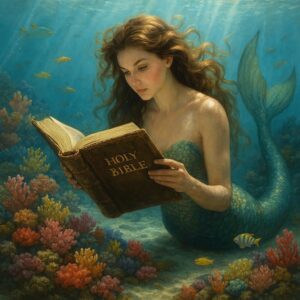
Understanding the Question: Why Do People Ask If Mermaids Are in the Bible?
Before we dive into the scriptures, it’s helpful to understand why this question is so popular. It’s not just a random thought; it comes from a genuine desire to connect modern stories with ancient texts.
-
Curiosity About the Supernatural: The Bible is full of supernatural events—angels, demons, miracles, and prophetic visions. People naturally wonder if mythical creatures like mermaids fit into this spiritual world.
-
Searching for Confirmation: Some hope to find proof that mermaids were real creatures, created by God, and simply mentioned in a way we don’t immediately recognize.
-
Misinterpretation of Passages: Certain Bible verses use poetic language to describe sea creatures. Without context, these descriptions can sound fantastical to modern ears.
-
Cultural Influence: Stories like the Disney film The Little Mermaid are so ingrained in our culture that people are curious if their favorite characters have a basis in the “Good Book.”
Understanding these motivations helps us approach the topic with empathy and a desire to provide a thoughtful, well-researched answer.
The Straightforward Answer: No, Mermaids Are Not in the Bible
Let’s be direct. If you are looking for a verse that says, “And God created the mermaids, every swimming creature with the torso of a human,” you will not find it.
The Bible is primarily concerned with God’s relationship with humanity, the history of Israel, and the coming of Jesus Christ. Its purpose is theological, not biological. It doesn’t aim to catalog every single creature that exists or ever existed.
Important Note: The Bible mentions many real animals (lions, doves, fish, sheep) and some symbolic or mythological beings (like dragons in the Book of Revelation). However, the specific hybrid creature we call a “mermaid” is entirely absent from its pages.
“But What About…?” The Key Bible Verses People Often Confuse with Mermaids
Even though the word “mermaid” isn’t there, several verses and characters are frequently brought up in this debate. Let’s look at them one by one.
1. The “Sea Creatures” of Genesis
In the Genesis account of creation, God creates all living things.
“So God created the great sea creatures and every living creature that moves, with which the waters swarm, according to their kinds, and every winged bird according to its kind. And God saw that it was good.” — Genesis 1:21 (ESV)
This verse mentions “great sea creatures.” The original Hebrew word used here is tanninim (תַּנִּינִם), which is often translated as “sea monsters” or “serpents.”
-
What it really means: In the ancient Near East, tanninim were often associated with chaos and evil, like the chaos monster Leviathan (which we’ll get to next). In Genesis, the writer is making a powerful statement: even these mighty, terrifying creatures are not gods to be feared. They are simply creations of the one true God.
-
Could it be a mermaid? No. The context and the word’s usage elsewhere in the Old Testament point to a large, powerful, and likely reptilian or serpentine creature—not a human-fish hybrid.
2. The Leviathan
The Leviathan is the most famous sea monster in the Bible. It is described in several books, most notably in Job 41.
“Can you draw out Leviathan with a fishhook or press down his tongue with a cord?… His sneezings flash forth light, and his eyes are like the eyelids of the dawn. Out of his mouth go flaming torches; sparks of fire leap forth. Out of his nostrils comes forth smoke, like that of a boiling pot and burning rushes.” — Job 41:1, 18-20 (ESV)
This is a terrifying, fire-breathing dragon-like creature of immense power. It is a symbol of God’s ultimate authority, as only He can tame such a beast.
-
Could it be a mermaid? Absolutely not. The description is of a massive, powerful monster, not a gentle or alluring half-human creature. Some scholars think it might be a poetic description of a crocodile or a whale, but its portrayal is entirely different from a mermaid.
3. Dagon, the Philistine Fish God
This is perhaps the most interesting connection, though it still isn’t a mermaid. Dagon was a major deity worshiped by the Philistines, the enemies of Israel. You can read about him in the book of 1 Samuel, chapter 5, where the Ark of the Covenant is placed in Dagon’s temple.
While the Bible doesn’t give a physical description of Dagon, historical and archaeological sources suggest he was often depicted as a fish god. Some images show him as a man wearing a fish cloak or having the lower body of a fish.
-
Could it be a mermaid? Here, we are getting closer to the concept of a mermaid—a divine being associated with the sea and having fish-like features. However, Dagon is a male idol, not a female mermaid. The Bible presents him as a false god, a powerless idol that falls on its face before the Ark of the Lord. He is a warning against idolatry, not an endorsement of mermaids.
4. The “Sirens” in the Septuagint
This is a more technical point, but it’s important for a thorough understanding. The Septuagint is the ancient Greek translation of the Hebrew Old Testament. In a few places, the translators used the Greek word for mythical creatures.
For example, in the book of Isaiah (13:21 and 34:14), the Hebrew text describes desolate places being filled with wild animals and howling creatures. When translated into Greek, the word seirēn (siren) was used.
In Greek mythology, sirens were dangerous creatures, part-woman and part-bird, who lured sailors to their doom with their enchanting music and voices. Over time, in medieval Europe, the image of the siren merged with other folklore to create the modern idea of the mermaid.
-
Could it be a mermaid? This is where the confusion begins. The word “siren” was used in a Bible translation, and centuries later, that word became associated with mermaids. However, the original Hebrew text does not describe mermaids. It describes wild animals, jackals, and ostriches—creatures that would inhabit a ruined city. The Greek translation used a mythical word to describe a real scene of desolation, not to introduce a new type of creature.
Comparative Table: Bible “Mermaid” Candidates vs. Actual Mermaids
To make this clearer, here is a table comparing the biblical references we’ve discussed with the characteristics of a modern mermaid.
| Candidate/Reference | Biblical Source | Description in the Bible | Similar to a Mermaid? | Key Difference |
|---|---|---|---|---|
| The Mermaid | N/A | Half-human, half-fish, often beautiful and alluring. | The standard. | Not found in the Bible. |
| Tanninim (Sea Creatures) | Genesis 1:21 | Large, powerful sea creatures / monsters. | No. | Not described as human-like at all. |
| Leviathan | Job 41, Psalms | A massive, fire-breathing sea monster. Symbol of chaos. | No. | A terrifying monster, not a humanoid. |
| Dagon | 1 Samuel 5 | A Philistine idol/god. | Conceptually, yes. | A male deity, depicted as a false god, not a living creature. |
| Sirens (in translation) | Isaiah 13:21 (LXX) | In the Greek translation, creatures dwelling in ruins. | Word association only. | The Hebrew original describes real animals. |
So, Where Did the Idea of Mermaids Come From?
If not from the Bible, where do mermaids come from? Their origin is a rich tapestry woven from various cultural and historical threads.
Ancient Mythology
-
The Babylonian God Oannes: Dating back to the 4th century BCE, the Babylonian priest Berossus described a being called Oannes. It had the body of a fish but the head and feet of a man. It came out of the sea to teach humanity wisdom, writing, and laws. This is a very early example of a divine fish-man.
-
Greek and Roman Mythology: As mentioned, the Greeks had sirens (bird-women) and gods like Triton, the son of Poseidon, who was often depicted as a merman. The Romans adopted these myths. The Roman writer Pliny the Elder even wrote about sightings of “sea people” as factual accounts in his natural history.
Sighting and Misidentification
For centuries, sailors returned from long voyages with tales of mermaids. What were they actually seeing?
-
Manatees and Dugongs: This is the most widely accepted theory. These large, slow-moving marine mammals have a rounded body, flippers, and a flat, paddle-like tail. When seen from a distance, especially through the haze of exhaustion or sea-spray, a nursing mother holding her calf upright against her chest could easily be mistaken for a human form in the water. The face, with its droopy eyes and snout, is not exactly beautiful, but a lonely sailor’s imagination might fill in the gaps.
-
Seals and Sea Lions: These animals can also appear human-like when they bob upright in the water, their round heads and curious stares resembling a human from afar.
-
The Psychological Factor: Long voyages were monotonous and dangerous. The line between reality and fantasy could blur. The desire to see something familiar, combined with the stress of the journey, likely played a significant role in these sightings.
Folklore and Symbolism
Mermaids in folklore were not the friendly, singing princesses of Disney. They were often seen as omens of disaster, luring men to their deaths or causing storms and shipwrecks. They represented the untamed, dangerous, and alluring nature of the sea itself. They were a way for people to personify the ocean’s mystery and power.
Why Doesn’t the Bible Talk About Mermaids?
This is a great question that gets to the heart of the Bible’s purpose.
-
The Bible’s Focus: The Bible is a theological document. Its main characters are God, humanity, and the spiritual struggle between good and evil. It isn’t a textbook of zoology or a catalog of world mythology. It addresses the myths of surrounding cultures (like Dagon) to show their powerlessness compared to God, but it doesn’t adopt their specific mythical creatures as real.
-
A Warning Against Pagan Myths: The Old Testament constantly warns the Israelites against adopting the beliefs and practices of their pagan neighbors. These cultures had pantheons of gods and mythical beings associated with nature. Including mermaids or similar creatures as part of God’s creation could have blurred the lines and led people back to worshiping nature rather than the Creator.
-
Symbolism vs. Literalism: When the Bible does use mythological imagery, like Leviathan or the dragons in Revelation, it does so for symbolic purposes. Leviathan represents chaos that only God can control. The dragons in Revelation represent Satan and his forces of evil. These are powerful literary devices, not descriptions of real animals the authors expected you to encounter.
What Does This Mean for a Believer Today?
For Christians and those interested in the Bible, the absence of mermaids is not a problem. It simply clarifies what the Bible is and isn’t.
-
Freedom in Non-Essentials: The Bible doesn’t comment on everything. You are free to enjoy mermaid stories, art, and films as works of human creativity. They are part of the rich tapestry of culture and imagination that God has allowed humanity to develop. Enjoying a fictional story is not a sin.
-
Focus on the Message: The lack of mention helps believers focus on what is actually there: the story of redemption, the call to love God and others, and the guidance for a meaningful life.
-
Understanding the World: It encourages a thoughtful approach. When you hear a claim about the Bible, it’s good to check it out for yourself. Understanding the historical and cultural context of the scriptures prevents misinterpretation and builds a stronger, more informed faith.
Conclusion
So, to return to our main question: Are mermaids mentioned in the Bible?
The answer is a clear and straightforward no. The Bible does not contain any references to half-human, half-fish creatures known as mermaids. Passages about “sea creatures” refer to real animals or mythological symbols of chaos. The Philistine god Dagon was a fish-like idol, not a living mermaid, and the use of the word “siren” in some translations is a linguistic quirk, not a biblical endorsement of the myth.
The stories of mermaids come from human imagination, ancient mythology, and the misidentification of real marine animals like manatees. While the Bible doesn’t mention them, it does affirm God as the Creator of the real and wondrous creatures that fill our oceans.
Frequently Asked Questions (FAQ)
1. Is the word “mermaid” in the Bible?
No, the specific English word “mermaid” does not appear in any standard translation of the Bible.
2. Could mermaids have been real creatures that just weren’t mentioned?
While the Bible doesn’t mention every creature, the idea of a human-fish hybrid goes against the biological “kinds” described in Genesis, where creatures reproduce “according to their kinds.” There is also no credible scientific evidence that such creatures have ever existed.
3. What does the Bible say about sea monsters?
The Bible mentions “great sea creatures” (tanninim) in Genesis and describes a specific one called Leviathan in Job and Psalms. These are portrayed as powerful creatures, often symbolizing chaos, which demonstrate God’s supreme power over all creation.
4. Is Dagon a mermaid in the Bible?
No. Dagon was a male idol and the national god of the Philistines. While historical sources depict him with fish-like features, the Bible presents him as a false, powerless god, not a living creature.
5. Can Christians believe in mermaids?
Christians are free to enjoy mermaid stories as fiction, just like any other fantasy tale. However, believing in them as literal, biological creatures would require setting aside both scientific understanding and a literal reading of Genesis regarding created “kinds.” Most view them as part of our rich cultural mythology.
Additional Resource
For a deeper dive into the fascinating topic of Leviathan and its meaning in the Old Testament, you can read this scholarly article from TheTorah.com:
The Leviathan: A Biblical Embodiment of Chaos