As a health-conscious person of faith, you might find yourself at a crossroads. You hear about the benefits of acupuncture—relief from chronic pain, reduced stress, and overall wellness. But a question lingers in your mind: Where in the Bible does it talk about acupuncture?
It is a fair question. You want to make sure that the treatments you pursue align with your spiritual beliefs. You want to honor God with your body, but you also want to take advantage of modern (and ancient) medical practices that can help you feel better.
Let’s address this question directly and honestly. We will explore the scriptures, discuss the origins of acupuncture, and provide a clear, balanced perspective for the modern believer.
The Short Answer
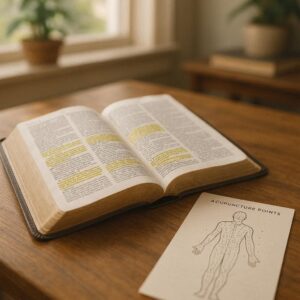
If you are looking for a specific verse—like “Thou shalt insert needles into thy skin for pain”—you will not find it. The Bible does not mention acupuncture by name.
However, the Bible does have a lot to say about healing, the body, wisdom, and the source of truth. To understand how acupuncture fits into a Christian worldview, we need to look at the broader principles found in Scripture.
This article will serve as your guide. We will look at what the Bible says about medicine, how to discern spiritual practices, and whether acupuncture is something a Christian can consider in good conscience.
Understanding Acupuncture: Separating Fact from Fiction
Before we can look at the Bible, we need to understand what acupuncture actually is. There is a lot of misinformation out there.
Acupuncture is a key component of Traditional Chinese Medicine (TCM). It has been practiced for thousands of years. The procedure involves inserting very thin needles into specific points on the body. These points are called acupoints.
How Does It Work?
From a Western medical perspective, researchers believe acupuncture works in several ways:
-
Stimulates nerves: The needles influence the activity of nerves in the underlying tissues and muscles.
-
Releases endorphins: It triggers the release of the body’s natural pain-killing chemicals.
-
Alters blood flow: It can increase blood circulation to specific areas, promoting healing.
-
Reduces inflammation: Studies suggest it can help regulate the body’s inflammatory response.
The World Health Organization (WHO) recognizes acupuncture as effective for treating over 50 conditions, including chronic pain, headaches, and nausea.
The Historical and Spiritual Context
It is important to acknowledge that acupuncture originated in a culture with different spiritual beliefs than Judaism or Christianity. Traditional Chinese Medicine is based on the concept of Qi (pronounced “chee”). This is believed to be a vital life energy that flows through pathways in the body called meridians. Illness is thought to be caused by a blockage or imbalance in the flow of Qi.
This is where the concern usually arises for Christians. Does getting acupuncture mean you are subscribing to a belief in “Qi” or worshipping ancestors? Not necessarily. Important Note: Many modern acupuncture practitioners, especially in Western countries, practice a “medical acupuncture” that strips away the Taoist philosophy. They focus purely on the physiological effects based on modern neuroscience and anatomy.
What The Bible Actually Says About Healing
Since the Bible doesn’t mention needles or meridians, we must look at the principles it lays out regarding health, sickness, and healing.
Here are the key biblical themes that relate to the question of acupuncture.
God as the Ultimate Healer
Throughout Scripture, God reveals Himself as the one who heals.
-
Exodus 15:26: “He said, ‘If you listen carefully to the Lord your God and do what is right in his eyes, if you pay attention to his commands and keep all his decrees, I will not bring on you any of the diseases I brought on the Egyptians, for I am the Lord, who heals you.'”
-
Psalm 103:2-3: “Praise the Lord, my soul, and forget not all his benefits—who forgives all your sins and heals all your diseases.”
These verses establish a foundational truth: all healing ultimately comes from God. Whether it happens through a miracle, a doctor’s hands, or a natural process, the source is the same.
The Use of Medicine and Physicians
The Bible acknowledges the role of physicians and medicine. It does not condemn the use of physical means to treat illness.
-
Job’s friends: While they were poor comforters, they are referred to as “miserable comforters,” not as sinners for practicing medicine. The culture of the time used balms and oils for treatment.
-
King Asa: In 2 Chronicles 16:12, we read a critique of King Asa: “In the thirty-ninth year of his reign Asa was afflicted with a disease in his feet. Though his disease was severe, even in his illness he did not seek help from the Lord, but only from the physicians.” The issue here was not that he consulted physicians; it was that he only consulted them and excluded God. His heart was in the wrong place.
-
The Good Samaritan: In the parable of the Good Samaritan (Luke 10:34), the Samaritan tends to the injured man by “pouring on oil and wine.” These were the common medicinal treatments of the day. Jesus used this as an example of godly behavior.
Paul and Luke: The Apostle Paul refers to his companion Luke as “the beloved physician” (Colossians 4:14). This is a clear endorsement of the medical profession. Luke used the tools of his trade to care for the sick, and Paul saw this as valuable ministry work.
Wisdom and Taking Care of Your Body
The Bible calls our bodies “temples of the Holy Spirit” (1 Corinthians 6:19-20). This means we have a responsibility to care for them. Using wisdom to maintain our health is a spiritual act.
-
Proverbs 4:20-22: “My son, pay attention to what I say; turn your ear to my words. Do not let them out of your sight, keep them within your heart; for they are life to those who find them and health to one’s whole body.” God’s wisdom leads to health.
-
3 John 1:2: “Dear friend, I pray that you may enjoy good health and that all may go well with you, even as your soul is getting along well.”
Seeking relief from pain or treatment for an ailment is not unspiritual. It can be an act of good stewardship of the body God gave you.
Does Acupuncture Conflict with Christian Doctrine?
This is the heart of the matter. For a Christian, the question isn’t just “does it work?” but “does it compromise my faith?”
Let’s break down the potential concerns.
The Issue of “Qi” and Eastern Mysticism
| The Concern | The Counterpoint |
|---|---|
| Acupuncture is based on the spiritual concept of “Qi,” a life force that is not biblical. Christians believe the soul and body are united, but not that a “force” flows through physical meridians. | Many acupuncturists view the meridian system as a map of the body’s electrical or neural pathways, not a spiritual one. You can view the treatment as a physical therapy that stimulates the nervous system, much like physical therapy or massage. |
| The philosophy behind TCM can include Taoist elements, which contradict monotheistic faith. | You are not required to believe in the ancient philosophy to receive a medical treatment. You don’t need to believe in the Greek theory of humors to take an antibiotic. |
The Principle of Discernment
The Bible encourages believers to “test everything; hold fast what is good” (1 Thessalonians 5:21). This is a call to use your mind and your faith to evaluate things.
When considering acupuncture, ask yourself these questions:
-
What is the intent? Am I seeking healing to better serve God and my family, or am I looking for a mystical experience?
-
What is the focus? Does the practitioner focus on medical outcomes (pain relief, reduced inflammation) or on spiritual energy work?
-
What does my conscience say? The Bible is clear that if you have doubts about something, it is better to refrain (Romans 14:23). If you feel a check in your spirit, it is wise to listen to it.
The Danger of Syncretism
Syncretism is mixing different religious beliefs. This is a real concern. You cannot worship the God of the Bible while also believing your healing comes from manipulating a “universal life force.”
However, receiving a medical treatment is not the same as adopting a religion.
-
Example: If a doctor prescribes a medication discovered through research that was funded by a non-Christian organization, does that make the pill “demonic”? No. It is a tool. God has given humans wisdom to discover things, whether they know Him or not.
A Helpful Analogy: Think of it like using a computer. The internet was developed by DARPA, a secular government agency. The first computers were built in a largely secular academic environment. Yet, you use a computer to read your Bible app and listen to worship music. You have taken a tool and dedicated its use to God. The same can be true for acupuncture.
Where In The Bible Does It Talk About Acupuncture? Looking at the Principles
Since there is no direct verse, we must look for principles that might support or caution against it.
Verses That Support a Holistic View of Health
The Bible often speaks of man as a unified being—body, soul, and spirit. Acupuncture acknowledges the connection between the physical body and overall well-being.
-
Proverbs 14:30: “A heart at peace gives life to the body, but envy rots the bones.” This acknowledges the mind-body connection. Emotional and spiritual health impacts physical health.
-
1 Thessalonians 5:23: “May your whole spirit, soul and body be kept blameless…” This tripartite view of man shows that we are more than just flesh and blood.
Verses About Suffering and Seeking Help
Some believers wonder if they should simply “offer up” their pain to God rather than seek treatment. While suffering can produce character (Romans 5:3-4), the Bible does not command us to seek out suffering or refuse medical help.
-
1 Timothy 5:23: Paul gives Timothy specific medical advice: “Stop drinking only water, and use a little wine because of your stomach and your frequent illnesses.” This shows that practical, physical remedies are appropriate for physical ailments.
-
James 5:14-15: “Is anyone among you sick? Let them call the elders of the church to pray over them and anoint them with oil in the name of the Lord.” Here, prayer is combined with the physical act of anointing with oil. It is both spiritual and physical.
Practical Guidelines for Christians Considering Acupuncture
If you are a Christian who is suffering and considering acupuncture, here is a practical, step-by-step guide to help you navigate the decision.
Step 1: Start with Prayer
Before you book an appointment, take it to the Lord.
-
Ask for wisdom (James 1:5).
-
Surrender your health to Him.
-
Ask Him to guide you to the right practitioner and to give you peace about the decision.
Step 2: Do Your Research on the Practitioner
This is crucial. You need to know who you are going to.
-
Look for a “Medical Acupuncturist”: Many medical doctors (MDs) and chiropractors (DCs) have additional training in acupuncture. They view it strictly as a physiological treatment.
-
Ask Questions: When you call the clinic, ask:
-
“What is your philosophy on healing?”
-
“Do you incorporate spiritual elements into your sessions, such as talking about ‘Qi’ as a spiritual force, or do you focus on the physical and neurological aspects?”
-
“Can you explain how this treatment might help my specific condition from a scientific standpoint?”
-
-
Read Reviews: See what other patients say. Do they talk about the medical results or the “spiritual experience”?
Step 3: Set Your Own Intentions
Go into the treatment with a clear mind and a clear faith.
-
Mentally dedicate the treatment to God. You can pray silently, “Lord, I am using this tool to care for the body You gave me. Please let it be effective for my good and Your glory.”
-
View the needles as a physical stimulus, not a spiritual conduit.
-
If the practitioner begins to discuss spiritual concepts that make you uncomfortable, you have every right to respectfully ask them to stop or to end the session.
Step 4: Listen to the Holy Spirit
Pay attention to your inner peace (or lack thereof).
-
If you feel uneasy: If something feels “off,” do not ignore it. It is better to walk away than to violate your conscience.
-
If you have peace: If, after prayer and research, you feel calm and confident, you can proceed with a clear conscience.
Frequently Asked Questions (FAQ)
Here are some common questions Christians have about acupuncture.
1. Is acupuncture a sin?
The Bible does not label acupuncture as a sin. Sin is a matter of the heart and disobedience to God’s commands. If you undergo acupuncture as a medical treatment to care for your body, with gratitude toward God as the ultimate healer, it is not a sin. However, if you seek it as a replacement for God or engage in worship of other spirits through it, that would be problematic.
2. Can I pray while receiving acupuncture?
Absolutely. In fact, it can be a wonderful time of quiet prayer. You can use that time to meditate on Scripture, pray for your family, or simply rest in God’s presence. It turns a medical procedure into a time of spiritual refreshment.
3. What about other alternative therapies like yoga or reiki?
This is a separate but related question.
-
Yoga: Similar to acupuncture, yoga has roots in Eastern spirituality. Many Christians practice “Christian Yoga” or simply view it as stretching and exercise, separating the physical postures from the spiritual roots. The discernment process would be the same: what is your intent, and what is the focus of the class?
-
Reiki: This is more challenging. Reiki is explicitly about channeling “universal life energy.” It is inherently a spiritual practice aimed at manipulating energy. Because its entire framework is spiritual and non-biblical, most Christian theologians advise against it.
4. Doesn’t God want me to just trust Him for healing?
Yes, God wants you to trust Him. But trusting God does not mean sitting passively and doing nothing. Trusting God means believing that He is in control of the outcome, regardless of the method.
-
If you have a bacterial infection, you trust God while taking antibiotics.
-
If you break your leg, you trust God while the doctor sets it in a cast.
-
If you have chronic pain, you can trust God while trying acupuncture.
Trust is about the source of the healing (God), not the means.
5. What if my pastor or church leaders say it’s wrong?
This is a matter of church authority and conscience. It is wise to honor your spiritual leaders (Hebrews 13:17). If they have a strong conviction against it, you should have a respectful conversation with them.
-
Ask them to share their specific concerns.
-
Share your research and your perspective.
-
If you still disagree, you must follow your own conscience before God, but do so with humility and grace. Do not let it become a divisive issue.
Conclusion
So, where in the Bible does it talk about acupuncture? It doesn’t. But the Bible gives us something better than a simple rule: it gives us wisdom.
We learn that God is the source of all healing. We learn that using medicine and physicians is permissible and even wise. We learn that we must test everything and hold fast to what is good. We learn to listen to our conscience.
Acupuncture can be a valid tool for a Christian to use in caring for their body. The key is discernment. Understand the treatment, choose a practitioner wisely, set your intentions on God, and listen to the Holy Spirit. By doing this, you can navigate the intersection of ancient medicine and modern faith with confidence and peace.
To summarize: The Bible doesn’t mention acupuncture, but it encourages us to use wisdom in caring for our bodies, to seek healing, and to ensure our practices align with our faith in God as the ultimate source of all health.