To understand how to honor the dead, we first need to understand how the Bible views death itself. Scripture doesn’t see death as a cold end, but rather as a transition.
For the believer, death is often described as “falling asleep” (1 Thessalonians 4:13). This perspective changes the tone of our memorialization from one of hopeless despair to one of “hopeful remembrance.” We honor the dead not because they are gone forever, but because their lives had intrinsic value given by God.
The Value of the Body
The Bible teaches that our bodies are the “temple of the Holy Spirit” (1 Corinthians 6:19). This is why Christian tradition has historically emphasized a respectful handling of remains. Whether through burial or cremation, the intent is always reverence.
Ways the Bible Shows Us to Honor the Dead
The Scriptures provide several examples and commands regarding how we should treat those who have passed away.
1. Proper Burial and Respect for the Body
In the Old Testament, a proper burial was considered a significant act of kindness and respect.
-
Abraham purchased a cave to bury his wife, Sarah (Genesis 23).
-
Joseph gave strict instructions for his bones to be carried back to the Promised Land (Hebrews 11:22).
-
Jesus Himself was wrapped in clean linen and placed in a new tomb by Joseph of Arimathea (Matthew 27:57-60).
2. The Season of Mourning
The Bible never tells us to “just get over it.” In fact, it validates our tears. Even Jesus wept at the tomb of His friend Lazarus (John 11:35).
-
Ecclesiastes 3:4 tells us there is “a time to weep and a time to laugh; a time to mourn and a time to dance.”
-
Honoring the dead involves allowing yourself and others the space to grieve.
3. Carrying on a Godly Legacy
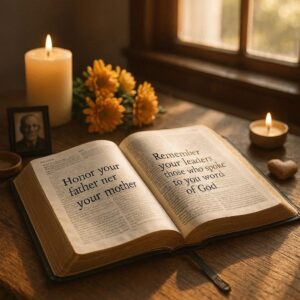
Perhaps the greatest way to honor a loved one is to emulate the virtues they lived out. Hebrews 13:7 says:
“Remember your leaders, who spoke the word of God to you. Consider the outcome of their way of life and imitate their faith.”
Comparing Biblical Practices and Modern Traditions
How do ancient biblical customs stack up against how we honor loved ones today?
| Biblical Practice | Modern Application | Scriptural Basis |
| Preparation with spices | Embalming/Professional Care | John 19:40 |
| Gathering of the community | Funerals and Wakes | Genesis 50:7 |
| Eulogies/Recalling deeds | Memorial Services | Acts 9:39 |
| Acts of Charity in their name | Endowments/Donations | Proverbs 10:7 |
What the Bible Cautions Against
While honoring the dead is encouraged, the Bible draws a clear line between honor and worship.
-
Avoid Necromancy: The Bible strictly forbids attempting to contact or conjure the spirits of the dead (Deuteronomy 18:10-12). Our focus should remain on God.
-
The State of the Dead: We are encouraged to remember them, but the Bible teaches that the dead are in God’s hands and do not interact with the living world in the way some folklore suggests (Ecclesiastes 9:5-6).
-
Focus on the Living: While we honor the past, we are called to serve the living. Jesus once said, “Let the dead bury their own dead,” emphasizing that our primary mission is to spread the Kingdom of God (Luke 9:60).
Important Note for Readers: Honoring the dead is an act for the living. It helps us find closure, express love, and reflect on our own mortality. However, the Bible teaches that our prayers and rituals do not change the eternal status of the deceased; that rests solely on their relationship with God during their lifetime.
Practical Ways to Honor a Loved One Today
If you are looking for tangible ways to honor someone while staying true to biblical principles, consider these steps:
-
Share Their Stories: Keep their memory alive by telling children and friends about their faith and character.
-
Support a Cause They Loved: If they cared about the poor, donate to a local shelter in their name.
-
Plant a Memorial: A tree or garden can serve as a living reminder of the life they lived.
-
Practice Forgiveness: If there was unresolved conflict, honoring them can mean choosing to forgive and move forward in peace.
FAQ: Common Questions About Honoring the Dead
Is cremation biblical?
The Bible does not explicitly forbid cremation. While burial was the standard practice in Scripture to symbolize the “planting” of a seed for resurrection, most theologians agree that God is capable of resurrecting any body, regardless of how it was handled.
Should we pray to deceased saints or relatives?
Biblically, prayer is directed to God alone. While we can be inspired by the lives of “the great cloud of witnesses” (Hebrews 12:1), our communication should be with the Father through Jesus Christ.
How long should a period of mourning last?
There is no set biblical “timer.” In the Bible, mourning periods ranged from seven days to thirty days (Numbers 20:29). Modern grief is personal; take the time you need.
Additional Resource
For a deeper dive into the theology of the afterlife and grieving with hope, visit BibleGateway’s Guide on Grief and Loss.
Conclusion
Honoring the dead according to the Bible means treating their remains with dignity, allowing ourselves the grace to mourn, and carrying forward the legacy of faith they left behind. It is a balance of looking back with gratitude and looking forward with the hope of the resurrection. Ultimately, we honor our loved ones best by living lives that reflect the love and truth of God.