When we read the Bible, we often focus on the characters, the miracles, and the big theological ideas. However, sometimes the most profound lessons are hidden in everyday objects.
One of the most consistent and powerful symbols throughout Scripture is the vessel.
From the clay jars carried by Gideon’s army to the golden chalices in the Temple, vessels are everywhere. But the Bible rarely mentions them just to describe furniture or kitchenware.
In both the Old and New Testaments, vessels represent people. They represent you and me.
God is described as a Potter. We are the clay. And the question Scripture asks repeatedly is: What kind of vessel are you?
This guide explores the major types of vessels in the Bible. We will look at the literal materials (clay, wood, metal, glass) and the spiritual qualities they represent.
Whether you are a student of theology, a curious reader, or someone looking for encouragement, this article will help you understand why God cares so much about containers.
Understanding the Concept of Vessels in Scripture
Before we dive into specific types, we need to establish a baseline.
H3: What Exactly is a Vessel?
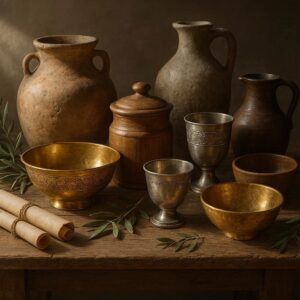
In biblical terms, a vessel is any hollow container used to hold something. This includes cups, pots, jars, pitchers, flasks, bowls, and sacks.
However, the Hebrew (keli) and Greek (skeuos) words are much broader than our English word “vessel.” They can also refer to tools, weapons, or luggage.
Important Note:
Whenever you see the word “vessel” in the Bible, context is key. It could be a literal cooking pot, or it could be a metaphor for the human body or spirit.
H3: The Potter and the Clay: The Core Metaphor
The single most important theme regarding vessels is found in the Book of Jeremiah.
“Arise, and go down to the potter’s house, and there I will cause thee to hear my words.” — Jeremiah 18:2
God sends Jeremiah to watch a potter at work. When the pot becomes marred or defective, the potter doesn’t throw the clay away. He reshapes it into another vessel.
This tells us two things:
-
God is sovereign. He has the right to shape us.
-
Defects aren’t final. We can be reshaped.
Classification by Material
The Bible categorizes vessels primarily by what they are made of. The material reveals the vessel’s value, durability, and intended purpose.
1. Vessels of Clay (Earthenware)
Clay vessels are the most frequently mentioned type in the Bible.
Characteristics:
-
Fragile: They break easily.
-
Common: Everyone owned them.
-
Permeable: They could absorb liquids and odors.
-
Inexpensive: If a clay pot broke, you threw it away or used the shards (broken pieces) to scoop ash.
Spiritual Meaning:
Clay represents humanity. We are made from the dust of the ground. Clay vessels remind us that we are weak and mortal.
Key Scripture:
“But we have this treasure in earthen vessels, that the excellency of the power may be of God, and not of us.” — 2 Corinthians 4:7
Paul explains that the Gospel is a precious treasure. God puts it in fragile, human containers. Why? So that when we succeed, nobody praises the container. They praise the content.
Examples:
-
The water pots at the wedding in Cana (John 2). They were stone, but served the purpose of purification.
-
The pitcher used by Gideon (Judges 7). His men hid torches inside clay pitchers. When they broke the pitchers, the light shone out.
Application:
You don’t need to be strong in your own power. You just need to be available. God shines through the cracks.
2. Vessels of Gold and Silver
Precious metal vessels were reserved for royalty and worship.
Characteristics:
-
Durable: They lasted for generations.
-
Refined: They required intense heat to purify the metal.
-
Valuable: They were often used as tribute or treasure.
-
Dedicated: Gold items were often “uncommon” or holy.
Spiritual Meaning:
Gold represents divinity, royalty, and purity. Silver often represents redemption (connecting to the shekels paid for redemption in the Torah).
Key Scripture:
“In a great house there are not only vessels of gold and of silver, but also of wood and of earth; and some to honour, and some to dishonour.” — 2 Timothy 2:20
Paul uses this to explain that in the Church, there are different levels of usefulness. If you cleanse yourself from sin, you can be a vessel of honor.
Examples:
-
The Candlestick (Menorah) in the Tabernacle was made of pure gold.
-
The Cups used by Joseph for divination (Genesis 44) were silver.
-
The Vessels of the Temple taken by Nebuchadnezzar to Babylon (Daniel 5). 3. Vessels of Wood and Stone
These are the “everyday” tools.
Characteristics:
-
Wood: Lightweight, common, susceptible to rot.
-
Stone: Heavy, permanent, “unclean” things were often contained in stone to prevent the spread of impurity.
Spiritual Meaning:
Wood often represents humanity (the Tree of Life, the Cross). Stone represents the Law or Christ (the Cornerstone).
Examples:
-
The Ark of the Covenant was made of wood and overlaid with gold (humanity covered by divinity).
-
The Stone Waterpots at Cana represented the heavy, unchanging nature of the Old Covenant Law.
Comparative Table: Materials and Meaning
| Material | Cost | Durability | Biblical Symbolism | Human Application |
|---|---|---|---|---|
| Clay | Low | Fragile | Humanity, Humility, Frailty | We are weak; God is strong. |
| Wood | Low | Moderate | Earthly service, The Cross | Useful for daily tasks. |
| Stone | Moderate | High | Law, Permanence, Christ | Heavy, unchanging truth. |
| Silver | High | High | Redemption, Money | Price paid for freedom. |
| Gold | Very High | Very High | Divinity, Kingship, Purity | Righteousness, Royal Priesthood |
Classification by Function and Use
The Bible also classifies vessels by their job. It is not enough to look good; a vessel must be useful.
Vessels of Ministry (The Temple Vessels)
In the Tabernacle and Temple, every single item had a specific function.
1. The Laver (Basin)
A large bronze basin filled with water. Priests washed their hands and feet here before ministering.
-
Symbolism: Cleansing before service. We cannot serve God effectively while holding onto filth.
2. The Censer (Firepan)
A small shovel or cup used to carry burning coals and incense.
-
Symbolism: Prayer. The smoke rising represented the prayers of the people ascending to God.
-
Example: In Revelation, golden bowls full of incense are the prayers of the saints.
3. The Oil Flasks/Horns
Samuel used a horn of oil to anoint David. Elijah filled the widow’s jars with oil.
-
Symbolism: The Holy Spirit. Oil is consistently a type of the Spirit and empowerment.
Vessels of Judgment and Wrath
Not all vessels carry blessing. Some carry judgment.
The Cup of Wrath:
“Awake, awake, stand up, O Jerusalem, which hast drunk at the hand of the LORD the cup of his fury…” — Isaiah 51:17
In the Old Testament, prophets often spoke of nations drinking from the “cup” of God’s anger. In the New Testament, Revelation describes bowls (vials) poured out upon the earth containing plagues.
Application:
This duality shows us that God is holy. The same hands that bless sinless vessels also judge sinful ones.
Vessels of Hospitality and Daily Life
-
Pitchers: Used to carry water from the well. Often the task of women (Rebekah, the Samaritan woman).
-
Bottles/Wineskins: Made of animal skin. Jesus taught that you don’t put new wine in old wineskins. The old skin is brittle; the new wine expands. It bursts.
-
Sacks: Used by Joseph’s brothers to carry grain.
The “Elect” Vessel: A Case Study in Paul
One of the most famous uses of the word “vessel” is regarding the Apostle Paul.
“But the Lord said unto him, Go thy way: for he is a chosen vessel unto me, to bear my name before the Gentiles, and kings, and the children of Israel.” — Acts 9:15
Before Paul was a Christian, he was a persecutor. He was, metaphorically, a dirty jar used for violence.
However, God looked at Saul of Tarsus and saw a chosen vessel.
What made Paul a good vessel?
-
Availability: When God called, he responded, “Lord, what wilt thou have me to do?”
-
Specific Purpose: He was designed for a specific mission (to the Gentiles).
-
Content: He carried the name of Jesus.
Important Note:
Being a “chosen vessel” does not mean you are perfect. It means you are assigned. Paul struggled, suffered, and admitted his flaws. But he stayed in the Master’s hands.
Women as Vessels in Scripture
In the cultural context of the Bible, women were often symbolized as vessels. While this can be misunderstood today, within the biblical narrative, it emphasizes honor and protection.
1 Peter 3:7:
“Likewise, ye husbands, dwell with them according to knowledge, giving honour unto the wife, as unto the weaker vessel…”
Peter calls the wife the “weaker vessel.”
This is not a statement of lesser value. A crystal wine glass is “weaker” than a ceramic coffee mug, but it is more delicate and often more valuable.
Interpretation:
Men are called to honor their wives because they are precious. You don’t punch a hole in a fine china plate. You handle it with care.
The Cleansing and Repairing of Vessels
A recurring theme is that vessels can become unclean or marred.
Ritual Impurity
Under Levitical law, if a clay pot touched a dead insect or an unclean animal, the pot had to be broken. It could not be cleaned.
-
Lesson: Sin deeply contaminates some areas of life. Sometimes, the old way of life must be completely “broken” for a new creation to emerge.
The Refiner’s Fire
Metal vessels (silver/gold) are cleansed differently. You don’t break them. You put them in the fire.
-
The Process: The refiner heats the metal until it melts. The impurities (dross) float to the top and are skimmed off.
-
The Result: The metal becomes reflective. The refiner knows it is pure when he can see his face in it.
-
Application: Trials in life are not punishment. They are the Refiner’s process. God is looking at us, waiting until He can see His own reflection in our character.
Practical Lessons: Becoming a Vessel of Honor
So, after reviewing the types of vessels in the Bible—clay, gold, wood, cups, and bowls—what does God actually want from us?
Here is a simple checklist:
1. Empty Yourself
A vessel that is full of yesterday’s wine cannot receive today’s new wine. You cannot be filled with the Spirit if you are already filled with pride, anger, or self-sufficiency.
2. Stay on the Wheel
A pot that is taken off the potter’s wheel before it is finished will collapse. Stay teachable. Stay in the process.
3. Keep Yourself Clean
“If a man therefore purge himself from these, he shall be a vessel unto honour, sanctified, and meet for the master’s use…” — 2 Timothy 2:21
We are responsible for our own maintenance. We “purge” ourselves through repentance, prayer, and reading the Word.
4. Be in the House
A vessel sitting on a shelf is useless. A cup is made to be used. You are designed for community and service. Table: 7 Types of Vessels and Their Spiritual Counterparts
| Vessel Type | Bible Reference | Literal Use | Spiritual Meaning |
|---|---|---|---|
| Clay Jar | Judges 7, 2 Cor 4 | Holding water/oil, hiding light | Human body; weakness |
| Golden Bowls | Revelation 5 | Holding incense | Prayers of the saints |
| Wineskin | Matthew 9 | Holding fermented wine | Flexibility; New Covenant |
| Laver/Basin | Exodus 30 | Washing priests | Cleansing by the Word |
| Alabaster Box | Mark 14 | Holding expensive perfume | Extravagant worship |
| Cup | Luke 22 | Drinking | Portion/Division (Cup of Blessing, Cup of Suffering) |
| Sack | Genesis 42 | Carrying grain | Provision, storage |
Frequently Asked Questions (FAQ)
Q1: What does “vessel” mean in the Bible?
A: In the Bible, a “vessel” refers to any container, tool, or piece of luggage. Spiritually, it almost always refers to a person whom God uses to contain His Spirit or carry out His work.
Q2: What are the different types of vessels mentioned in the Bible?
A: The Bible mentions vessels of clay (pottery), wood, stone, silver, gold, and brass (bronze). Functionally, it mentions cups, bowls, flagons, pots, pitchers, and sacks.
Q3: What does it mean to be a “vessel of honor”?
A: Based on 2 Timothy 2:20-21, a vessel of honor is a believer who has cleansed themselves from sin and false teaching. They are “sanctified” (set apart) and useful to the Master for good works.
Q4: Are women called “vessels” in the Bible?
A: Yes, 1 Peter 3:7 refers to the wife as the “weaker vessel.” This is understood as a call for husbands to treat their wives with honor and gentleness, recognizing their preciousness and delicate nature.
Q5: Why did God use clay pots to symbolize people?
A: Clay is a perfect metaphor because it is common, fragile, and dependent on the potter. It reminds us that we are created beings with no right to “talk back” to our Creator (Romans 9:21), and that our strength comes from God, not ourselves.
Q6: What is the difference between a vessel of mercy and a vessel of wrath?
A: Romans 9 explains that God, as the Potter, has the right to make different kinds of vessels. Vessels of wrath endure judgment to demonstrate God’s power. Vessels of mercy receive glory. This highlights God’s sovereignty and grace.
Conclusion
From the dusty clay of Jeremiah’s workshop to the golden streets of Revelation, the Bible uses vessels to tell the story of redemption. We are all containers. The question is not whether you are a vessel—every human is. The question is what you are filled with, and whose hands you rest in.
Whether you feel like a cracked pot, a dirty jar, or a polished cup, the Gospel offers hope. The Potter is not done with you yet.
Additional Resource
To deepen your understanding of biblical symbolism, we highly recommend using a reliable Bible concordance (like Strong’s) to study the Hebrew word Keli and the Greek word Skeuos.
Link:
Blue Letter Bible – Study Tools for Vessels (Ideal for looking up original Greek and Hebrew definitions)