When we think of flies, we often think of nuisance, decay, or dirt. In our daily lives, they are pests to be swatted away. But within the rich tapestry of biblical literature, even the smallest and most bothersome creatures carry profound spiritual significance. The spiritual meaning of flies in the Bible is multifaceted, serving as powerful symbols woven into narratives of warning, judgment, and even unexpected grace.
Understanding this symbolism requires us to step into the ancient Near Eastern world. For the authors and original audiences of the Bible, the natural world was a direct canvas upon which God’s character, actions, and messages were displayed. Flies, by their very nature, became potent metaphors. This article will explore these layers of meaning, moving beyond a simplistic “good vs. evil” interpretation to uncover the nuanced roles flies play in Scripture. Our journey will take us from the plagues of Egypt to the wisdom literature of Ecclesiastes, and into the prophetic warnings that shaped a nation’s understanding of their covenant with God.
Understanding Symbolism in Biblical Context
Before we focus on flies specifically, it’s crucial to grasp how symbolism works in the Bible. Biblical authors didn’t use symbols randomly; they drew from the observable realities of their environment.
-
Nature as Revelation: The physical world was seen as a testament to God’s power and personality (Psalm 19:1). Animals, insects, and weather patterns were not just natural phenomena but potential messengers or signs.
-
Cultural Lens: In an agrarian society without modern pest control, a swarm of flies was not merely annoying—it was a catastrophe. It could spoil food, spread disease, and disrupt sacrifices and daily life. This immediate, tangible impact made them a perfect symbol for disruption and corruption.
-
Layering of Meaning: A single symbol can carry multiple, sometimes parallel, meanings. A fly can represent both a specific divine judgment and a general principle of corruption. We must consider the context to discern the primary message.
Flies as Agents of Judgment and Plague
The most dramatic and clear-cut appearance of flies in the Bible is as instruments of God’s judgment, most famously during the Exodus.
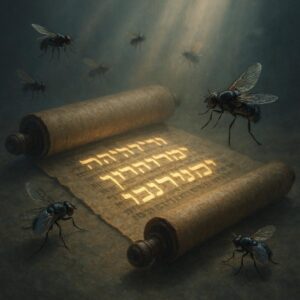
The Fourth Plague: Flies Upon Egypt (Exodus 8:20-32)
This narrative provides the cornerstone for understanding flies as a divine instrument. God instructs Moses to warn Pharaoh: “If you do not let my people go, I will send swarms of flies on you and your officials, on your people and into your houses. The houses of the Egyptians will be full of flies; even the ground will be covered with them.”
Key Spiritual Meanings in this Account:
-
Distinction and Separation: A pivotal detail is that the land of Goshen, where the Israelites lived, was exempt from the plague (Exodus 8:22). The flies were a targeted judgment, making a visible, uncomfortable distinction between God’s people and their oppressors. The spiritual meaning here is one of divine separation and protection for the covenant people.
-
Corruption of Idolatry: Ancient Egypt deified many creatures, but notably, the fly was not a major god. Some scholars suggest the plague was a direct affront to the Egyptian god Uatchit, sometimes depicted as a fly, or more broadly, a humiliation of Egypt’s pantheon. The flies represented the corruption and impotence of false gods.
-
The Unclean Overcoming the Ordered: Egypt, particularly Pharaoh’s court, represented a ordered, powerful civilization. The swarm of flies—tiny, chaotic, and unclean—overwhelmed that order, symbolizing how God’s judgment can disrupt human arrogance and power structures from the ground up.
Table: The Plague of Flies vs. Other Insect Plagues
| Plague | Insect | Key Symbolic Focus | Spiritual Meaning |
|---|---|---|---|
| Fourth Plague | Flies (“`árov“) | Separation, Corruption, Nuisance | Targeted judgment; distinction between holy and profane; corruption of idolatry. | | ||
| Eighth Plague | Locusts | Consumption, Devastation | Complete stripping of resources and pride; a consuming judgment. |
| (Proverbial) | Ants | Industry, Preparation | Wisdom, diligence, and foresight (Proverbs 6:6-8). |
Flies as Symbols of Decay, Impurity, and Sin
Beyond a specific plague, flies are intrinsically linked to decay and impurity because of their biological role. This connection forms a powerful spiritual metaphor.
-
Ecclesiastes 10:1: “As dead flies give perfume a bad smell, so a little folly outweighs wisdom and honor.” This is perhaps the most memorable proverb involving flies. The analogy is potent:
-
Perfume: Represents wisdom, honor, a life of good reputation.
-
Dead Flies: Represent folly, sin, or careless action.
-
The Meaning: Just as a single dead fly can corrupt an entire vial of precious perfume, a small act of foolishness or sin can tarnish a lifetime of accumulated wisdom and honor. The spiritual lesson is the disproportionate power of sin to corrupt and the need for diligent wisdom.
-
-
Association with Death and Sacrifice: Flies are attracted to decaying matter and blood. In the context of Old Testament sacrifices—which were to be pure, unblemished, and pleasing to God—the presence of swarming flies would have been a profound desecration. This connects flies spiritually to that which ruins or profanes the sacred.
-
The “Lord of the Flies”: In the Hebrew Old Testament, the name of the Philistine god Beelzebub (2 Kings 1:2) is derived from “Baal-zebub,” meaning “Lord of the Flies.” This was likely a mocking derogatory term used by Israelites, associating the rival god with filth, decay, and the demonic. This linguistic link firmly places flies within the realm of spiritual impurity and opposition to the one true God.
Potential Positive Connotations: Persistence and Penetration
While overwhelmingly negative, the behavior of flies can be used to illustrate positive spiritual truths by way of contrast or observable analogy.
-
Persistence: A fly’s relentless buzzing and refusal to be easily deterred can be a metaphor for negative persistence, like nagging (Ecclesiastes 10:1’s “folly”). However, this same trait could be reframed positively. Just as a fly finds a way, believers are called to be persistent in prayer (Luke 18:1-8).
-
Penetration: Flies can enter the smallest spaces. Prophetically, this could symbolize how sin or corruption can find its way into the most protected areas of our lives or communities if we are not vigilant.
Flies in Prophetic and Apocalyptic Literature
The prophetic books use vivid imagery, and flies fit into descriptions of desolation and consequence.
-
Isaiah 7:18-19: The Lord will whistle for “the fly that is in the farthest part of the rivers of Egypt” as part of a coming judgment. Here, the fly (likely representing the Egyptian army or influence) is a tool in God’s hand to discipline His rebellious people. It emphasizes God’s sovereign control over all nations and forces, even those perceived as unclean or hostile.
-
Imagery of Desolation: The presence of buzzing flies is a classic image of a place abandoned to death and decay, a consequence of turning away from God’s life-giving order.
Practical Lessons for Modern Spiritual Life
What does the spiritual meaning of flies in the Bible mean for us today? These ancient symbols offer timeless insights.
-
Beware the “Little Follies”: Ecclesiastes 10:1 is a perpetual warning. In our spiritual walk, we must guard against the “small” compromises, the “harmless” lies, or the “minor” lapses in character. Like dead flies, they have the potential to spoil the fragrance of our testimony.
-
God Distinguishes and Protects: The Goshen principle reminds us that God sees and knows His people. In times of widespread cultural or moral decay, God provides a spiritual “separation” and protection for those who are in covenant with Him.
-
Discern Spiritual Decay: Flies are attracted to what is already decaying. Spiritually, if we find ourselves plagued by persistent “flies”—recurring sin, toxic thoughts, or destructive patterns—it may be a signal to check for areas of “decay” in our hearts that need the cleansing and healing of Christ.
-
God’s Sovereignty Over All: From using flies as a precise plague to calling them a tool of judgment in prophecy, the Bible shows God is Lord over all creation—the majestic and the minute, the clean and the unclean. Nothing is outside His ultimate authority.
Important Note for Readers: When interpreting biblical symbolism, avoid overly literal or superstitious applications. Seeing a single fly in your house is not a sign of divine judgment! The meaning is found in the broader biblical narrative and principles. The purpose is to understand God’s character and our spiritual state, not to divine omens from everyday events.
Conclusion
The spiritual meaning of flies in the Bible travels from dramatic displays of divine judgment to potent proverbs about the corrosive nature of folly. They serve as unwelcome reminders of impurity, decay, and the consequences of turning from God’s order. Yet, within that symbolism, we also find truths about God’s power to protect, His sovereignty over all forces, and the call to guard our hearts from the small corruptions that can spoil a life of faith. By understanding these ancient symbols, we gain deeper insight into the consistency of God’s message and the profound relevance of His Word for navigating our own spiritual landscapes.
Frequently Asked Questions (FAQ)
Q: Does seeing a fly have a specific spiritual meaning for me today?
A: Not in a direct, prophetic sense. The Bible does not teach us to look for omens in random events. Instead, the symbolic meaning of flies should guide our general spiritual awareness: reminding us to avoid folly, guard against decay in our faith, and trust in God’s protection.
Q: Is Beelzebub literally the “god of flies”?
A: “Beelzebub” is a derogatory name given by Israelites, meaning “Lord of the Flies.” It was a mocking insult toward a Philistine deity (likely Baal), associating him with filth and insignificance. In the New Testament, it becomes a name for Satan, carrying forward the idea of a ruler associated with impurity and corruption.
Q: Are flies ever seen as positive in the Bible?
A: Directly, no. Their symbolic value is almost entirely negative due to their association with decay and plague. However, their observable traits (persistence, penetration) can be used to illustrate positive actions, like persistent prayer, by way of analogy from the natural world.
Q: What’s the difference between the plague of flies and the plague of locusts?
A: While both are judgments, flies symbolized pervasive corruption, nuisance, and the profaning of space (homes, land). Locusts symbolized total consumption and devastation of resources, a stripping away of provision and wealth. The fly plague was more about contamination, the locust plague about annihilation.
Additional Resources
For further study on biblical symbolism and the cultural background of the Old Testament, we recommend exploring reliable theological resources. A great starting point is the Biblical Archaeology Society’s website, which features articles written by scholars on the historical and cultural context of the Scriptures: https://www.biblicalarchaeology.org/ (Note: This is an external resource providing scholarly context, not a doctrinal endorsement).