If you’ve ever read through the books of Exodus or the Song of Songs, you might have stumbled upon a strange, aromatic ingredient: galbanum. Unlike the more familiar frankincense and myrrh, galbanum often remains a mystery. What is this substance, and why was it considered so important that God Himself included it in the recipe for the most sacred object in the Tabernacle? This guide will take you on a journey beyond a simple definition. We’ll explore its botanical origins, its profound spiritual symbolism, and its tangible uses that bridge the ancient world with our own search for meaning and wellness today. Prepare to discover a hidden dimension of biblical worship.
The Botanical Foundation: What is Galbanum, Actually?
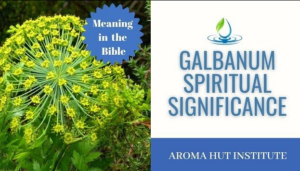
Before we delve into its spiritual significance, let’s ground our understanding in the physical world. Galbanum is not a man-made concoction but a completely natural resin. It is harvested from several species of ferula, a large, perennial herb native to the mountainous regions of Iran, Afghanistan, and Turkey. These plants are part of the Apiaceae family, which also includes carrots, parsley, and giant fennel.
The resin is obtained by making cuts in the plant’s living roots or lower stem. A milky, sticky sap exudes and hardens upon contact with air. This results in two forms:
-
Tears: Small, pure, pale yellow or greenish droplets.
-
Mass: A darker, lumpy aggregate of resin mixed with plant debris.
Its most defining characteristic is its powerful aroma. Descriptions vary, but it is consistently noted for being sharp, green, earthy, and balsamic. To some, it smells like pine or crushed greenery; to others, it has a musky, almost animalistic depth. This complexity is the key to understanding its biblical role. It is not a conventionally “sweet” fragrance on its own, but it acts as a powerful fixative and enhancer when blended with other spices, making their scents richer, deeper, and longer-lasting.
A Note on Sourcing and Authenticity
Important Note for Readers: True, high-quality galbanum resin and essential oil are still available today from specialist aromatherapy and perfumery suppliers. When seeking it for study or personal use, ensure you are purchasing from reputable sources that provide information on the botanical species and country of origin. Its powerful scent means it should be used sparingly and with care.
Galbanum’s Primary Biblical Role: The Sacred Incense
The most significant mention of galbanum in the Bible is in Exodus 30:34-38, where God gives Moses the explicit, divine recipe for the holy incense to be used exclusively in the Tabernacle (and later, the Temple).
The Sacred Recipe (Exodus 30:34-35):
“Then the Lord said to Moses, ‘Take fragrant spices—gum resin, onycha, galbanum—and pure frankincense, all in equal amounts, and make a fragrant blend of incense, the work of a perfumer. It is to be salted and pure and sacred.’”
This was no ordinary air freshener. This incense was burned twice daily on the Altar of Incense inside the Holy Place, and its smoke represented the prayers of the people ascending to God (Psalm 141:2, Revelation 8:3-4). The inclusion of galbanum here is non-negotiable and divinely mandated.
Why Was Galbanum Included in This Holy Blend?
Galbanum’s role is deeply symbolic, rooted in its unique aromatic properties:
-
The Principle of Unity: The incense was a ketoret, a compounded blend. No single spice could be used alone. Galbanum, with its harsh and green scent, was mixed with the sweeter, more costly frankincense and other spices. This symbolizes the unity of the community—individuals with different personalities, backgrounds, and roles (some “sweet,” some “sharp”) coming together to create something holy and pleasing to God.
-
The Fixative Agent: In perfumery, a fixative binds the more volatile scents, giving the blend stability and longevity. Spiritually, this can represent the steadfastness, faithfulness, and enduring nature of true worship and prayer. It suggests that our prayers are not fleeting but are established and remembered.
-
The Symbol of Humility and Repentance: Some rabbinical commentaries suggest that the less-pleasant scent of galbanum represents sinners within the community. Their inclusion, transformed through the unifying act of worship, is essential. It signifies that no one is beyond the grace of God when brought into the covenant community.
The Holy Incense Ingredients & Their Symbolic Meanings
| Ingredient | Physical Description | Suggested Spiritual Symbolism |
|---|---|---|
| Stacte (Gum Resin) | A rare, sweet myrrh or balsam | Tears, preciousness, anointing |
| Onycha | A powdered aromatic shellfish operculum | Purification, fiery passion of prayer |
| Galbanum | Sharp, green, earthy resin | Unity, community, humility, grounding |
| Pure Frankincense | Sweet, citrusy resin | Holiness, righteousness, divine favor |
Beyond Exodus: Other Biblical Appearances
While Exodus 30 provides the cornerstone, galbanum appears in one other poignant biblical context:
Song of Songs 1:12-13 (NIV):
“While the king was at his table, my perfume spread its fragrance. My beloved is to me a sachet of myrrh resting between my breasts. My beloved is to me a cluster of henna blossoms from the vineyards of En Gedi.”
Note: The Hebrew word used here, כֹּפֶר (kopher), is complex. While many modern translations use “henna blossoms,” the Septuagint (the ancient Greek translation of the Old Testament) and the Vulgate (the Latin translation) translated it as “galbanum.” Scholars debate the exact meaning, but if it is galbanum, its presence in this passionate love poem adds another layer. It could symbolize the intoxicating, complex, and all-encompassing nature of love—a blend of sweetness and deep, earthy reality.
From Sacred Ritual to Ancient Medicine: Practical Uses
The biblical authors lived in a world where the spiritual and physical were intimately connected. Galbanum was not just a symbolic token; it was a valued practical substance. Ancient naturalists like Dioscorides and Pliny the Elder documented its uses, which help us understand why it was on hand for the Tabernacle’s construction.
Historical Medicinal and Practical Applications:
-
Antispasmodic & Carminative: Used to relieve intestinal cramps, gas, and digestive discomfort.
-
Anti-inflammatory & Vulnerary: Applied to wounds, bruises, and inflammations to promote healing.
-
Emmenagogue: Believed to stimulate menstrual flow.
-
Respiratory Aid: Its sharp aroma was thought to clear congestion and aid breathing.
-
Perfumery & Embalming: Used as a fixative in ancient perfumes and unguents.
Helpful List: Galbanum in the Ancient World View
Element: Earth (due to its grounding, root-derived scent)
Property: Warming and drying (in Galenic humoral theory)
Purpose: To bind, to fix, to strengthen, and to ground scattered energies.
Connection: Its use in incense and medicine shows that worship involved the whole person—spirit and body.
Galbanum for Modern Readers: Relevance Today
You might wonder, “What does an ancient, sticky resin have to do with my life today?” The lessons of galbanum are surprisingly contemporary.
1. A Model for Authentic Community: In an age of curated online personas and divisive discourse, galbanum reminds us that true community requires all types. The “sweet” and the “sharp,” the easy-going and the challenging, belong together. Our differences, when offered up in a spirit of unity, create a richer, more enduring “fragrance” than uniformity ever could.
2. A Metaphor for Honest Prayer: Our prayers don’t have to be only sweet and polite. Galbanum legitimizes bringing our raw, earthy, and difficult emotions before God—our anger, confusion, and repentance. It is the “fixative” that makes our whole, honest cry to God a sustained and established prayer.
3. A Bridge to Holistic Wellness: The renewed interest in essential oils and plant-based remedies has brought galbanum back into view. While we must use modern medical knowledge, understanding its historical use connects us to a long tradition of seeking healing from the natural world, appreciating the wisdom embedded in creation.
Important Note: This article provides historical and spiritual context. It is not medical advice. Galbanum essential oil is potent. If you are interested in its aromatic or potential topical uses, consult a qualified aromatherapist and always conduct a patch test. It should not be ingested.
Conclusion
Galbanum in the Bible is far more than a forgotten ingredient; it is a profound multi-sensory symbol. From its commanded place in the holy incense of the Tabernacle to its potential whisper in the poetry of the Song of Songs, it teaches us about the necessity of unity within diversity, the power of honest and enduring prayer, and the tangible connection between worship, community, and the created world. Its sharp, green scent continues to invite us into a deeper, more grounded, and more authentic faith.
Frequently Asked Questions (FAQ)
Q1: Can I buy and burn biblical incense today?
A: While you can purchase resins like frankincense, myrrh, and galbanum individually, the exact biblical recipe is unknown (the identity of “stacte” and “onycha” is debated). Furthermore, Exodus 30 forbade making an identical blend for personal use. Many respect this by not attempting to replicate the holy incense for common use.
Q2: What does galbanum essential oil smell like?
A: It has a very strong, complex aroma. Most people detect intense green, woody, and earthy notes—like a forest after rain, broken pine branches, or even fresh-cut herbs. It has a balsamic undertone and can be overwhelming on its own but beautiful as a stabilizing note in a blend.
Q3: Is galbanum mentioned in the New Testament?
A: No, galbanum is not mentioned by name in the New Testament. However, the symbolism of incense and prayer is carried forward (e.g., Luke 1:10, Revelation 5:8, 8:3-4). The principles it represents—unity, the inclusion of all believers, and the ascent of prayer—are central to New Testament theology.
Q4: Was galbanum expensive in Bible times?
A: Yes, as an imported resin from distant regions, it would have been a valuable commodity. Its inclusion in the sacred incense, alongside frankincense and myrrh, signifies that worship required the offering of costly and precious things.
Additional Resources
For those wishing to explore the botany and ancient use of biblical plants further, a superb academic resource is the “Hebrew Bible and Its World” series. You can find relevant publications through university press websites, such as The University of Chicago Press (search for topics like “flora of the Bible” or “ancient Near Eastern aromatics”).