The Bible is a rich tapestry of history, faith, and humanity, and its names are a doorway into that world. Each name carries a weight of meaning, a story of origin, and a legacy that often spans generations. Exploring biblical names alphabetically is a fascinating way to connect with these ancient texts on a personal level. In this guide, we focus on Bible names that start with the letter P, uncovering the profound meanings and captivating narratives behind them. Whether you’re seeking a name for a child, researching for a study, or simply curious, this comprehensive list will serve as your essential reference.
Understanding the Power of Biblical Names
In the ancient Near Eastern world, a name was far more than a simple label. It was seen as an expression of a person’s essence, destiny, or character. Parents often chose names based on circumstances surrounding the birth, a hope for the child’s future, or in acknowledgment of God’s action in their lives. Many Hebrew names are theophoric, meaning they embed the name of God within them—such as El (God) or Yah (short for Yahweh).
“She will give birth to a son, and you are to give him the name Jesus, because he will save his people from their sins.” (Matthew 1:21). This verse perfectly illustrates the principle: the name Jesus (Yeshua) directly means “Yahweh saves,” defining his very mission.
As we explore names beginning with P, we’ll see this principle in action, from names meaning “rock” to those proclaiming “God has delivered.”
A Note on Pronunciation and Origins
Biblical names come primarily from Hebrew (Old Testament) and Greek (New Testament), with some Aramaic influence. Pronunciation can vary. We’ll provide common anglicized pronunciations to help. Remember, the “P” in these ancient languages is a plosive sound, much like the English “P.”
Comprehensive List of Bible Names Starting With P
Here is an exhaustive, alphabetized list of notable biblical figures whose names begin with P, followed by deeper dives into the most significant ones.
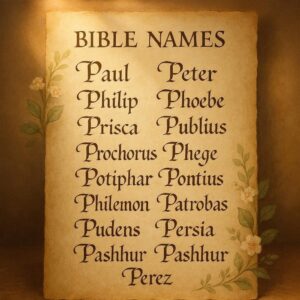
Male Names: Paul, Peter, Philip, Pharaoh, Pilate, Pontius, Publius, Phinehas, Perez, Parmenas, Patrobas, Philemon, Phlegon, Porcius, Pudens, Pashhur, Pekah, Pekahiah, Pedaiah, Pagiel, Palal, Palti, Parnach, Pathrusim, Peleg, Penuel, Peter, Phelet, Philologus, Phygelus, Piram, Poratha, Prochorus, Ptolemy, Putiel.
Female Names: Phoebe, Priscilla (Prisca), Puah, Persis.
Place Names: Palestine, Patmos, Paddan Aram, Peniel, Philippi, Phoenicia, Ptolemais, Pura, Pithom.
Prominent & Powerful: Key “P” Names in Scripture
Let’s explore the stories and meanings behind some of the most impactful Bible names that start with P.
Peter: The Rock
-
Meaning: “Rock” or “Stone” (from the Greek Petros, translating the Aramaic Cephas).
-
Key References: Matthew 4:18-20, Matthew 16:13-19, Acts 2.
-
Story: Originally named Simon, a fisherman from Galilee, he was given the name Peter by Jesus himself. This signified his role as the “rock” upon which Jesus would build his church. Peter’s journey is one of dramatic highs and lows—walking on water, boldly declaring Jesus as Messiah, denying him three times, and ultimately becoming a foundational leader of the early Christian church, preaching at Pentecost.
-
Significance: Peter’s name change symbolizes transformative faith. His story offers hope, showing that flawed individuals can be used mightily for God’s purposes.
Paul: The Apostle to the Nations
-
Meaning: “Small” or “Humble” (Latin Paulus). His Hebrew name was Saul, meaning “asked for.”
-
Key References: Acts 9, 13-28; Numerous New Testament Epistles (Romans, Corinthians, etc.).
-
Story: A fervent Pharisee and persecutor of early Christians, Saul underwent a radical conversion on the road to Damascus after encountering the risen Christ. He became the Apostle Paul, the most prolific missionary and writer of the New Testament, spreading the gospel throughout the Roman Empire.
-
Significance: Paul’s life is a testament to redemption and grace. His name shift from Saul (Hebrew) to Paul (Roman) also reflects his mission to bridge Jewish and Gentile worlds.
Philip: The Evangelist
-
Meaning: “Lover of Horses” (Greek).
-
Key References: Matthew 10:3; Acts 6:5, 8:4-40; John 1:43-46, 14:8.
-
Story: Two key Philips appear in the New Testament:
-
Philip the Apostle: One of the twelve disciples, pragmatic and inquisitive (John 6:7, John 14:8).
-
Philip the Evangelist: One of the seven deacons chosen in Acts 6. He powerfully preached in Samaria and famously explained Scripture to and baptized the Ethiopian eunuch, demonstrating the gospel’s expansion beyond traditional boundaries.
-
-
Significance: The name Philip is associated with practical service and strategic evangelism.
Pharaoh: The Title of Power
-
Meaning: “Great House” (Egyptian, referring to the royal palace, later used for the king himself).
-
Key References: Genesis 41; Exodus 1-14.
-
Story: Multiple Pharaohs appear in the Bible, most famously the unnamed ruler in Exodus who oppressed the Israelites and refused to let them go, leading to the ten plagues and the Exodus. Another significant Pharaoh promoted Joseph to vizier (Genesis 41).
-
Significance: The title represents worldly power, authority, and, in the Exodus narrative, a heart hardened against God’s will, serving as a foil for God’s sovereign power.
Priscilla (Prisca) & Phoebe: Pillars of the Early Church
-
Priscilla (Prisca):
-
Meaning: “Ancient” or “Venerable” (Latin).
-
Story: A tentmaker alongside her husband Aquila. They worked, traveled, and taught with Paul, even risked their lives for him, and instructed the eloquent Apollos in Christian doctrine (Acts 18). She is often mentioned before her husband, suggesting significant standing.
-
-
Phoebe:
-
Meaning: “Bright,” “Pure” (Greek).
-
Story: A deaconess (diakonos) of the church in Cenchreae. Paul commends her in Romans 16:1-2 as a benefactor (prostatis) to many, including himself, and entrusted her with delivering the Epistle to the Romans.
-
-
Significance: These women exemplify leadership, scholarship, patronage, and vital ministry in the foundational years of Christianity.
Comparative Table: Key Apostles Named with P
| Name | Meaning | Primary Role | Key Character Trait | Notable Contribution |
|---|---|---|---|---|
| Peter | Rock | Apostle to the Jews, Church Leader | Impulsive, Passionate, Later Steadfast | Apostolic preaching, leadership in Jerusalem, author of two epistles. |
| Paul | Small/Humble | Apostle to the Gentiles, Missionary-Theologian | Zealous, Intellectual, Resilient | Missionary journeys, founding churches, author of 13 New Testament epistles. |
| Philip | Lover of Horses | Apostle (Gospels) / Evangelist-Deacon (Acts) | Practical, Obedient, Inquisitive | Bringing Nathanael to Jesus (Apostle); Evangelizing Samaria & the Ethiopian (Evangelist). |
Lesser-Known But Meaningful “P” Names
The Bible is filled with fascinating individuals whose stories, though brief, are impactful.
-
Phinehas: (Meaning: “Nubian” or “Mouth of Brass”) Grandson of Aaron. His zealous action in Numbers 25 stopped a plague and secured a covenant of permanent priesthood for his lineage. He is remembered for his passionate defense of God’s holiness.
-
Perez: (Meaning: “Breach” or “Breakthrough”) Twin son of Judah and Tamar (Genesis 38). His birth was marked by struggle, yet he is listed in the genealogy of King David and, ultimately, Jesus Christ (Matthew 1:3), showing how God works through unusual and difficult beginnings.
-
Publius: (Meaning: “Public” or “Common”) The chief official on Malta who showed hospitality to Paul and his shipwrecked companions. His father was healed by Paul, leading to many others on the island being cured (Acts 28:7-10).
-
Puah: One of the two Hebrew midwives (with Shiphrah) who courageously defied Pharaoh’s order to kill newborn Israelite boys, citing the vigor of Hebrew women (Exodus 1:15-21). They are celebrated for their fear of God and moral bravery.
-
Persis: (Meaning: “Persian Woman”) A female member of the church in Rome whom Paul greeted as “my dear friend… who has worked very hard in the Lord” (Romans 16:12). A simple but powerful testament to dedicated, behind-the-scenes labor.
Important Note for Readers:
When studying these names, context is everything. Always read the surrounding chapters to understand the full narrative and the person’s role within God’s larger story. A Bible dictionary or concordance is an invaluable tool for deeper study.
The Legacy of “P” Names Today
Biblical names that start with P remain enduringly popular. Peter, Paul, Philip, and Priscilla are classic choices that carry a sense of history, strength, and faith. Lesser-known names like Phinehas, Phoebe, and Perez offer unique options with deep roots and powerful meanings. They connect the bearer to a specific virtue or story—be it rock-like faith, transformative zeal, or courageous breakthrough.
Additional Resource: For further in-depth study on biblical names and their etymologies, we recommend visiting the Bible Hub Lexicon, a free and robust online tool for exploring original languages.
Conclusion
This guide has journeyed through the profound world of Bible names that start with P, from the foundational apostles Peter and Paul to the courageous midwife Puah. We’ve seen how each name encapsulates a story of faith, destiny, or divine interaction. These names are not mere relics but enduring legacies that continue to inspire, teach, and connect us to the rich spiritual heritage of the Biblical text.
Frequently Asked Questions (FAQ)
Q: What is the most common Bible name starting with P?
A: In terms of narrative importance and frequency of mention, Peter and Paul are the most prominent. For general usage, Peter, Paul, and Philip have been consistently common historically.
Q: Are there any books of the Bible named after people starting with P?
A: Yes. The New Testament epistles Philippians (addressed to the church in Philippi, named after Philip II of Macedon) and Philemon (addressed to a man named Philemon) are named with “P” origins. The books of Peter (1 & 2 Peter) are, of course, named for the apostle.
Q: Which Bible name starting with P means “rock”?
A: Peter is the name that directly means “rock” (from the Greek Petros).
Q: Who was the Pharaoh during the Exodus?
A: The Bible does not specify his personal name. He is simply titled “Pharaoh.” Historians and archaeologists have debated his identity, with candidates including Ramesses II or Thutmose III, but the scripture focuses on his office and role in the narrative rather than his personal identity.
Q: Is Pilate a biblical name?
A: Yes. Pontius Pilate was the Roman prefect who presided over the trial of Jesus and ordered his crucifixion. The name Pilate is likely derived from the Latin pilatus, possibly meaning “armed with a javelin.”