Have you ever been reading the Bible aloud—maybe in a small group, Sunday school class, or even during personal study—and stumbled over a name? You’re not alone. Names from the ancient world can be tongue-twisters, and “Cyrene” is one that often gives readers pause. Getting it right matters. It shows respect for the text, builds confidence in your reading, and helps listeners follow along without distraction.
This comprehensive guide is your one-stop resource for mastering the pronunciation of “Cyrene.” We’ll move beyond a simple phonetic spelling to explore its origins, its place in biblical history, and why this ancient city’s name still echoes in our churches and studies today. Let’s solve this pronunciation puzzle together.
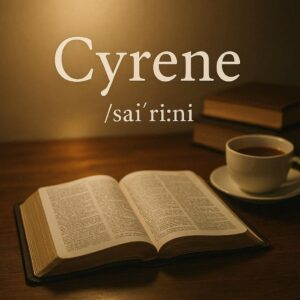
Understanding Cyrene: More Than Just a Name
Before we tackle the sounds, let’s understand what we’re pronouncing. Cyrene wasn’t just a random word; it was a powerful and influential city. Knowing its story adds meaning to the name and helps cement its correct pronunciation in your memory.
The Historical Powerhouse: Cyrene in the Ancient World
Cyrene was a major Greek and later Roman city on the coast of North Africa, in what is now modern-day Libya. Founded in the 7th century BC, it became the capital of a prosperous region known as Cyrenaica, famous for its intellectual life (it was home to philosophers and mathematicians) and its valuable export: silphium, a plant used in medicine and cooking that was so prized it may have been driven to extinction.
Its significance to us is its connection to the Jewish Diaspora. Centuries before the New Testament, Jewish communities settled in Cyrene. By the time of Jesus, a substantial Jewish population lived there, maintaining their faith and customs far from Jerusalem. This sets the stage for its biblical appearances.
Cyrene in the Biblical Narrative
Cyrene is mentioned several times in the New Testament, always in connection with people from that city who are engaged with the events of the early Christian faith.
-
Simon of Cyrene: The most famous reference is in the Gospels (Matthew 27:32, Mark 15:21, Luke 23:26). Simon was the man compelled to carry the cross of Jesus on the way to Golgotha. Mark’s Gospel even mentions he was “the father of Alexander and Rufus,” suggesting his family was known to the early Christian community in Rome.
-
Cyrenians in Jerusalem: In Acts 2, during Pentecost, Cyrenians are listed among the devout Jews from every nation who heard the apostles speaking in tongues. This indicates a direct link between the Jerusalem church and the Cyrenian Jewish community.
-
Cyrenian Evangelists: In Acts 11:20, after the persecution following Stephen’s death, some men from Cyprus and Cyrene traveled to Antioch and began speaking to Greeks, not just Jews. This was a pivotal moment—the first large-scale, intentional preaching to Gentiles, which led to the explosive growth of the church in Antioch.
-
Lucius of Cyrene: In Acts 13:1, Lucius of Cyrene is named as one of the prophets and teachers in the influential church at Antioch, the very church that commissioned Paul and Barnabas for their first missionary journey.
As you can see, people from Cyrene were not bystanders; they were active, crucial participants in the earliest days of Christianity. Pronouncing their homeland correctly is a small but meaningful nod to their role in our faith history.
The Correct Pronunciation of Cyrene
Now, let’s get to the heart of the matter. Based on historical linguistics and the consensus of biblical scholars, teachers, and standard reference works, here is the accepted pronunciation.
The Standard Pronunciation
The most widely accepted pronunciation of Cyrene in English, particularly in academic and theological settings, is:
sigh-REE-nee
Let’s break it down phonetically:
-
Cy- (First Syllable): Sounds like the word “sigh” or the “si” in “silent.” It is a long ‘i’ sound (/saɪ/).
-
-rene (Second and Third Syllables): Sounds like “REE-nee.” The emphasis or stress falls strongly on the second syllable, “REE.” The final “e” is pronounced as a long ‘e’ (like “knee”).
Phonetic Spelling: /saɪˈriːniː/
Syllable Emphasis Breakdown
Correct syllable stress is key to sounding natural.
| Syllable | Sound | Stress Level |
|---|---|---|
| Cy (1st) | sigh | Low |
| REE (2nd) | ree | HIGH (Primary Stress) |
| nee (3rd) | nee | Low |
Think of the rhythm like the name “Bernadette” (ber-na-DETTE) or “symphony” (SYM-pho-ny). The punch lands in the middle.
Audio Comparison: Right vs. Common Mistakes
Since we can’t include actual audio, here’s a comparative table to “hear” it in your mind.
| Correct Pronunciation | Common Mispronunciation | Why It’s Incorrect |
|---|---|---|
| sigh-REE-nee | SIGH-reen (2 syllables) | Wrong stress, misses final vowel sound. |
| sigh-REE-nee | sir-EEN | Starts with a soft “sir” instead of “sigh.” |
| sigh-REE-nee | KY-reen | Uses a hard “K” sound, which is the ancient Greek letter but not the adopted English sound. |
Important Note: You may occasionally hear a scholarly pronunciation closer to the ancient Greek: “kye-RAY-nay” (with a hard ‘k’ and a long ‘a’). While historically interesting, “sigh-REE-nee” is the standard, expected pronunciation in virtually all English-language churches, seminaries, and Bible studies today. Using the hard ‘k’ might sound overly technical or out of place in most settings.
Why Do We Get It Wrong? Common Pronunciation Pitfalls
Understanding common errors helps us avoid them. Most mistakes come from applying modern English reading rules to an ancient name.
-
The Silent ‘E’ Trap: In English, a final ‘e’ often makes the vowel in the middle long but is itself silent (e.g., “take,” “line”). People see “Cyrene” and assume it’s “Sigh-reen.” But in names transliterated from Greek, final vowels are often pronounced. The ‘e’ at the end of Cyrene says its name: “ee.”
-
The “Cy-” Confusion: The “Cy-” combination is tricky. In words like “cycle” or “cynic,” it’s a soft ‘s’ sound. In others, like “cyber,” it can sound like “sye.” “Sigh” is the consistent choice for this biblical name.
-
Shifting the Stress: Placing the emphasis on the first syllable (SIGH-reen) is the most frequent error. English loves first-syllable stress, but many classical names stress later syllables (e.g., Jeremiah, Gethsemane).
Pronunciation in Different Contexts
Should you say it the same way everywhere? Essentially, yes. Consistency is good. However, your audience might influence your slight delivery.
-
In Church or Bible Study: Use the clear, confident sigh-REE-nee. It’s the most pastoral and accessible choice.
-
In Academic or Theological Settings: sigh-REE-nee remains perfectly correct. You might reference the Greek “kye-RAY-nay” if discussing linguistic origins, but it’s not necessary for standard speech.
-
When Reading Aloud to Children: Slow it down: “sigh… REE… nee.” You can even turn it into a little call-and-response: “Can you say sigh-REE-nee?”
A Helpful Memory Tool
Need a mnemonic to lock it in? Try this phrase:
“I gave a sigh of relief when I saw the knee of the runner was really okay.”
Sigh – Rea – Knee = Cyrene.
Deep Dive: The Linguistic Journey from Greek to English
For the history and language buffs, here’s how we got from the ancient world to our modern pronunciation.
Cyrene comes from the Ancient Greek Κυρήνη (Kyrḗnē).
-
The initial κ (kappa) is a hard ‘k’ sound.
-
The υ (upsilon) was pronounced like the French ‘u’ or German ‘ü’—a tricky sound for English speakers that has softened over time into our long ‘i’.
-
The stress in Greek was on the second-to-last syllable (the η), which translates to our strong stress on “REE.”
-
The final η (eta) is a long ‘a’ sound that evolved into a long ‘e’ in Latin and later English.
This transliteration process—moving a word from one alphabet and language system to another—is why we end up with an English spelling (“Cyrene”) that suggests a different sound than the original Greek. Our pronunciation is an English convention that has developed over centuries of Bible translation and scholarship.
Practical Application: Using “Cyrene” Confidently
Let’s put this knowledge into practice with a short reading exercise. Read this passage from Mark 15:21 aloud, focusing on the name:
“And they compelled a passerby, Simon of Cyrene (sigh-REE-nee), who was coming in from the country, the father of Alexander and Rufus, to carry his cross.”
Notice how placing the stress on “-REE-” makes the sentence flow naturally. Try it again, this time emphasizing the wrong syllable (“SIGH-reen”). Feel how it disrupts the rhythm? The correct pronunciation fits seamlessly into the cadence of the English text.
Conclusion
Pronouncing biblical names correctly, like Cyrene as sigh-REE-nee, is a simple yet meaningful act of engaging deeply with Scripture. It connects us to the historical reality of people like Simon, who carried the cross, and the Cyrenian evangelists who helped launch the Gentile mission. By understanding its origin, avoiding common pitfalls, and practicing the standard pronunciation, you can read and speak about this important place with clarity and confidence.
Frequently Asked Questions (FAQ)
Q1: Is it ever correct to pronounce it “KY-reen”?
A: In common English usage, especially within a biblical context, “KY-reen” is generally considered incorrect. While it attempts a more Greek sound, it is not the standard adopted by English Bible dictionaries, audio Bibles, or theological institutions. Stick with “sigh-REE-nee.”
Q2: I’ve heard “Cyrenaica” (the region). How is that pronounced?
A: Great question! It follows the same pattern: sigh-reh-NAY-ih-kuh. The stress moves to the third syllable, “NAY.”
Q3: Are there audio resources where I can hear this pronunciation?
A: Yes. Most major online Bible dictionaries have audio pronunciations. Websites like BibleHub.com or the audio features in Bible study apps (e.g., Blue Letter Bible, YouVersion) often include reliable spoken pronunciations from scholarly sources.
Q4: Why does this level of detail matter for my faith?
A: It’s not about being pedantic. Accuracy is a form of respect for the text and its history. It aids clear communication when teaching or discussing the Bible and helps internalize these names as belonging to real people and places, enriching your understanding of the biblical world.
Additional Resources
For further study on biblical places and names, we recommend exploring the “Places” and “Dictionary” tools on BibleGateway.com. Their resources are thorough, accessible, and provide valuable context for your reading.