In our daily lives, our ears are essential for communication, learning, and connection. But have you ever stopped to consider what your ears represent in a spiritual sense? In the Bible, the ear is far more than a physical organ for hearing sounds. It is a profound symbol of obedience, understanding, covenant relationship, and spiritual receptivity. To grasp the biblical meaning of the ear is to learn the sacred art of listening—not just with our heads, but with our hearts.
This comprehensive guide will explore the layered spiritual significance of the ear throughout Scripture. We’ll move from simple hearing to deep understanding, and finally, to willing obedience. Our journey will uncover why having “ears to hear” is one of the most critical calls in the entire Biblical narrative.
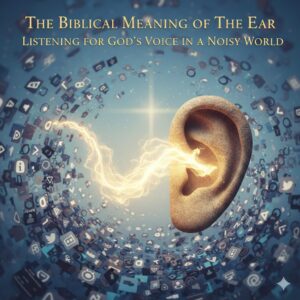
The Ear as a Symbol: More Than Hearing
At its most fundamental level, the physical ear in the Bible represents the gateway for receiving information, primarily through the spoken word. In a time before widespread literacy, hearing was the primary way knowledge and instruction were transmitted. However, the Biblical authors consistently use the ear to point to a deeper, spiritual reality.
Key Symbolic Meanings of the Ear:
-
Receptivity to Divine Communication: The ear is the channel through which God’s word, laws, prophecies, and wisdom are received.
-
The Seat of Understanding and Discernment: It’s associated with the inner capacity to process, perceive, and comprehend spiritual truth.
-
A Marker of Covenant Relationship: The act of “uncovering” or “boring” an ear signified a permanent bond of servitude and loyalty.
-
A Call to Attention and Obedience: Biblical commands to “hear” are often appeals for immediate and active compliance, not just passive listening.
This symbolism sets the stage for one of the Bible’s most urgent spiritual admonitions.
“He Who Has Ears to Hear, Let Him Hear”: The Paramount Spiritual Call
This famous phrase, repeated by Jesus seven times in the Gospels (e.g., Matthew 11:15, Mark 4:9, Revelation 2:7) and echoed throughout Revelation, is the cornerstone of understanding the biblical meaning of the ear. It’s a deliberate paradox meant to jolt the listener.
Jesus isn’t speaking about physical deafness. He is highlighting a spiritual condition. Everyone in the crowd had physical ears, but not all had “ears to hear”—the spiritual readiness to receive, understand, and internalize His message. This call distinguishes between:
-
Hearing (Physical): The sound waves hitting the eardrum.
-
Hearing (Spiritual): The engaged, receptive, and obedient response of the whole person to God’s word.
“The hearing ear and the seeing eye, the Lord has made them both.” – Proverbs 20:12 (ESV)
This verse reminds us that our capacity for spiritual perception is itself a gift from God, to be used for His purposes.
The Prophetic Problem: Dull and Heavy Ears
The prophets of the Old Testament repeatedly confronted Israel with a spiritual diagnosis: deafness. They had ears, but they did not listen.
-
Isaiah’s Commission (Isaiah 6:9-10): God tells Isaiah to preach even though the people will “be ever hearing, but never understanding.” Their hearts are calloused, and their ears are dull.
-
Jeremiah’s Lament (Jeremiah 6:10): “To whom shall I speak and give warning, that they may hear? Behold, their ear is uncircumcised, and they cannot listen.” An “uncircumcised ear” is one that is closed off, unclean, and unreceptive to God’s voice.
This condition wasn’t limited to ancient Israel. It is a universal human tendency to selectively hear what we want and shut out challenging truth. The Bible calls this state having “heavy” ears (Acts 28:27).
The Obedient Ear: From Hearing to Doing
In Biblical thought, true hearing is inseparable from action. To “hear” God’s law is to obey it. The famous Jewish prayer, the Shema (Deuteronomy 6:4), begins with “Hear, O Israel: The Lord our God, the Lord is one.” This “hearing” implies loving God with all one’s heart, soul, and strength—a total life response.
The ultimate model of the obedient ear is found in the Messiah. Psalm 40:6, prophetically applied to Jesus in Hebrews 10:5, states:
“Sacrifice and offering you did not desire, but my ears you have opened…” (NKJV) or “…but a body you have prepared for me…” (ESV).
The imagery is of God digging out or boring the ear of the servant, preparing Him not for ritual sacrifice, but for the perfect obedience of listening and doing God’s will, culminating on the cross. This points us to a powerful ritual law.
The Covenant of the Ear: The Voluntary Slave
One of the most vivid illustrations of the ear’s meaning is in Exodus 21:1-6. If a Hebrew slave who could go free after six years chose instead to stay with his master out of love, a public ceremony was held:
-
The slave would declare his love for his master, wife, and children.
-
His master would bring him to the doorpost.
-
Using an awl, the master would pierce the slave’s ear against the doorpost.
This act created a permanent, visible mark of covenant loyalty. The pierced ear symbolized:
-
Permanent Belonging: The slave now permanently belonged to that household.
-
Loving Obedience: His service was now motivated by love, not compulsion.
-
Attentiveness: His ear was now specially “opened” or dedicated to listening to and carrying out his master’s commands for life.
For the Christian, this is a powerful picture of discipleship: a voluntary, loving surrender to Jesus as Master, marked by a life dedicated to listening to and obeying His voice.
The Anatomy of Spiritual Hearing: A Comparative Table
Let’s break down the difference between mere physical hearing and the spiritual hearing the Bible advocates.
| Aspect | Physical Hearing | Biblical “Ears to Hear” (Spiritual Hearing) |
|---|---|---|
| Primary Action | Sound perception | Active receptivity and engagement |
| Goal | Information gathering | Transformation and obedience |
| Engages | The brain (intellect) | The heart, soul, and mind (whole person) |
| Response | Often passive | Always active; leads to action |
| Condition | Can be impaired by noise or damage | Can be impaired by sin, pride, or a hard heart |
| Biblical Metaphor | “Hearing but not perceiving” (Isa 6:9) | “The good soil” that hears the word and bears fruit (Mark 4:20) |
Practical Steps to Cultivate “Ears to Hear”
How do we move from having dull ears to having ears that are attentive to God? Here are actionable steps based on Scriptural principles:
-
Come with Humility: Approach God’s Word and prayer with a humble heart, acknowledging your need to hear from Him. Pride is the great deafener (James 4:6).
-
Create Space for Silence: In our noisy world, God often speaks in a “still small voice” (1 Kings 19:12). Regularly step away from digital and social noise to listen.
-
Read Scripture Expectantly: Don’t just study the Bible for information. Read it as a love letter and a command from your Master. Ask, “Lord, what are you saying to me today through this?”
-
Practice Immediate, Partial Obedience: When you sense a clear, Biblical prompting from God (e.g., to forgive, to serve, to confess), act on it immediately, even in a small way. Obedience tunes our spiritual ears.
-
Gather with Others: God often speaks through the body of Christ. Listen to wise, spiritually mature believers. “Let the wise hear and increase in learning” (Proverbs 1:5).
-
Pray for Open Ears: Simply ask. David prayed, “Incline my heart to your testimonies” (Psalm 119:36). Ask God to give you an attentive heart and open ears.
Important Note: Discerning God’s voice requires aligning what you hear with the unchanging truth of Scripture. God will never lead you to do something that contradicts His revealed Word and character. Always test what you hear against the Bible.
The Ear in Key Biblical Stories
-
Samuel’s Call (1 Samuel 3): The young boy Samuel heard a voice calling his name. It took him and Eli three times to realize it was the Lord. Eli’s instruction was crucial: “Speak, Lord, for your servant is listening.” This posture—of a servant ready to listen—is the key.
-
The Healing of the Deaf Man (Mark 7:31-37): Jesus’ healing act is symbolic: He took him aside (separation from the crowd), put his fingers into the man’s ears (opening the physical channel), spat and touched his tongue (enabling speech), looked to heaven (source of power), sighed (compassion for human brokenness), and said “Ephphatha!” (Be opened!). This is a perfect picture of Jesus’ ministry to open spiritually deaf ears and loose mute tongues to praise God.
-
Peter Cuts Off Malchus’s Ear (John 18:10-11): In a rash act of violent “defense,” Peter severs the ear of the high priest’s servant. Jesus immediately rebukes him and heals the ear (Luke 22:51). This act symbolizes the rejection of worldly, violent solutions and the restoration of listening—even to a difficult path of suffering.
Conclusion: The Lifelong Journey of Listening
The biblical meaning of the ear takes us on a journey from the side of the head to the center of the soul. It transforms a common bodily function into a sacred discipline. It is not about mystical experiences, but about the daily, humble posture of a servant whose ear has been opened by love, dedicated to a Master, and trained to listen in the quiet and through His Word. In a world full of conflicting voices, may we be people who truly have “ears to hear,” responding to God’s voice with understanding, faith, and joyful obedience, ready to act on what we have heard.
Frequently Asked Questions (FAQ)
Q: Does God literally speak to our physical ears today?
A: While God can speak audibly, the Bible emphasizes that He primarily speaks through His written Word (Scripture), through the convicting and guiding work of the Holy Spirit in our conscience, through circumstances, and through the wise counsel of other believers. Any perceived “voice” must be rigorously tested against the truth of Scripture.
Q: What does it mean to have an “uncircumcised ear” (Jeremiah 6:10)?
A: Circumcision was a sign of God’s covenant. An “uncircumcised” ear is one that is outside the covenant, closed off, and unclean. It is spiritually insensitive and unwilling to receive God’s word. It represents a heart that is not dedicated to God.
Q: How can I know if I’m really hearing from God or just my own thoughts?
A: This is a common and important question. Use these checks:
-
Consistency with Scripture: God will not contradict His revealed Word.
-
The Test of Peace: Does it bring the peace of Christ, even if challenging? (Colossians 3:15).
-
Confirmation through Godly Counsel: Do mature, spiritually-minded believers see wisdom in it?
-
The Fruit Test: If followed, would it likely produce the fruits of the Spirit (love, joy, peace, etc.)?
Q: Is the phrase “incline your ear” just poetic?
A: No, it’s a powerful active metaphor. To “incline” or “turn” your ear (as in many Psalms) means to deliberately lean in, to focus your attention, to intentionally redirect your listening away from other noises and toward God. It’s a conscious act of the will.
Additional Resources
To continue your study on listening to God and spiritual discernment, we recommend this excellent, practical book:
-
[Foster, Richard. Celebration of Discipline. HarperOne, 1998.] – The chapter on the “Discipline of Meditation” is particularly helpful for learning to listen to God in Scripture.