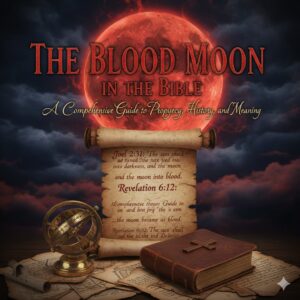
The sight of a blood moon—the deep, ruddy glow of a total lunar eclipse—has captivated humanity for millennia. In our modern age, we understand the science: the Earth aligns between the sun and the moon, casting its shadow and filtering sunlight through our atmosphere, bathing the moon in coppery red light. Yet, long before telescopes and orbital mechanics, this dramatic celestial event was viewed through a lens of awe, mystery, and divine prophecy. For countless seekers, students of Scripture, and observers of the skies, the central question remains: what is the blood moon biblical meaning?
This article is your definitive, human-written guide. We will journey beyond the headlines and sensational theories to explore the rich, complex, and often misunderstood relationship between this astronomical event and Biblical text. We’ll examine direct scriptural references, trace the history of interpretation, and provide a balanced perspective to help you form your own understanding. Our goal is not to promote fear or set dates, but to offer clarity, depth, and reliable insight into one of the Bible’s most fascinating symbolic phenomena.
What is a Blood Moon? The Science Behind the Symbol
Before we delve into theology, let’s firmly establish what we’re talking about. A “blood moon” is not a formal astronomical term, but a popular name for the appearance of the moon during a total lunar eclipse.
The Simple Science:
-
The Sun, Earth, and Moon align in a straight line, with Earth in the middle.
-
Earth blocks direct sunlight from reaching the moon.
-
However, sunlight scatters through Earth’s atmosphere. Shorter wavelength colors (blues and greens) are filtered out, while longer wavelength red and orange light bends around our planet and illuminates the lunar surface.
-
The result is the moon transforming into a haunting, dark red or copper orb—a “blood moon.”
This natural process is predictable and can be calculated centuries in advance. Understanding this demystifies the event and allows us to appreciate how ancient peoples, without this scientific framework, interpreted it as a potent sign or omen.
Key Astronomical Terms vs. Colloquial Names
| Astronomical Term | Colloquial / Prophetic Term | Description |
|---|---|---|
| Total Lunar Eclipse | Blood Moon | The full moon enters Earth’s umbra (full shadow), taking on a red hue. |
| Tetrad | Blood Moon Tetrad | A series of four consecutive total lunar eclipses, with no partial eclipses in between, each separated by six full moons. |
| Solar Eclipse | Darkened Sun | The moon passes between Earth and the sun, blocking the sun’s light. |
| Prophetic Passover / Sukkot | – | When a lunar eclipse falls on the Hebrew feast days of Passover or Sukkot (Tabernacles). |
Direct Biblical References to the Blood Moon
The phrase “blood moon” itself is a modern label. The Bible uses vivid, poetic language to describe celestial phenomena. The primary passages that form the cornerstone of this topic are found in the Old Testament prophetic books and the New Testament book of Acts and Revelation.
1. Joel 2:30-31 (Cited in Acts 2:19-20)
This is arguably the most significant reference. The prophet Joel declares a message from God:
“I will show wonders in the heavens and on the earth, blood and fire and billows of smoke. The sun will be turned to darkness and the moon to blood before the coming of the great and dreadful day of the Lord.” (Joel 2:30-31, NIV)
This passage pairs a moon “turned to blood” with a darkened sun, a classic description of lunar and solar eclipses. The context is the “Day of the Lord,” a future time of both judgment and salvation. The apostle Peter later quotes this exact passage on the Day of Pentecost (Acts 2:19-20), linking the events of that day—the outpouring of the Holy Spirit—to the “last days” prophecies of Joel.
2. Revelation 6:12-13
The apocalyptic vision given to the Apostle John includes:
“I watched as he opened the sixth seal. There was a great earthquake. The sun turned black like sackcloth made of goat hair, the whole moon turned blood red, and the stars in the sky fell to earth…” (Revelation 6:12-13, NIV)
Here, the blood moon is part of a catastrophic celestial upheaval following the opening of a seal of God’s judgment. It is one element in a larger, terrifying sequence of events signaling monumental divine action.
3. Other Supporting Passages
-
Isaiah 13:10: “For the stars of heaven and their constellations will not give their light; the sun will be darkened in its going forth, and the moon will not cause its light to shine.” (This speaks of the judgment on Babylon, using similar cosmic language).
-
Ezekiel 32:7: “When I put out your light, I will cover the heavens, and make its stars dark; I will cover the sun with a cloud, and the moon shall not give her light.” (A prophecy against Egypt).
-
Luke 21:25-26: Jesus Himself said, “There will be signs in the sun, moon and stars… the powers of the heavens will be shaken.”
Important Note: Biblical scholars often interpret this language in two primary ways: (1) as literal future celestial events, or (2) as highly symbolic, apocalyptic imagery common in ancient Near Eastern literature, depicting the “unmaking” of creation during times of great geopolitical or divine judgment.
Historical & Prophetic Interpretations of Blood Moons
The interpretation of blood moons has evolved, with a significant surge in modern interest tied to specific lunar patterns.
The “Blood Moon Tetrad” Prophecy
In recent decades, the focus has shifted to the significance of lunar tetrads—four total lunar eclipses in a row—occurring on Jewish feast days. This connection was popularized in the 21st century.
The argument posits that when a tetrad coincides with Passover and Sukkot in consecutive years, it is a direct sign from God, often related to significant events for Israel and the world.
Recent Feast-Aligned Tetrads and Associated Events:
| Tetrad Dates (Passover & Sukkot) | Associated Historical Events (As Cited by Proponents) |
|---|---|
| 1493-1494 | Expulsion of Jews from Spain (1492). |
| 1949-1950 | Re-establishment of the State of Israel (1948). |
| 1967-1968 | Israel’s Six-Day War and capture of Jerusalem (1967). |
| 2014-2015 | Viewed as a potential sign of a coming major event. |
A Critical Perspective: While the historical alignments are intriguing, it’s crucial to approach this with caution. Correlation does not equal causation. Many other tetrads have occurred without major recorded events, and historians debate the directness of these links. The Bible does not specifically mention “tetrads.” This interpretation is a modern synthesis of astronomy, history, and prophecy.
What Did Blood Moons Signify in Ancient Times?
In the ancient worldview shared by many Biblical writers, the heavens were seen as a “canvas of the divine.” Celestial events were rarely seen as mere accidents.
-
Portents of Change: Eclipses were often viewed as omens, signaling the death of a king, impending disaster, or a major shift in fortune.
-
Literary Symbolism: The darkening of sun and moon was a powerful metaphor for chaos, judgment, and the overturning of the established order (see the passages in Isaiah and Ezekiel against nations).
-
Apocalyptic Expectation: In Jewish apocalyptic literature (like parts of Daniel, and later, Revelation), cosmic disturbances signaled the end of the current age and the ushering in of God’s direct, universal reign.
A Balanced, Realistic View: Separating Signal from Noise
With so much information—and misinformation—available, how should a thoughtful person approach the blood moon biblical meaning? Here is a balanced framework.
What the Blood Moon Likely Does Signify (Biblical Principles)
-
A Call to Attention: God often uses creation to get humanity’s attention. A blood moon can serve as a natural “stop and look up” moment, prompting reflection on our Creator and His majesty (Psalm 19:1).
-
A Reminder of Prophecy: It points us back to the authoritative words of Scripture in Joel, Revelation, and Jesus’ own teachings. It encourages us to study prophecy with humility and focus on its core message: God is sovereign over history.
-
A Symbol of the Times: The Bible clearly states that celestial signs will increase in frequency and intensity as part of the “birth pains” leading to the end of the age (Matthew 24:7-8, Luke 21:25). A blood moon can be a sobering reminder that we are living in the prophetic timeline.
-
A Focus on Jesus, Not the Sign: The central message of Scripture is redemption through Jesus Christ. Any prophetic sign should ultimately direct our gaze to Him, the author and finisher of our faith, not to fear or date-setting.
What the Blood Moon Likely Does Not Signify (Common Misconceptions)
-
A Precise Date-Setting Tool: Scripture is clear: “But about that day or hour no one knows…” (Matthew 24:36). Using blood moons or tetrads to predict an exact date for Christ’s return goes against this clear warning.
-
An Automatic Trigger for a Specific Event: While God may use them in His timing, there is no Biblical formula that states “X tetrad = Y event.” This view risks turning God’s sovereign signs into a mechanistic prophecy code.
-
A Cause for Fear for Believers: For those who have faith in Christ, these signs are not threats but reminders of promised redemption. “When these things begin to take place, stand up and lift up your heads, because your redemption is drawing near” (Luke 21:28).
-
A Uniquely Modern Phenomenon: Blood moon tetrads have happened throughout history. Our awareness of them is greater due to modern astronomy and communication.
How to Respond: A Practical Guide for the Reader
When you see news of the next blood moon, instead of anxiety or sensationalism, consider this practical response:
1. Look Up with Wonder: Step outside and observe the event. Let it instill a sense of awe at the precision and beauty of God’s creation.
2. Look Back at Scripture: Re-read the passages in Joel, Acts, and Revelation. Pray for wisdom and understanding.
3. Look Within in Reflection: Use the moment for spiritual self-assessment. Is your life aligned with God’s purposes?
4. Look Around with Compassion: Prophetic signs are a call to share the hope of the Gospel with others who may be fearful or unaware.
5. Look Forward with Hope: Let it solidify your hope in the ultimate fulfillment of God’s promises—the restoration of all things and the return of Jesus Christ.
Frequently Asked Questions (FAQ)
Q: Does the Bible literally say “blood moon”?
A: No. The Bible uses the descriptive phrase “the moon will be turned to blood” (Joel 2:31) or “the whole moon turned blood red” (Revelation 6:12). The term “blood moon” is a modern, descriptive label for the event these verses are describing.
Q: Should I be afraid when a blood moon happens?
A: Not if you are a follower of Christ. The Bible instructs believers to view such signs as reminders of God’s sovereignty and the certainty of His promises. For those without faith, it can serve as a legitimate wake-up call to seek truth. Fear is never the end goal; awareness and repentance are.
Q: Did the 2014-2015 Blood Moon Tetrad prove prophecy is being fulfilled now?
A: It highlighted interest in Biblical prophecy, but it did not “prove” a specific fulfillment. Significant events related to Israel did not immediately follow that tetrad in the way popular theories suggested. It reinforced that we must be patient and avoid the temptation of precise prediction.
Q: How can I learn more about Biblical prophecy responsibly?
A: Focus on respected Biblical scholars and theologians who approach prophecy with exegetical care (interpreting text in context) rather than sensational headline-driven approaches. Study the major themes of prophecy—the Day of the Lord, the return of Christ, the final judgment, and the new creation—rather than focusing solely on deciphering signs.
Conclusion
The blood moon biblical meaning is a profound tapestry woven from science, Scripture, and symbol. It points us to a God who speaks through His creation and His Word, using celestial signs as harbingers of His ultimate plan. While modern theories like the “Blood Moon Tetrad” spark interest, the core message remains timeless: a call to attention, repentance, and hopeful anticipation of God’s promised redemption. By grounding our understanding in Biblical context and avoiding speculative extremes, we can appreciate the blood moon not as a cryptic countdown, but as a majestic reminder of the Creator’s sovereign hand over all of history.