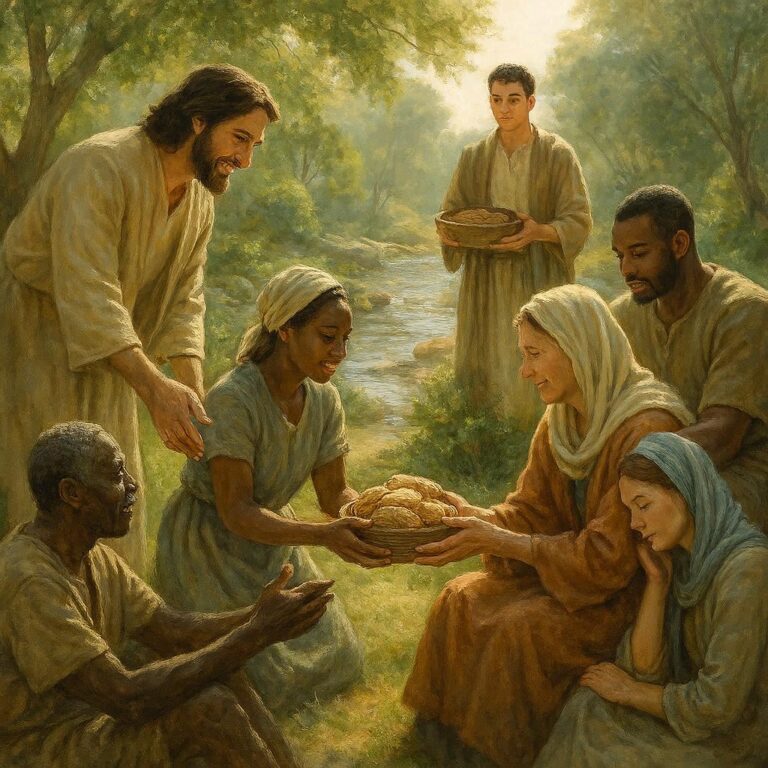
The concept of atonement stands as a cornerstone of the Christian faith, a rich and profound theme woven throughout the tapestry of Scripture. Yet, for many, the term remains shrouded in religious jargon, a theological idea that feels distant from everyday life. What does atonement truly mean in the Bible? Why is it so central, and how does an ancient ritual impact a modern believer?
At its heart, the biblical meaning of attonement is about reconciliation. It’s the story of a broken relationship made whole, a profound chasm bridged, and the ultimate price paid for love. It answers humanity’s deepest need: how can we, imperfect and separated from a holy God, be brought back into right relationship with Him?
This guide will take you on a journey through the Bible to uncover the full, transformative meaning of atonement. We’ll move from the symbolic sacrifices in the wilderness to the historical crucifixion on a hill, discovering why this ancient truth remains the bedrock of hope for millions today.

Understanding the Core Concept: What Does “Atonement” Mean?
Before diving into the biblical narrative, let’s unpack the word itself. The English term “atonement” was coined in the 16th century, literally meaning “at-one-ment.” It describes the state of being “at one” or in harmony with another. This perfectly captures the biblical essence: the act by which estranged parties are reconciled.
In the original languages of the Bible, the meaning is even more vivid:
-
Hebrew (Old Testament): The primary word is kaphar, which means “to cover, to purge, to make propitiation.” It implies the covering of sin, not in a sense of hiding it, but of dealing with it decisively so that the relational barrier is removed.
-
Greek (New Testament): Key words include katallagē (reconciliation, exchange) and hilasmos (propitiation, expiation). These point to a change in status—from enmity to friendship—through a sacrificial offering that turns away wrath.
“For all have sinned and fall short of the glory of God, and all are justified freely by his grace through the redemption that came by Christ Jesus. God presented Christ as a sacrifice of atonement, through the shedding of his blood—to be received by faith.” — Romans 3:23-25 (NIV)
This foundational verse from the Apostle Paul ties together the human problem (sin), the divine solution (Christ’s sacrifice), and the mechanism (atonement received by faith).
The Blueprint: Atonement in the Old Testament
The New Testament’s declaration of Jesus’ sacrifice doesn’t appear in a vacuum. It is the stunning, long-awaited fulfillment of patterns and promises established centuries earlier. The Old Testament provides the essential blueprint.
The Day of Atonement (Yom Kippur): The Sacred Ritual
The most dramatic illustration of atonement in the Old Testament is the annual Day of Atonement, detailed in Leviticus 16. This solemn holy day was the only day the High Priest could enter the Most Holy Place in the Tabernacle (and later, the Temple) to make sacrifices for the sins of the entire nation.
The ritual was intricate and rich with symbolism:
-
The Two Goats: The High Priest would present two male goats. One was chosen by lot to be “for the LORD.”
-
The Sacrifice for the Lord: The first goat was sacrificed as a sin offering. Its blood was sprinkled on and before the Ark of the Covenant’s mercy seat—the very throne of God’s presence. This act signified that the penalty for sin (death) was paid, satisfying God’s holy justice.
-
The Scapegoat for Azazel: The High Priest would then lay his hands on the head of the second goat, confessing over it all the sins of Israel. This goat, called the “scapegoat,” was then led away into the wilderness, never to return. This powerful act symbolized the complete removal of sin from the people—carried away, never to be held against them again.
This dual-action ritual perfectly illustrated the two-fold effect of atonement: propitiation (satisfying justice) and expiation (removing sin).
The Sacrificial System: A Pattern of Substitution
Beyond Yom Kippur, the entire Levitical sacrificial system taught the principle of substitutionary atonement. An innocent, unblemished animal would take the place of the guilty sinner. The sinner would lay hands on the animal, identifying with it, before it was slain. This taught that:
-
Sin has a deadly cost (Romans 6:23).
-
God, in His mercy, provides a way for sin to be covered.
-
This way requires the shedding of blood (Leviticus 17:11).
However, the Old Testament itself hints at the insufficiency of animal sacrifices. Prophets like Isaiah and Micah spoke of God’s greater desire for mercy and a contrite heart (Micah 6:6-8; Isaiah 1:11-17). The system was a “shadow of the good things to come,” pointing forward to a perfect, once-for-all sacrifice (Hebrews 10:1-4).
Comparison: Old Testament Shadow vs. New Testament Fulfillment
| Feature | Old Testament Atonement (The Shadow) | New Testament Atonement in Christ (The Fulfillment) |
|---|---|---|
| Mediator | A human high priest from the line of Aaron | Jesus Christ, the eternal High Priest from the order of Melchizedek (Hebrews 7) |
| Sacrifice | Unblemished animals (bulls, goats, lambs) | Jesus Christ, the sinless “Lamb of God” (John 1:29) |
| Frequency | Repeated annually (Day of Atonement) and constantly | Once for all time, finished work (Hebrews 9:25-26) |
| Scope | Covered the sins of the nation of Israel (ceremonially) | Available to all people, for all time, dealing with sin’s root and guilt |
| Access | Only the High Priest entered God’s presence | All believers now have direct access to God through Christ (Hebrews 4:16) |
| Effect | Provided ceremonial cleansing, a covering of sin | Provides complete forgiveness, new heart, and eternal redemption |
The Fulfillment: Atonement in the Life and Death of Jesus Christ
The New Testament announces that the long-awaited, final atonement has arrived in the person of Jesus of Nazareth. He did not come to abolish the Law but to fulfill it (Matthew 5:17).
Jesus as the Ultimate Sacrifice
The New Testament uses the language of the Old Testament system to explain what Jesus accomplished on the cross:
-
The Lamb of God: John the Baptist’s declaration (John 1:29) directly connects Jesus to the Passover lamb and the sacrificial system. Like the Passover lamb, His death protects people from judgment.
-
The Perfect High Priest: The Book of Hebrews extensively develops this theme. Jesus, as both perfect High Priest and perfect sacrifice, offered Himself to God, securing an eternal redemption (Hebrews 9:11-12).
-
The Mercy Seat: Romans 3:25 states that God presented Jesus as a “propitiation” (Greek: hilastērion), which is the same word used for the “mercy seat” on the Ark of the Covenant. Jesus’ blood is now the place where God’s justice and mercy meet.
The Crucifixion: The Atoning Event
The cross is the historical moment where atonement was accomplished. Key aspects include:
-
Substitution: “Christ died for our sins” (1 Corinthians 15:3). He took our place, bearing the punishment we deserved (Isaiah 53:5-6).
-
Propitiation: His sacrifice satisfied the righteous wrath of God against sin, turning it away from those who believe (1 John 2:2).
-
Expiation: His sacrifice cleanses us from the defilement and guilt of sin (1 John 1:7).
-
Reconciliation: By removing the barrier of sin, He restored the relationship between God and humanity (2 Corinthians 5:18-19).
-
Redemption: He paid the price to buy us out of slavery to sin and death (Mark 10:45).
“He himself bore our sins in his body on the cross, so that we might die to sins and live for righteousness; by his wounds you have been healed.” — 1 Peter 2:24 (NIV)
Theories of the Atonement: Understanding the “How”
Throughout church history, theologians have emphasized different facets of the atonement’s work, like viewing a magnificent diamond from various angles. No single theory captures its full glory, but together they enrich our understanding.
Important Note: These are not competing, contradictory theories but complementary perspectives on a multi-dimensional truth. The Bible itself uses a rich array of metaphors (sacrifice, ransom, victory, legal justification) to describe what happened at the cross.
Key Historical Perspectives
-
Christus Victor (Christ the Victor): This ancient view emphasizes Christ’s victory over the oppressive powers of sin, death, and the devil. Through His death and resurrection, He liberated humanity from their tyranny (Colossians 2:15).
-
Satisfaction Theory: Articulated by Anselm of Canterbury, this view frames atonement in terms of honor and justice. Human sin is an infinite offense against God’s honor. Humanity, being finite, cannot make sufficient satisfaction. Only God can, but it must be made by a human. Therefore, the God-man, Jesus Christ, makes the perfect satisfaction on our behalf.
-
Moral Influence Theory: Associated with Peter Abelard, this view focuses on the cross as the ultimate demonstration of God’s love, meant to awaken a loving and penitent response in us. While the cross is certainly a powerful demonstration of love, this view is often criticized for lacking the objective, transactional element clearly present in Scripture.
-
Penal Substitutionary Atonement: Developed during the Reformation, this view highlights that Christ, as our substitute, bore the penalty (penal) for sin in our place (substitution). He took the punishment demanded by God’s justice, so that we might receive forgiveness and righteousness (Isaiah 53:5; 2 Corinthians 5:21). This is a dominant perspective in Protestant evangelical theology.
Helpful List: What the Atonement Achieves for the Believer
Based on the unified witness of Scripture, here is what Christ’s atoning work secures:
-
Forgiveness of Sins: Our record of debt is canceled (Colossians 2:14).
-
Justification: We are declared “not guilty” and righteous before God (Romans 5:1).
-
Adoption: We are brought into God’s family as beloved children (Galatians 4:4-5).
-
Sanctification: We are set apart and being made holy, empowered to live a new life (Hebrews 10:10, 14).
-
Eternal Hope: We have the confident promise of resurrection and eternal life with God (1 Corinthians 15:20-22).
Why Atonement Matters Today: Personal and Transformative Implications
The doctrine of atonement is far from a dusty theological artifact. It has direct, life-changing implications for anyone who engages with it.
1. It Addresses Our Deepest Guilt and Shame.
We all carry the weight of mistakes, failures, and regret. Atonement speaks directly to this burden, offering not just a pep talk, but a declaration: “The price is paid. You are clean. You are forgiven.” This allows for genuine, deep-seated healing.
2. It Defines Our Identity.
We are no longer defined by our worst moments or our sin. Our core identity becomes “atoned for,” “reconciled,” “child of God.” This is a foundation for unshakeable security and worth.
3. It Fuels Our Freedom and Ethics.
Understanding the immense cost of our forgiveness breaks the power of sin and fuels a desire to live a life that honors the One who paid such a price. Gratitude, not guilt, becomes the primary motivation for moral living.
4. It Is the Foundation for True Peace.
The “at-one-ment” with God brings a profound peace—first, peace with God (Romans 5:1), and subsequently, the peace of God that guards our hearts (Philippians 4:7). It reconciles us vertically, which empowers reconciliation horizontally with others.
5. It Offers Certain Hope in the Face of Death.
Because atonement deals conclusively with sin, and the “wages of sin is death” (Romans 6:23), it removes death’s ultimate sting. The resurrection of Jesus is the first fruit of the new life secured by His atoning death.
Common Questions and Misunderstandings (FAQ)
Q: If God is love, why was a violent sacrifice necessary? Couldn’t He just forgive?
A: This questions touches on the nature of God’s love and justice. The Bible presents God’s love as holy and just. To simply overlook sin would be to condone evil and violate His own perfect moral character. The atonement demonstrates that God’s love is so great that He provided the sacrifice Himself in Christ, satisfying justice so that He could forgive us righteously and lavishly.
Q: Does this mean God the Father was punishing Jesus?
A: This must be handled with great care. The Bible teaches that Jesus willingly offered Himself (John 10:18) as our substitute. The Trinitarian God—Father, Son, and Spirit—was united in the mission of salvation. The Father did not pour out wrath on an unrelated third party; rather, in the mystery of the Incarnation, God the Son took human nature upon Himself and, in that capacity, bore the consequences of human sin to rescue us.
Q: Is the atonement only for certain people?
A: The Bible presents the atonement as sufficient for all but efficient for those who believe. Christ’s sacrifice is of infinite value, capable of covering the sins of the whole world (1 John 2:2). However, its benefits are personally applied through faith and repentance (John 3:16; Acts 20:21).
Q: How is this different from other religions where sacrifice is made?
A: Key distinctions are found in the nature of the sacrifice and the direction of the action. In many religious systems, humans offer a sacrifice up to a deity to appease or earn favor. In the biblical narrative, it is fundamentally God providing the sacrifice for humanity. It is not us reaching up to God, but God reaching down to us in grace.
Q: What do I need to “do” to receive this atonement?
A: The work of atonement is complete. It is a gift offered. We receive it through faith—trusting in what Jesus accomplished on our behalf—and repentance, turning from trusting in ourselves to trusting in Him. It’s not about earning, but about receiving a finished work (Ephesians 2:8-9).
Conclusion
The biblical meaning of atonement is the story of a holy God who, driven by immeasurable love, orchestrated history’s most costly rescue mission to reconcile broken humanity to Himself. From the symbolic coverings of the Old Testament to the final, perfect sacrifice of Jesus Christ, atonement reveals the seriousness of sin, the profundity of God’s justice, and the breathtaking depth of His grace. It transforms our identity, secures our hope, and invites us into an everlasting relationship of peace with our Creator.
Additional Resource
For a deeper academic and theological exploration of the themes discussed, you may find the resources at the The Gospel Coalition’s Topic Page on the Atonement helpful. (Note: This is an example link format; ensure any linked resource is reputable and aligns with your website’s standards.)
Disclaimer
This article is intended for educational and spiritual enrichment purposes. It reflects a summary of mainstream Christian theological understanding based on biblical texts. Views on aspects of atonement theology may vary among different Christian traditions. Readers are encouraged to engage directly with the biblical source material and seek guidance from their own faith community.
Date: January 15, 2026
Author: [Your Website/Brand Name]