Numbers in the Bible are far more than digits; they are a language of divine symbolism, revealing patterns, truths, and God’s character. Among these, the number 11 stands out as one of profound complexity and intriguing duality. Unlike numbers like 7 (completion) or 12 (divine governance), the meaning of 11 is often nuanced, pointing to concepts of imperfection, disorder, transition, and the critical moments just before fulfillment. This article will serve as your essential guide to understanding the biblical meaning of 11, exploring its appearances, symbolic layers, and the powerful lessons it holds for our spiritual journey today.
Understanding Biblical Numerology
Before we delve into the specifics of the number 11, it’s crucial to establish what biblical numerology is—and what it is not.
Biblical numerology is not a practice of divination, fortune-telling, or seeking mystical codes. Rather, it is the study of the symbolic and thematic significance of numbers used by the biblical authors under divine inspiration. These numbers often highlight spiritual realities, emphasize messages, and create a cohesive theological tapestry across both the Old and New Testaments.
A key principle is that numbers can have both positive and negative connotations depending on their context. The number 11, as we will see, is a prime example of this dynamic.
The Symbolic Foundation of Numbers 10 and 12
To grasp the meaning of 11, we must first look at the numbers that frame it: 10 and 12.
-
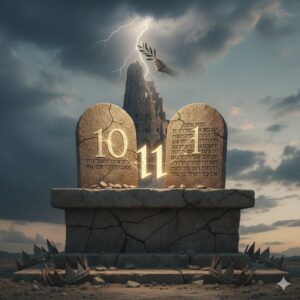
10 universally symbolizes completeness of order, divine law, and human responsibility. We see this in the Ten Commandments (Exodus 20:1-17), the completion of a tithe (a tenth), and the ten plagues that brought a complete judgment on Egypt.
-
12 symbolizes divine governmental perfection and completeness. This is evident in the 12 tribes of Israel, the 12 apostles of Jesus, the 12 gates and foundations of the New Jerusalem (Revelation 21).
Given this framework, the number 11 emerges as the number that falls short of 12 and goes beyond 10. It represents:
-
Disorder, imperfection, and incompleteness.
-
Transition, anticipation, and the brink of a new beginning.
-
Judgment and the consequences of rebellion.
-
In certain prophetic contexts, it can signify a divine revelation or calling.
The Number 11 in the Old Testament
The Old Testament provides the foundational appearances of the number 11, establishing its core symbolic meanings.
The Sons of Jacob and the Missing Tribe
One of the most direct examples is found in the history of Israel’s patriarchs. Jacob (Israel) had 12 sons, who became the fathers of the 12 tribes of Israel. This represented the perfect, God-ordained structure for His chosen people.
However, after the reign of King Solomon, the kingdom was divided. The northern kingdom (Israel) consisted of 10 tribes, and the southern kingdom (Judah) consisted of 2 tribes (Judah and Benjamin). This political split created a state of incompleteness and disorder from the original divine ideal.
Later, during the exile and return, the 12-tribe structure was never fully restored in the same political sense. The number 11, in this historical lens, symbolizes the fractured state of God’s people, a nation in a transitional and imperfect condition, awaiting a future restoration.
Joseph’s Dreams and the Eleven Stars
In Genesis 37:9, the young Joseph has a second dream, which he recounts to his family:
“Behold, I have dreamed another dream. Behold, the sun, the moon, and eleven stars were bowing down to me.”
Here, the eleven stars clearly represent his eleven brothers. The sun and moon represent his father and mother. This dream prophesied Joseph’s future leadership over his family. Symbolically, the number 11 (the brothers) is in a state of submission to the 12th (Joseph). It marks a period of tension, jealousy, and transition that would lead to Joseph’s descent into Egypt and, ultimately, the preservation of the entire family. The story begins with 11 brothers opposing the 12th, a picture of disorder that God sovereignly uses to bring about salvation and order.
Kings and Reigns Marked by Disorder
Several kings in the Bible ruled for periods connected to 11, often during times of instability.
-
Zedekiah, the last king of Judah before the Babylonian captivity, is noted as reigning for 11 years (2 Kings 24:18). His reign ended in catastrophic judgment, the destruction of Jerusalem, and the exile—the ultimate consequence of national imperfection and rebellion against God.
-
Jehoiakim, another king of Judah, also reigned for 11 years (2 Kings 23:36). His reign was characterized by evil and submission to foreign powers, setting the stage for the coming judgment.
These reigns underscore the association of 11 with periods of impending divine judgment resulting from moral and covenantal failure.
The Number 11 in the New Testament
The New Testament continues and deepens the symbolism of 11, particularly in the aftermath of Christ’s ministry.
The Eleven Apostles: Transition and Imperfection
Following the betrayal and suicide of Judas Iscariot, the group of twelve apostles was reduced to eleven (Matthew 28:16; Mark 16:14; Luke 24:9; Acts 1:26). This was a period of profound incompleteness, confusion, and transition for the disciples. They were in a state between the old reality of Jesus’ physical presence and the new reality of the coming Holy Spirit.
The eleven apostles represent the church in its embryonic, imperfect state, awaiting the empowerment and completion that would come at Pentecost. It wasn’t until Matthias was chosen by lot to replace Judas (Acts 1:26) that the group was restored to 12—signaling the restored foundation for the new, Spirit-empowered people of God.
The Eleventh Hour Parable
In Matthew 20:1-16, Jesus tells the Parable of the Workers in the Vineyard. The landowner goes out to hire workers at different times of the day: early morning, the third, sixth, and ninth hours. Finally, he goes out at the eleventh hour—one hour before the end of the workday—and hires more workers, paying them the same full wage as those who worked all day.
Here, the eleventh hour is rich with symbolism:
-
It represents the last possible moment, a time of urgent opportunity.
-
It signifies God’s abundant and unexpected grace, which is not limited by human timing or merit.
-
It speaks to the inclusion of the Gentiles and all who come to faith “late” in the grand narrative of salvation history.
This positive use shows 11 as a number of gracious transition and the brink of a joyful conclusion.
Symbolic Meanings and Theological Insights
Based on its scriptural appearances, we can summarize the core symbolic meanings of the number 11.
1. Imperfection and Disorder
As the number that falls short of the perfection of 12, 11 consistently points to systems, people, or times that are incomplete, unbalanced, or in a state of dysfunction. It is a symbol of something missing, a flaw in the divine pattern.
2. Transition and Anticipation
Eleven occupies the space between the completeness of order (10) and the completeness of divine government (12). It is therefore a powerful number of transition, waiting, and anticipation. It is the moment just before a new beginning, a critical pivot point.
3. Judgment and Consequences
Often, the disorder symbolized by 11 leads to or exists within a context of divine judgment. The 11-year reigns of wicked kings are a clear example. It represents the earthly consequence of turning away from God’s perfect order.
4. Revelation and Urgent Grace
In contexts like Joseph’s dream and the eleventh-hour workers, 11 precedes a major revelation or an act of profound grace. It can mark the critical moment when God intervenes or reveals His plan, often in unexpected ways.
Comparative Table: Biblical Meaning of Key Numbers
| Number | Primary Symbolism | Key Biblical Examples | Relationship to 11 |
|---|---|---|---|
| 10 | Completeness of order, law, human responsibility | Ten Commandments, Ten Plagues | 11 goes beyond this order, often into disorder. |
| 11 | Imperfection, transition, judgment, urgent grace | Eleven stars, Eleventh-hour workers, Eleven apostles | The core subject – a number of tension and change. |
| 12 | Divine governmental perfection, completeness | 12 Tribes, 12 Apostles, New Jerusalem | 11 falls short of this perfection and points toward it. |
| 7 | Spiritual completeness, perfection, rest | Seven days of creation, Seven churches | 11 lacks the wholeness and rest symbolized by 7. |
| 40 | Testing, trial, probation, preparation | 40 days in the wilderness, 40 days of flood | Both are transitional, but 40 is a period of process, while 11 is a critical juncture. |
Practical Applications for Today
Understanding the biblical meaning of 11 isn’t just an academic exercise; it offers valuable insights for our faith and lives.
-
Recognizing Seasons of Transition: You may be in an “11” season—a time that feels incomplete, confusing, or between what was and what will be. This biblical symbol reminds us that such times are part of God’s narrative. The eleven apostles’ period of confusion gave way to Pentecost. Our transitional seasons can precede powerful new beginnings.
-
Heeding Warnings of Disorder: The association with judgment calls for self-examination. Are there areas of life—personal, relational, or spiritual—that are in a state of “11” (disorder, rebellion, imbalance)? This number urges us to seek God’s restoration and alignment with His perfect will (12).
-
Embracing the Eleventh-Hour Grace: Never believe it is too late to respond to God’s call or receive His mercy. The parable of the eleventh-hour workers is a eternal testament to God’s generous, un-earnable grace. His timing and generosity defy human logic.
-
Anticipating God’s Revelation: Joseph’s dream with eleven stars was a revelation that caused immediate strife but ultimately led to salvation. Sometimes, God’s revelations and callings come into our “11” moments of tension, pointing us toward a future we cannot yet see fully.
Important Note for Readers
A crucial reminder: While biblical numerology reveals fascinating patterns and divine emphasis, our faith must rest firmly on the clear, taught doctrines of Scripture—the person and work of Jesus Christ, salvation by grace through faith, and the authority of God’s Word. Numerology should illuminate the text, not overshadow it. Always interpret numbers through the lens of clear biblical teaching and context.
Frequently Asked Questions (FAQ)
Q: Is the number 11 considered “unlucky” in the Bible?
A: The Bible does not assign “luck” to numbers. While 11 is often associated with disorder, imperfection, and judgment, these are theological and symbolic concepts, not superstitions. God is sovereign over all seasons, including those symbolized by 11.
Q: What does it mean if I keep seeing the number 11 (e.g., on clocks, receipts)?
A: The Bible does not teach that God communicates through random, personalized number sequences in this way. This is a modern concept often tied to “angel numbers,” which is not a biblical practice. If a biblical number comes to mind, use it as a prompt to study its actual scriptural meaning and pray for wisdom, rather than seeking a secret message.
Q: Are there any positive meanings of 11 in the Bible?
A: Absolutely. The most prominent positive meaning is found in the “eleventh hour” parable, which symbolizes the boundless, surprising grace of God that arrives at the last moment. Additionally, the eleven stars in Joseph’s dream preceded his exaltation and the saving of his family, indicating a revelation that leads to a positive outcome.
Q: How does the number 11 relate to end-times prophecy?
A: Some students of prophecy note that certain visions in Daniel and Revelation involve sequences of kings or events where the number 11 appears, sometimes symboling a rebellious or imperfect kingdom (e.g., Daniel 7’s “little horn” arising after ten others). However, such interpretations are complex and debated. The core meanings of transition and imperfection remain the key.
Q: Should I look for the number 11 when I read the Bible?
A: Read for understanding and devotion first. When you notice a number repeated (like the 11 years of a king’s reign or the eleven apostles), let it prompt you to ask: “Why is this detail included? What is the spiritual or historical context?” This leads to richer study, rather than treating it as a code to crack.
Conclusion
The biblical meaning of 11 unfolds as a compelling study in divine symbolism. It stands in the tension between order and perfection, often marking periods of human failing, divine transition, and urgent grace. From the eleven stars of Joseph’s dream to the eleven apostles awaiting Pentecost, this number guides us to recognize our own seasons of incompleteness, to heed calls to alignment, and to always welcome the astounding grace that can arrive at the very last moment. In the grand narrative of Scripture, the number 11 reminds us that even in disorder, God is sovereignly working to bring about His perfect purposes.
Additional Resource
For a deeper dive into biblical numerology and the significance of other numbers, we recommend the scholarly resource: The Bible and Numerology: A Study of Biblical Numbers and Their Significance from Bible Study Tools. This link provides a solid, scripture-based foundation for further study.