For many, “The Twelve Days of Christmas” is a catchy, cumulative carol about a series of extravagant gifts. It’s a staple of holiday playlists and festive cheer. But beneath the surface of partridges in pear trees and leaping lords lies a rich tapestry of history, faith, and symbolism. The “12 Days of Christmas” biblical meaning isn’t spelled out in the lyrics themselves but is deeply woven into the fabric of the season it celebrates.
This article will serve as your definitive guide. We’ll journey beyond the tune to explore the true liturgical season of the Twelve Days, delve into the popular theory that the carol was a hidden catechism, separate fact from folklore, and uncover the enduring spiritual significance this period holds for Christians worldwide.
What Are the Actual 12 Days of Christmas?
Before we decode any hidden messages, it’s crucial to understand the foundational reality. The 12 Days of Christmas is not a countdown to Christmas Day; it is a celebration that begins after it.
-
Start: Christmas Day, December 25th (the Feast of the Nativity).
-
End: January 5th (Twelfth Night), the eve of the Feast of the Epiphany.
-
Climax: The Feast of the Epiphany, January 6th, which celebrates the manifestation of Christ to the Gentiles, symbolized by the visit of the Magi.
This period forms a sacred season in the Christian liturgical calendar (observed by Catholic, Anglican, Lutheran, and other traditions), known as Christmastide. It is a time of continued celebration, reflection on the Incarnation, and anticipation of the Epiphany.
“The Twelve Days mark a festive bridge between two profound feasts: the celebration of God entering our world as a child, and the revelation of that child as a light for all nations.”
A Liturgical Calendar Overview
The table below clarifies the timeline and key celebrations during Christmastide.
| Day | Date | Traditional Feast Day | Significance |
|---|---|---|---|
| 1st | Dec 25 | Christmas Day | The Nativity of Jesus Christ. |
| 2nd | Dec 26 | Feast of St. Stephen | The first Christian martyr, reminding us of the cost of discipleship. |
| 3rd | Dec 27 | Feast of St. John the Evangelist | Apostle of love, author of the Gospel of John. |
| 4th | Dec 28 | Feast of the Holy Innocents | Commemoration of the children killed by King Herod. |
| 5th | Dec 29 | Feast of St. Thomas Becket | Martyr for the liberty of the Church. |
| 6th | Dec 30 | (Varies) | Often a day for reflection on the Holy Family. |
| 7th | Dec 31 | Feast of the Holy Family / New Year’s Eve | Celebration of Jesus, Mary, and Joseph as a family unit. |
| 8th | Jan 1 | Solemnity of Mary, Mother of God | Honoring Mary’s role in salvation history. |
| 9th | Jan 2 | (Varies) | Feasts of early saints like St. Basil the Great & St. Gregory. |
| 10th | Jan 3 | (Varies) | The Most Holy Name of Jesus is often celebrated. |
| 11th | Jan 4 | (Varies) | A final day of preparation for Epiphany. |
| 12th | Jan 5 | Twelfth Night | A traditional night of feasting and celebration before Epiphany. |
| – | Jan 6 | The Epiphany of the Lord | The visit of the Magi, Christ revealed to the world. |
Note for Readers: The specific saints celebrated on some days can vary between different Christian traditions and calendars. The core structure—from Christmas to Epiphany—remains constant.
The “Hidden Catechism” Theory: Symbolism in the Carol
Now, let’s turn to the famous carol. A popular and enduring theory suggests that “The Twelve Days of Christmas” originated in England between 1558 and 1829 as a “catechism song” or a secret catechism. During this period, when Catholicism was suppressed, the carol is said to have been used to teach children the tenets of their faith covertly. Each gift symbolically represents a point of doctrine.
It is essential to approach this theory with a critical mind. There is no concrete historical evidence from the 16th or 17th centuries to prove this was the carol’s original purpose. The theory appears to have emerged in the 20th century. However, whether by design or later interpretation, the symbolic connections are fascinating and have become a meaningful way for many to reflect on the carol.
Breakdown of the Symbolic Gifts
The following list interprets the gifts according to the hidden catechism theory. Think of it not as confirmed history, but as a spiritual allegory that many find enriching.
-
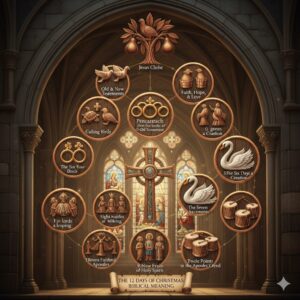
A Partridge in a Pear Tree: Jesus Christ. A partridge is known to feign injury to draw predators away from its nest, symbolizing Christ’s sacrifice on the cross to draw sin away from humanity. The pear tree is seen as representing the cross.
-
Two Turtle Doves: The Old and New Testaments, offering the complete story of salvation and God’s relationship with His people.
-
Three French Hens: The three theological virtues: Faith, Hope, and Love (Charity) (1 Corinthians 13:13).
-
Four Calling Birds: The four Gospels: Matthew, Mark, Luke, and John, which proclaim the good news of Jesus Christ.
-
Five Gold Rings: The first five books of the Old Testament, known as the Torah or Pentateuch (Genesis, Exodus, Leviticus, Numbers, Deuteronomy), which provide the foundation for God’s law and promises.
-
Six Geese A-Laying: The six days of creation (Genesis 1), emphasizing God as the creator of all life.
-
Seven Swans A-Swimming: The seven gifts of the Holy Spirit: wisdom, understanding, counsel, fortitude, knowledge, piety, and fear of the Lord (Isaiah 11:2-3).
-
Eight Maids A-Milking: The eight Beatitudes taught by Jesus in the Sermon on the Mount (Matthew 5:3-10).
-
Nine Ladies Dancing: The nine fruits of the Holy Spirit: love, joy, peace, patience, kindness, goodness, faithfulness, gentleness, and self-control (Galatians 5:22-23).
-
Ten Lords A-Leaping: The Ten Commandments, the fundamental moral law given by God (Exodus 20:1-17).
-
Eleven Pipers Piping: The eleven faithful apostles (excluding Judas Iscariot).
-
Twelve Drummers Drumming: The twelve points of belief in the Apostles’ Creed, a summary of early Christian doctrine.
Important Note: While this symbolic interpretation is beautiful and spiritually insightful, historians and musicologists generally agree it is a retrospective application of meaning, not the carol’s provable origin. The first known printed version appeared in England in 1780 in a children’s book, Mirth Without Mischief, with no mention of religious symbolism.
Separating Historical Fact from Spiritual Folklore
To provide a balanced view, let’s compare the key claims.
| Aspect | The “Hidden Catechism” Theory | The Scholarly & Historical Consensus |
|---|---|---|
| Origin Era | English Reformation (16th-18th Cent.) | First published in the late 18th century as a secular memory-and-forfeit game. |
| Purpose | Covert religious instruction for persecuted Catholics. | A festive “cumulative song” for merrymaking, often sung as a memory challenge where a player had to forfeit if they made a mistake. |
| Evidence | Lacks contemporary documentary proof; appears in 20th-century writings. | Supported by printed sources from the 1780s and folk song histories. |
| Value | Provides a rich, allegorical framework for personal meditation and connecting the carol to faith. It has become a meaningful tradition in itself. | Helps us understand the carol’s true place in cultural and social history as a popular folk song. |
| Biblical Link | Indirect. The link is not in the carol’s creation but in the symbolic interpretation of its imagery through a biblical lens. | Direct. The carol’s title and timing are intrinsically linked to the liturgical season of Christmastide, which is biblically and doctrinally significant. |
The most authentic biblical meaning of the 12 Days of Christmas, therefore, is not found in a secret code within the carol, but in the official liturgical season it is named after. This season is a deep, scripturally-rooted celebration.
The Profound Biblical Significance of Christmastide
The true spiritual weight of the Twelve Days lies in the collective celebration of the mysteries of the Incarnation and Theophany (divine manifestation). Each feast day within this octave directs our attention to a different facet of the Christmas story’s implications.
-
The Continuity of Salvation History: Christmastide doesn’t isolate Jesus’ birth. By celebrating St. Stephen (martyrdom) and the Holy Innocents (suffering) so close to Christmas, it immediately reminds us that the joy of the Nativity exists within a fallen world. The wood of the manger foreshadows the wood of the cross.
-
The Identity of Christ: The feasts of St. John (the divine Word) and the Holy Name of Jesus focus on who Jesus is: fully God and fully man. This period is a deep dive into the doctrine of the Incarnation.
-
The Family and the Church: The Feast of the Holy Family presents a model for human relationships. The following days also reflect on the broader Christian family—the Church—born through Christ’s coming.
-
A Light to the Nations (Epiphany): The entire season builds toward January 6th. The Magi represent all peoples of the earth. Their arrival signifies that the salvation wrought by the Jewish Messiah is intended for the entire world. This fulfills numerous Old Testament prophecies, such as Isaiah 60:3: “Nations shall come to your light, and kings to the brightness of your dawn.”
“The journey of the Magi is the perfect capstone to the Twelve Days. It moves the narrative from a private joy in Bethlehem to a universal proclamation: this child is the Savior for everyone, everywhere.”
How to Observe the 12 Days in a Meaningful Way
Moving beyond the commercial “Christmas is over on December 26th” mindset can bring great spiritual richness. Here are some practical ideas:
-
Extend Your Celebrating: Space out gift-giving (e.g., small gifts on different days), keep your decorations up until January 6th, and plan festive social gatherings after Christmas Day.
-
Daily Scripture Reading: Follow the liturgical readings for each day of Christmastide, which guide you through the relevant biblical passages.
-
Reflect on the Feasts: Learn about the saint or feast celebrated each day. What aspect of the Christmas story does it highlight?
-
Celebrate Twelfth Night & Epiphany: Have a special meal on January 5th. On Epiphany, bless your home with chalk (writing the traditional inscription, e.g., 20+C+M+B+24, for the year and the traditional names of the Magi), and share King’s Cake.
Conclusion
The “12 Days of Christmas” carol is a delightful cultural artifact, whose speculated hidden symbolism offers a creative lens for faith. However, the deeper, historically anchored biblical meaning of the 12 Days of Christmas is found in the sacred season of Christmastide itself—a profound twelve-day journey from celebrating the birth of Jesus, the Word made flesh, to rejoicing in the revelation of that Savior to all the world. It invites us to linger in the mystery of Emmanuel, “God with us.”
Frequently Asked Questions (FAQ)
Q: Is the “12 Days of Christmas” song secretly a Catholic code?
A: While a popular and meaningful modern tradition, there is no verifiable historical evidence that the song was originally created as a secret catechism. Scholars trace it to secular English folk song traditions. The symbolic associations are a later, devotional interpretation.
Q: When do the 12 Days of Christmas start and end?
A: They start on Christmas Day, December 25, and end on Twelfth Night, January 5. The season concludes with the Feast of the Epiphany on January 6.
Q: What is the most important biblical significance of this period?
A: It liturgically connects two core Christian mysteries: the Incarnation (God becoming human at Christmas) and the Epiphany (God-in-Christ being revealed as a light for all nations). It celebrates the world-altering reality of “God with us.”
Q: Should I take my Christmas tree down on December 26th?
A: Traditionally, no! The Christmas season is just beginning. Keeping your decorations up until the Epiphany (January 6) is a wonderful way to honor the full liturgical season. Twelfth Night (Jan 5) is the traditional time for taking them down.
Additional Resources
For those wishing to explore the liturgy and theology of Christmastide further, an excellent resource is the “The Liturgical Year” section of the Catholic Encyclopedia on New Advent, which provides detailed historical and theological context for this and all Christian seasons: [New Advent – Liturgical Year](http://www.newadvent.org/cathen/