Have you ever noticed how often the number ten appears in the Bible? It’s not a coincidence. From the foundational Ten Commandments to the prophecies in Revelation, the number 10 holds a deep, symbolic weight that threads through Scripture, revealing patterns of God’s character and humanity’s journey. In the Bible, numbers often carry meaning beyond simple counting; they are a part of God’s language of symbolism.
This article will serve as your trusted guide to understanding the rich, biblical meaning of the number 10. We will explore its themes of divine perfection in government, complete human responsibility, and the totality of testimony. Our journey will take us from Genesis to Revelation, uncovering the consistent message this number brings to our faith.
Understanding Biblical Numerology: A Foundation
Before we dive into the specifics of the number 10, let’s establish a clear understanding of biblical numerology. This is not about finding secret codes or predicting the future, as in modern numerology. Instead, biblical numerology is the study of the symbolic and thematic significance of numbers used in Scripture.
-
It’s About Symbolism, Not Math: The writers of the Bible, inspired by the Holy Spirit, used numbers to reinforce spiritual truths, highlight patterns, and structure narratives in a meaningful way.
-
Context is King: The meaning of a number is always derived from its context—how it is used in a story, law, or prophecy.
-
A Tool for Understanding: Recognizing numerical patterns can deepen our appreciation for the Bible’s intricate design and divine authorship.
With this in mind, let’s explore what the number 10 consistently represents.
The Core Symbolism of the Number 10 in Scripture
Throughout the biblical narrative, the number 10 emerges with two primary, interconnected meanings:
-
Divine Order and Human Responsibility: Ten represents the completeness of divine law, order, and government. It signifies a system that is whole and sufficient. This is most perfectly seen in the Ten Commandments—God’s complete moral law for humanity. As such, the number 10 also points to human responsibility under that divine order. It marks a point where humanity is tested or held accountable before God.
-
Totality and Completeness: As a combination of the numbers 3 (divine perfection) and 7 (spiritual perfection), ten (3+7) can symbolize a completeness of divine order being established on earth. It often indicates a full cycle or a complete set.
The following table summarizes the key symbolic meanings and their biblical foundations:
| Symbolic Meaning | Description | Key Biblical Example |
|---|---|---|
| Divine Law & Order | Represents the perfection and sufficiency of God’s established system of government and morality. | The Ten Commandments (Exodus 20). |
| Human Responsibility | Signifies a test, a tithe, or a point where mankind’s obedience and accountability to God’s order are measured. | The testing of the Israelites with the ten plagues or the ten spies. |
| Completeness of Testimony | Indicates a full, complete witness or record. | The Ten Commandments written on two tablets (a complete legal witness). |
| Earthly Governance | Can represent worldly kingdoms or systems in opposition to God, often in a complete but temporary form. | The ten horns/toes in Daniel and Revelation, symbolizing complete but fragile earthly power. |
The Number 10 in Action: Key Stories and Themes
Let’s trace the appearance of the number 10 through the Bible to see its symbolic meaning come to life.
The Ten Commandments: The Foundation of Divine Order
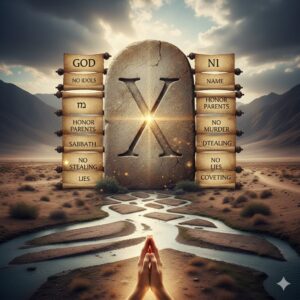
The most iconic use of the number 10 is, without doubt, the Decalogue—the Ten Commandments. They were written by “the finger of God” on two tablets of stone (Exodus 31:18).
-
Complete Moral Code: They are not a partial list but a complete summary of God’s moral law, governing humanity’s relationship with God (Commandments 1-4) and with each other (Commandments 5-10).
-
Structure of Ten: Their division into ten statements is intentional, signifying a perfect, whole, and sufficient legal covenant from God to His people. This establishes the number 10 as the number of divine law and covenantal responsibility.
“And he wrote on the tablets the words of the covenant—the Ten Commandments.” – Exodus 34:28b (NIV)
The Ten Plagues of Egypt: Judgment and Complete Testimony
God executed ten plagues upon Egypt to compel Pharaoh to release the Israelites. The use of ten plagues was a complete and overwhelming demonstration.
-
A Complete Judgment: The plagues systematically judged the gods of Egypt and demonstrated Yahweh’s supreme power over all creation—the Nile, animals, weather, health, and light.
-
A Full Cycle of Divine Testimony: Ten plagues represented a complete cycle of testimony against Egypt’s sin and oppression. It left no room for doubt about God’s authority and justice.
The Testing of Faith: Patriarchs and the Tithe
The number 10 frequently appears in stories of testing and human response to God.
-
Abraham’s Final Test: God tested Abraham with the command to sacrifice his son, Isaac. While not explicitly numbered, Jewish tradition and many scholars note that this was Abraham’s tenth and final test, completing a cycle of trials that proved his faith.
-
The Origin of the Tithe: After a military victory, Abraham gave a tenth (a tithe) of all the spoils to Melchizedek, the priest of God Most High (Genesis 14:20). This act established the principle of the tithe (10%) as an acknowledgment of God’s ultimate ownership and provision. The tithe symbolizes the human responsibility to respond to God’s order with gratitude and obedience.
The Twelve Spies and the Ten of Unbelief
When Moses sent spies to explore Canaan, they returned with a report after forty days. The group consisted of twelve spies, but their response was defined by the number ten.
-
Ten Spies: Brought back a fearful report focused on the giants and their own weakness, saying, “We can’t attack those people; they are stronger than we are” (Numbers 13:31).
-
Two Spies (Joshua and Caleb): Brought back a report of faith focused on God’s promise, saying, “We should go up and take possession of the land, for we can certainly do it” (Numbers 13:30).
-
The Meaning: The ten spies represented the complete failure of human reasoning and faithless responsibility. Their unanimous doubt led to forty years of wandering for the whole nation.
Parables of Jesus: Responsibility and Stewardship
Jesus used the number 10 in His parables to illustrate accountability before God.
-
The Ten Virgins (Matthew 25:1-13): Ten bridesmaids await the bridegroom; five are wise (prepared) and five are foolish (unprepared). The ten represent the complete community of those professing to wait for Christ. The parable is a warning to be spiritually prepared for accountability at His return.
-
The Ten Minas (Luke 19:11-27): A nobleman gives ten of his servants one mina each, instructing them to “put this money to work” until he returns. Upon his return, he holds them accountable for their stewardship. The ten servants represent the complete set of those entrusted with God’s resources. The parable teaches faithful responsibility with what God has given us.
Prophetic Visions: The Number 10 in Daniel and Revelation
In prophetic literature, the number 10 takes on a specific symbolism related to worldly kingdoms and the culmination of human government.
The Visions of Daniel
The prophet Daniel saw visions of successive empires, often using imagery of mixed materials or beasts.
-
The Statue with Feet of Iron and Clay (Daniel 2): King Nebuchadnezzar dreamed of a great statue. Its ten toes, partly of iron and partly of baked clay, symbolize a final, fragmented kingdom (or coalition of kingdoms) at the end of human history, which will be destroyed by God’s eternal kingdom.
-
The Fourth Beast with Ten Horns (Daniel 7): Daniel sees a terrifying fourth beast with ten horns, representing a powerful end-times empire. From among the ten horns, a “little horn” arises, speaking boastfully and waging war against God’s people. The ten horns symbolize the completeness of this empire’s political power.
The Apocalypse of John
The Book of Revelation builds upon Daniel’s imagery, using the number 10 to depict the full scope of opposition to God.
-
The Beast with Ten Horns (Revelation 13:1): John sees a beast rising from the sea with ten horns and seven heads. This beast represents a satanic, worldly power. The ten horns are explicitly said to be “ten kings” who receive authority for “one hour” alongside the beast (Revelation 17:12-13).
-
The Symbolism: Here, the number 10 represents the totality of earthly kingdoms and political power in a final, unified rebellion against God and His Christ. It is a complete but temporary system, destined for destruction at Christ’s return.
Important Note for Readers: The interpretation of prophetic numbers, especially in Daniel and Revelation, varies among Christian traditions. The key takeaway is not to fixate on identifying specific modern nations, but to understand the symbolic message: that human political systems, in their complete array, will ultimately be judged and replaced by the perfect and everlasting kingdom of God.
The Number 10 in Everyday Biblical Life and Ritual
Beyond grand narratives and prophecies, the number 10 was woven into the fabric of Israel’s worship and law, emphasizing completeness and responsibility.
-
The Ten-stringed Harp: The psalmist calls to praise God “with the ten-stringed harp” (Psalm 33:2, 92:3). This may symbolize the fullness of musical praise offered to God.
-
The Tabernacle and Temple: While not exclusively based on ten, measurements and elements (like the ten lavers in Solomon’s Temple, 1 Kings 7:38-39) often incorporated this number, reflecting the perfection and order of God’s dwelling place.
-
The Ten Generations: Biblical genealogies are sometimes structured in groups of ten (e.g., ten generations from Adam to Noah, and from Noah to Abraham), marking complete epochs in God’s redemptive plan.
Practical Applications for Today
Understanding the biblical meaning of the number 10 is more than an intellectual exercise. It offers us timeless spiritual insights:
-
Recognizing God’s Complete Authority: The Ten Commandments remind us that God’s moral law is whole, good, and relevant. It calls us to a life of holistic obedience, not selective compliance.
-
Embracing Our Stewardship: From the tithe to the parables of the minas, the number 10 underscores that all we have is a trust from God. We are called to be faithful, responsible managers of our time, talents, and resources.
-
Cultivating a Faithful Response: In the face of challenges (like the ten spies), we are called to be like Joshua and Caleb—to base our confidence on God’s promise, not our perception of the obstacle.
-
Living with Prophetic Hope: The prophetic use of ten assures us that no matter how powerful or complete worldly systems appear, their authority is temporary and subject to Christ. We live in hope of His everlasting kingdom.
A Helpful List: Key Themes of the Number 10
To remember, the number 10 in the Bible often points to:
Completeness of God’s law and order.
Human responsibility and accountability.
A full cycle of testing or testimony.
The totality of earthly power (in prophecy).
The foundation of divine governance in human affairs.
Conclusion
The biblical meaning of the number 10 is a profound thread of divine order and human accountability woven throughout Scripture. From the bedrock of the Ten Commandments to the prophetic visions of worldly kingdoms, it signifies God’s complete system, our responsibility within it, and the surety of His ultimate judgment and reign. By recognizing this pattern, we gain a deeper appreciation for the Bible’s coherence and a clearer call to live faithfully under God’s perfect authority.
Frequently Asked Questions (FAQ)
Q: Is the number 10 always a positive symbol in the Bible?
A: Not always. While it fundamentally represents completeness (which is positive in God’s context), its moral value depends on what is complete. Ten commandments are positive (God’s perfect law). Ten faithless spies are negative (complete failure). Ten horns on a beast are negative (complete worldly rebellion).
Q: Should Christians tithe exactly 10% because of this symbolism?
A: The tithe (10%) was established in the Old Testament law as a standard. The New Testament emphasizes cheerful, generous giving from the heart, which may start at 10% but is not limited by it (2 Corinthians 9:7). The principle of the tithe acknowledges God’s ownership, but Christian giving is guided by grace, not legal obligation.
Q: How does the number 10 relate to the number 7 in the Bible?
A: Seven is the number of spiritual perfection and completion (e.g., creation week). Ten is the number of ordinal perfection or divine order being established, often involving human responsibility. They are complementary: 7 focuses on God’s perfect work; 10 focuses on the perfect system or test He institutes.
Q: Are we supposed to look for the number 10 in our daily lives for signs?
A: No. Biblical numerology is a tool for understanding the text of Scripture, not for divination or seeking hidden messages in everyday life. We are to live by faith in God’s revealed Word, not by seeking signs in numbers.
Additional Resources
For a deeper dive into biblical numbers and their symbolism, we recommend visiting Bible study websites that focus on textual analysis and historical context, such as BibleProject. Their videos and articles provide excellent, accessible overviews of biblical themes.