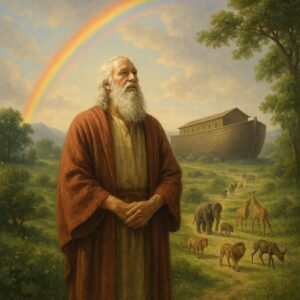
The name Noah evokes one of the most iconic images in human history: a vast ark, pairs of animals, and a world-renewing flood. Yet, the biblical meaning of Noah extends far beyond this dramatic narrative. His story is a cornerstone of faith, a complex tale of judgment and mercy, and a profound study in righteousness, obedience, and divine promise.
For believers and seekers alike, understanding Noah is to grapple with themes of grace, faithfulness, new beginnings, and the solemn covenants that shape the relationship between God and humanity. This guide will take you on a deep dive into the life, legacy, and lasting spiritual significance of this pivotal biblical figure.
Who Was Noah in the Bible? A Historical and Spiritual Profile
Before the flood, before the ark, there was a man living in a world described as deeply corrupt. The Book of Genesis introduces Noah not with a fanfare, but with a simple, powerful statement of character that sets him apart from everyone else.
The Context: A World Gone Astray
To appreciate Noah’s significance, we must understand the world he inhabited. Genesis chapter 6 paints a bleak picture:
Genesis 6:5 (ESV): “The Lord saw that the wickedness of man was great in the earth, and that every intention of the thoughts of his heart was only evil continually.”
Genesis 6:11-12 (ESV): “Now the earth was corrupt in God’s sight, and the earth was filled with violence. And God saw the earth, and behold, it was corrupt, for all flesh had corrupted their way on the earth.”
This was a society saturated with violence and moral decay. In this environment, finding faithfulness was like searching for a single flame in an abyss of darkness.
A Man of Righteousness and Blamelessness
Noah’s introduction is a direct contrast to this darkness:
Genesis 6:9 (ESV): “These are the generations of Noah. Noah was a righteous man, blameless in his generation. Noah walked with God.”
This three-fold description is the core of his biblical identity:
-
Righteous (Tsaddiq): This Hebrew term means being in right relationship—both with God and with others. It implies justice, integrity, and moral correctness. Noah’s life was aligned with God’s standards.
-
Blameless (Tamim): This doesn’t mean sinless perfection, but rather wholeness, integrity, or sincerity. It suggests a life of spiritual maturity and consistency, not spotless flawlessness. He was “complete” or “wholehearted” in his devotion.
-
Walked with God: This is the most intimate description. It denotes a life of daily communion, obedience, and fellowship. It echoes the relationship Enoch had before him (Genesis 5:24) and sets the template for a life of faith.
Important Note: Noah’s righteousness was “in his generation.” This phrase has been debated: some see it as despite his corrupt era, highlighting his exceptional faith, while others read it as within the context of his time, meaning he was the best of a bad lot. Either interpretation underscores that he was uniquely faithful when faithfulness was rare.
The Meaning and Symbolism of the Name “Noah”
Names in the Bible often carry prophetic or descriptive weight. The name Noah (Hebrew: Noach – נֹחַ) is deeply connected to his life’s purpose.
The root of the name is associated with “rest” (nuach – נוח). His father, Lamech, prophetically named him with a hopeful declaration:
Genesis 5:28-29 (ESV): “When Lamech had lived 182 years, he fathered a son and called his name Noah, saying, ‘Out of the ground that the Lord has cursed, this one shall bring us relief from our work and from the painful toil of our hands.’”
Lamech looked for “comfort” or “rest” from the curse of the ground following Adam’s sin. While Noah’s work in building the ark was immense, his legacy ultimately brought rest in two ways:
-
The flood washed away the violent, corrupted world, providing a reset.
-
He became the bridge to a new covenant and a new beginning for creation, offering spiritual rest from the relentless cycle of corruption.
His name, therefore, is a symbol of hope—the promise of comfort and renewal that follows divine judgment.
The Core Narrative: Noah, the Ark, and the Great Flood
The story of the flood (Genesis 6-9) is the centerpiece of Noah’s life. It’s a narrative of precise obedience, cataclysmic judgment, and miraculous preservation.
The Divine Commission and Noah’s Obedience
God shares His heartbreaking decision to “blot out man” (Genesis 6:7) with Noah, followed by detailed instructions for the ark.
The Specifications of the Ark vs. Common Perception
| Feature | Biblical Specification (Genesis 6:14-16) | Common Misconception |
|---|---|---|
| Purpose | To save Noah’s family and preserve animal life | A boat for a global “cruise” |
| Dimensions | 300 cubits long, 50 cubits wide, 30 cubits high | A small, cartoonish boat |
| Shape | Not described as a traditional ship; more like a massive, rectangular barge or chest (the word tevah is also used for baby Moses’ basket) | A pointed, seaworthy vessel with a sail |
| Material | Gopher wood, coated inside and out with pitch | Generic, untreated wood |
| Details | Three decks, one door, a window (or opening) finished to a cubit above | Multiple doors, portholes, a steering mechanism |
Noah’s response is immediate and unwavering: “Noah did this; he did all that God commanded him” (Genesis 6:22). This simple sentence, repeated in essence in Genesis 7:5, is the key to his character. For likely 75-100 years, he labored on a project that made no sense in a world that had never seen rain (Genesis 2:5-6), facing certain ridicule. His obedience was patient, persistent, and complete.
The Flood as Judgment and Salvation
The flood is a dual-purpose event. It is the instrument of God’s righteous judgment on irredeemable corruption. Yet, simultaneously, the ark is the instrument of God’s gracious salvation for the faithful. This dichotomy is central to biblical theology: God is both just and the justifier of those who have faith (Romans 3:26).
Hebrews 11:7 (ESV): “By faith Noah, being warned by God concerning events as yet unseen, in reverent fear constructed an ark for the saving of his household. By this he condemned the world and became an heir of the righteousness that comes by faith.”
This New Testament commentary reframes Noah’s obedience as an act of faith. His righteousness was expressed through his trusting action.
Life on the Ark and the New Beginning
For over a year, Noah, his wife, his three sons (Shem, Ham, and Japheth), and their wives lived in the closed ark, caring for the animals and waiting on God. The narrative emphasizes God’s role as the one who “shut him in” (Genesis 7:16) and the one who “remembered Noah” (Genesis 8:1). Salvation, from first to last, is initiated and sustained by God.
The climax is the landing on the mountains of Ararat, the sending of the birds, and the eventual disembarkation onto a cleansed, new world. Noah’s first act is worship—he builds an altar and offers sacrifices (Genesis 8:20). This act of gratitude and dedication pleases God and sets the stage for the covenant.
The Noahic Covenant: A Promise for All Creation
After the flood, God establishes the first universal covenant in the Bible. Unlike later covenants with specific people groups, this one is with Noah, his descendants, and every living creature (Genesis 9:9-10).
The Terms and Sign of the Covenant
God’s Promise:
-
He would never again curse the ground because of man.
-
He would never again destroy all life by a flood.
-
The natural order of seasons, day and night, would remain steadfast.
The Sign: The Rainbow
Genesis 9:12-13 (ESV): “And God said, ‘This is the sign of the covenant that I make between me and you and every living creature that is with you, for all future generations: I have set my bow in the cloud, and it shall be a sign of the covenant between me and the earth.’”
The rainbow is not a symbol of human diversity or pride, but of divine remembrance and faithfulness. It is a “war bow” hung in the sky, a powerful symbol of peace and restraint. It serves as a permanent, visible reminder to both God and humanity of this everlasting promise.
Important Note: The covenant is unconditional. It is not based on human behavior (“I establish my covenant with you…”) but on God’s own gracious character. It is the foundation upon which all human life continues.
The Complexity of Noah’s Legacy: A Post-Flail Fall
Noah’s story does not end with the covenant. Genesis 9:18-29 records a troubling incident where Noah, now a farmer, becomes drunk on his own wine and lies uncovered in his tent. His son Ham “sees the nakedness of his father” and tells his brothers, who respectfully cover Noah without looking.
This episode reveals several profound truths:
-
Noah Remained Human: Even the most righteous heroes of faith are fallen and capable of sin. The Bible presents its figures with unvarnished honesty.
-
The Curse on Canaan: Noah’s waking and his pronouncement of a curse on Ham’s son, Canaan, is one of the most difficult passages in Scripture. It has been tragically and erroneously used to justify racism and slavery. In its context, it is best understood as a prophetic judgment on the future Canaanite nations (known for their depravity) and a blessing on the lines of Shem (through whom the Messiah would come) and Japheth. The focus is on spiritual lineage, not racial hierarchy.
-
A World Still in Need of Salvation: The flood did not change human nature. Sin persisted, even in the family of the saved. This points forward to the need for a greater salvation—one that would address the heart, not just the environment.
The Theological Meaning of Noah in the Biblical Narrative
Noah’s role is not just historical; it’s deeply theological, serving as a pattern and a pointer throughout Scripture.
Noah as a Type of Christ
In Christian theology, Noah is seen as a “type” of Christ—a historical person whose life foreshadows the work of the Messiah.
Noah as a Type of Christ
| Aspect | Noah’s Role | Christ’s Fulfillment |
|---|---|---|
| Righteousness | Declared righteous in a wicked generation. | The perfectly righteous Son of God. |
| Obedience | Obeyed God’s command to build the ark. | Obeyed the Father’s will unto death. |
| Warning of Judgment | A “preacher of righteousness” (2 Peter 2:5). | Warned of final judgment. |
| Instrument of Salvation | Built the ark that saved his family. | Provides salvation through the cross. |
| New Beginning | Led creation into a renewed world. | Creates a new creation for believers. |
Just as the ark was the only means of salvation from the flood, Jesus is presented as the only means of salvation from final judgment (John 14:6; Acts 4:12). Entering the ark by faith is analogous to placing faith in Christ.
Lessons from the Life of Noah
-
Faith Requires Obedience in Unseen Things: Noah built an ark for a flood in a rainless world. True faith acts on God’s word, even when it defies conventional wisdom.
-
God’s Grace Precedes Human Righteousness: Noah “found grace in the eyes of the Lord” (Genesis 6:8) before he was called righteous. His works were a response to grace, not a means to earn it.
-
Salvation is of the Lord: From the design of the ark to shutting the door, God was the architect of salvation.
-
Covenant Faithfulness: The rainbow is an eternal reminder that God’s promises are trustworthy.
-
The Reality of Human Frailty: Even after great spiritual victories, vigilance is necessary.
Noah in the New Testament and Christian Thought
The New Testament authors consistently reference Noah to illustrate key doctrines.
-
Jesus Himself used the days of Noah as a direct parallel to the time before His second coming, emphasizing sudden judgment and the necessity of readiness (Matthew 24:37-39).
-
The Apostle Peter uses the flood narrative extensively:
-
As a type of baptism, symbolizing salvation through water (1 Peter 3:20-21).
-
As an example of God’s judgment on the ungodly and His rescue of the righteous (2 Peter 2:5, 3:5-6).
-
-
The Writer of Hebrews includes Noah in the “Hall of Faith” as the prime example of faith that condemns the world and inherits righteousness (Hebrews 11:7).
Conclusion: The Enduring Meaning of Noah
The biblical meaning of Noah is a rich tapestry woven with threads of judgment and mercy, corruption and righteousness, catastrophic end and hopeful beginning. He stands as a monument to faithful obedience in a faithless world, a recipient of grace, and the steward of a covenant that still upholds our physical world. His story humbles us with its honesty about human failure, yet lifts our eyes to a God who provides a way of salvation, preserves His promises, and ultimately points us to the true Ark of safety, Jesus Christ. In a world that often feels chaotic, Noah’s story and the sign of the rainbow whisper a timeless truth: God is faithful, and He provides rest.
Frequently Asked Questions (FAQ)
Q: Was Noah perfect or sinless?
A: No. The Bible describes him as “righteous” and “blameless” in his generation, meaning his life was marked by integrity and wholehearted devotion to God, not that he never sinned. The incident with the wine confirms his human frailty.
Q: How long did it take Noah to build the ark?
A: The Bible doesn’t explicitly state the timeframe. Genesis 6:3 mentions a 120-year period of God’s patience. Many scholars infer that this was the time given for repentance and also the time Noah spent building the ark, though this is not stated directly.
Q: Is the Noahic Covenant still in effect today?
A: Yes. God described it as an “everlasting covenant” (Genesis 9:16) with all living creatures. Every rainbow is a sign that this unconditional promise—that God will never again destroy the earth with a flood—remains fully in force.
Q: Why was the curse placed on Canaan (Ham’s son) and not directly on Ham?
A: The text doesn’t fully explain, but prophetic judgments in Genesis often address future nation groups. The curse fell on the line that would produce the Canaanite peoples, who later opposed Israel. The narrative focus is on the blessing of Shem’s line (the Semites, including Israel) and Japheth’s expansion.
Q: How is Noah a “preacher of righteousness” (2 Peter 2:5) if the Bible never records him speaking?
A: His preaching was likely both verbal and powerfully non-verbal. For decades, his very act of building a massive ark in obedience to God was a profound sermon, warning of coming judgment and calling for repentance. His life was his message.