Light is one of the most powerful and recurring symbols in the Bible. It represents God’s presence, truth, purity, guidance, and salvation. From the very first command, “Let there be light,” to the description of the New Jerusalem where “the Lord God gives them light,” this theme shines throughout scripture. It’s no surprise, then, that many beautiful and significant biblical names are directly tied to this radiant concept. Choosing a name that means light is a hopeful, powerful decision, reflecting a desire for wisdom, divine favor, and moral clarity.
This guide will illuminate the meanings, origins, and stories behind these luminous names. Whether you are seeking a name for a child, exploring for personal study, or simply fascinated by biblical language, this comprehensive resource will serve as your essential reference.
The Centrality of Light in Biblical Scripture
To fully appreciate these names, we must first understand the profound role light plays in the biblical narrative. Light is not merely a physical phenomenon; it is a core theological concept.
“The Lord is my light and my salvation— whom shall I fear?” — Psalm 27:1
This verse encapsulates the idea perfectly: light is equated with salvation and protection from fear. In the New Testament, this imagery becomes personified. Jesus Christ declares, “I am the light of the world. Whoever follows me will never walk in darkness, but will have the light of life” (John 8:12). Consequently, his followers are called to be lights themselves: “You are the light of the world” (Matthew 5:14).
The contrast between light and darkness represents the fundamental struggle between good and evil, knowledge and ignorance, divine fellowship and spiritual separation. Therefore, a name meaning “light” carries with it this rich tapestry of hope, divine connection, righteousness, and intellectual and spiritual illumination.
Categories of Luminous Names
Biblical names meaning light can be grouped into several categories, based on their linguistic origin and the specific aspect of light they represent. We will explore names from Hebrew, Aramaic, Greek, and other languages present in the biblical context.
1. Hebrew Names: The Original Lanterns
The Old Testament, originally written primarily in Hebrew, offers the deepest well of names connected to light. These names often come from roots like ‘or (light), nur (fire, light), zohar (radiance), and shachar (dawn).
Primary Hebrew Names Directly Meaning “Light”
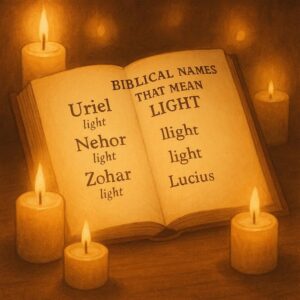
Uriel (אוּרִיאֵל)
-
Meaning: “God is my light” or “Light of God.”
-
Biblical Reference: While not a central figure in the canonical Protestant Bible, Uriel is mentioned in some deuterocanonical texts (2 Esdras) and is a prominent archangel in Jewish and Christian traditions. He is often associated with wisdom and illumination.
-
Significance: This name powerfully combines the divine with the concept of light, suggesting a person who is illuminated by or reflects God’s wisdom and truth.
Liora (לִיאוֹרָה) / Lior (לִיאוֹר)
-
Meaning: “I have a light” (Liora, feminine) or “My light” (Lior, unisex/masculine).
-
Origin: A modern Hebrew name derived from the word ‘or (light). While not found on a specific biblical character, its components are purely biblical Hebrew, making it a popular choice deeply rooted in the language of scripture.
-
Significance: It expresses a personal possession of light—hope, joy, and inner brightness.
Orah (אוֹרָה) / Or (אוֹר)
-
Meaning: “Light” (Orah, feminine; Or, masculine).
-
Origin: Directly from the Hebrew noun for light, ‘or. Like Liora, it is a modern Israeli name built on the foundational biblical word.
-
Significance: Simple, direct, and profoundly meaningful, representing purity, guidance, and goodness.
Zohar (זֹהַר)
-
Meaning: “Brilliance,” “Radiance,” “Splendor.”
-
Biblical Reference: Appears in descriptions of divine glory, such as in Ezekiel 8:2 and Daniel 12:3.
-
Significance: Implies a shining, majestic light—often the light of wisdom or divine presence. It is also the name of the foundational work of Jewish Kabbalah.
Nuriel (נוּרִיאֵל) / Nurit (נוּרִית)
-
Meaning: “Fire of God” or “Light of God” (Nuriel); “Buttercup” (a small, bright flower) or “Little fire” (Nurit).
-
Origin: From the Aramaic/Hebrew root nur (fire). Nuriel appears in Jewish angelology.
-
Significance: Conveys a fiery, passionate light—zeal, purification, and divine energy.
Hebrew Names Associated with Dawn and Morning Light
Dawn, the first light that breaks the darkness, is a potent symbol of hope, new beginnings, and redemption.
Shachar (שַׁחַר)
-
Meaning: “Dawn,” “Morning light.”
-
Biblical Reference: Used frequently in poetic books (e.g., Psalms, Isaiah). The “son of the dawn” is a poetic reference in Isaiah 14:12.
-
Significance: Represents new beginnings, the promise of a new day, and the hope that comes after darkness.
| Shachar | Related Names & Meanings |
|---|---|
| Direct Reference | “Dawn” or “Morning Light” |
| Conceptual Link | Hope, Renewal, Beginning |
| Modern Variants | Shahar (common Israeli name) |
Ayelet (אַיֶלֶת)
-
Meaning: “Morning star,” “Venus,” or “Gazelle.” In the context of Ayelet HaShachar (the morning star), it signifies the last, brightest star before dawn.
-
Biblical Reference: Appears in Proverbs and Psalms. “Ayelet HaShachar” is the title of Psalm 22.
-
Significance: Symbolizes beauty, the herald of light, and steadfastness through the night.
2. Greek and New Testament Names: The Light of the World
The New Testament, written in Greek, introduces names and translations that carry the light theme forward, often with a Christ-centered focus.
Photine (Φωτεινή) / Photios (Φώτιος)
-
Meaning: “Luminous,” “Full of light.”
-
Biblical/Historical Reference: Photine is the name traditionally given to the Samaritan woman at the well (John 4). In Eastern Orthodox tradition, she is revered as a great evangelist and martyr. Photios is a masculine form.
-
Significance: This name celebrates the transformative power of encountering divine light, as the Samaritan woman’s life was illuminated by her conversation with Jesus.
Lucas / Luke (Λουκᾶς)
-
Meaning: “From Lucania” (an Italian region), but popularly associated with the Latin lux (light) since antiquity.
-
Biblical Reference: Author of the Gospel of Luke and the Acts of the Apostles.
-
Significance: While the etymological link to “light” is not direct, the association has been strong for centuries. Saint Luke is often depicted with an ox or a painting of the Virgin, but his gospel brings the light of Christ’s story to the world.
Note on “Lucifer”: The Latin term Lucifer (light-bearer) was used in the Vulgate translation of Isaiah 14:12 to refer poetically to the fallen “morning star.” Due to this association with Satan, it is not used as a Christian given name and is included here only for historical and etymological clarity.
3. Names of Biblical Figures Associated with Light
Some names don’t mean light but belong to characters whose stories or roles are intimately connected to bringing light—truth, revelation, or salvation.
Elijah (אֵלִיָּהוּ)
-
Meaning: “My God is Yahweh.”
-
Story: The great prophet who confronted darkness (the prophets of Baal) on Mount Carmel with literal fire from heaven (1 Kings 18). He represented God’s light and power in a time of spiritual darkness.
Isaiah (יְשַׁעְיָהוּ)
-
Meaning: “Yahweh is salvation.”
-
Story: The prophet who famously proclaimed, “The people walking in darkness have seen a great light” (Isaiah 9:2), a passage seen as a prophecy of the coming Messiah.
Aaron (אַהֲרֹן)
-
Meaning: Meaning uncertain, possibly “exalted.”
-
Story: As the High Priest, he was responsible for tending the menorah in the Tabernacle—a perpetual light before the Lord (Exodus 27:20-21), symbolizing God’s eternal presence.
Comparative Table of Key Biblical Light Names
This table provides a quick-reference overview of the primary names discussed.
| Name | Origin Language | Direct Meaning | Gender | Key Association |
|---|---|---|---|---|
| Uriel | Hebrew | God is my light | Masculine | Archangel of wisdom |
| Lior/Liora | Hebrew | My light / I have light | Unisex/Feminine | Personal inner light |
| Orah/Or | Hebrew | Light | Feminine/Masculine | Pure, guiding light |
| Zohar | Hebrew | Radiance, Splendor | Unisex | Divine brilliance |
| Photine | Greek | Luminous, Full of light | Feminine | The Samaritan woman |
| Shachar | Hebrew | Dawn | Unisex | New beginnings, hope |
| Ayelet | Hebrew | Morning star | Feminine | Herald of the dawn |
Choosing a Name: Considerations and Reflections
Selecting a name, especially one with such deep significance, is a meaningful decision. Here are some helpful points to consider:
-
Cultural and Familial Context: How does the name sound with your surname? Does it honor your family’s heritage or faith tradition?
-
Pronunciation and Spelling: Consider the ease of pronunciation in your primary language. Some Hebrew names (like Zohar) are intuitive, while others may require gentle guidance.
-
The Story Behind the Name: Share the biblical story or meaning with your child as they grow. A name like Photine or Elijah comes with a powerful narrative of courage and transformation.
-
Modern Usage: Names like Lior and Or are contemporary and popular in Israel, making them accessible yet deeply rooted. Uriel has an ancient, majestic feel.
Important Note: When researching names, always refer to reputable sources such as scholarly Bible dictionaries, lexicons, or trusted cultural organizations. The meanings of ancient names can sometimes be simplified or misrepresented in popular baby name lists.
Beyond Given Names: Light in Symbolism and Language
The theme of light extends far beyond personal names. It is embedded in the rituals, poetry, and architecture of the biblical world.
-
The Menorah: The seven-branched lampstand in the Tabernacle and Temple was a symbol of God’s eternal light and the calling of Israel to be a “light to the nations” (Isaiah 42:6).
-
The Star of Bethlehem: The celestial light that guided the Magi to Jesus, symbolizing divine revelation to all peoples.
-
Transfiguration: The event where Jesus’ “face shone like the sun, and his clothes became as white as the light” (Matthew 17:2), revealing his divine glory.
-
Phrases like “The Light of Your Face”: A common Hebrew idiom denoting favor and blessing (e.g., Psalm 4:6).
Conclusion
Biblical names meaning light offer a beautiful bridge between ancient faith and modern identity. They carry within them a spark of the divine, a promise of guidance, and a hope that shines in darkness. From the direct brilliance of Or and Zohar to the storied luminosity of Photine and the hopeful dawn of Shachar, these names provide a rich palette of meaningful choices. By choosing such a name, you connect to a timeless symbol of all that is good, true, and sacred.
Frequently Asked Questions (FAQ)
Q: Are there any biblical boy names that mean light?
A: Yes. Uriel (“God is my light”), Or (“light”), Lior (“my light”), Zohar (“radiance”), and Shachar (“dawn”) are all used for boys. Nuriel (“fire/light of God”) is another strong option.
Q: Is Lucy a biblical name meaning light?
A: Lucy (and its variants Lucia, Luciana) derives from the Latin lux (light). While not the name of a specific biblical character, it is a name with strong historical Christian significance, borne by early saints like Saint Lucia of Syracuse. Its meaning is perfectly aligned with the biblical theme.
Q: What is the most direct Hebrew name for light?
A: Or (אוֹר) is the simplest, most direct Hebrew word and name for “light.” The feminine form is Orah.
Q: Does the name Michael mean light?
A: No. Michael (מִיכָאֵל) means “Who is like God?” It is a question, not a statement about light. It is the name of the great archangel, but its meaning is different.