Have you ever noticed how often certain numbers appear in the Bible? From the seven days of creation to the forty days of the flood, and the twelve tribes of Israel to the three days before the resurrection, numbers are woven into the very fabric of Scripture. They are far more than just figures used for counting. In the biblical worldview, numbers often carry deep symbolic, theological, and prophetic meaning, offering us a richer, more layered understanding of God’s message.
Understanding the biblical meaning of numbers is like finding a hidden harmony in a beautiful piece of music. It’s not about numerology, which seeks to predict the future or uncover hidden truths about individuals. Instead, biblical numerology is about recognizing the patterns and structures God has placed within His Word. These patterns point us to spiritual truths, divine completeness, and the orderly nature of God’s plan for creation and redemption.
In this guide, we will explore the significance of key numbers in the Bible. We will move beyond speculation and anchor our exploration in the text itself, seeing how these numbers are used consistently to convey specific themes. Our goal is to equip you with a framework that deepens your Bible reading, helping you see the beautiful consistency and intentional design from Genesis to Revelation.
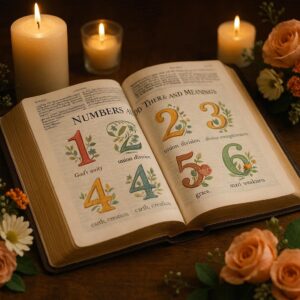
What is Biblical Numerology? (And What It Is Not)
Before we dive into specific numbers, it’s crucial to establish what we mean—and do not mean—by “biblical numerology.” This distinction is vital for a healthy and accurate interpretation of Scripture.
Biblical Numerology is: The study of the symbolic and thematic significance of numbers within the Bible. It observes how the biblical authors, under divine inspiration, used numbers to reinforce spiritual truths, highlight patterns in God’s activity, and structure their narratives for theological impact. It is a literary and theological observation.
Biblical Numerology is NOT: The practice of assigning mystical meanings to numbers in one’s personal life (like believing 7 is your “lucky” number), using numbers to predict future events, or decoding hidden messages through mathematical calculations (like gematria, which assigns numerical values to letters). The Bible expressly warns against divination, occult practices, and seeking secret knowledge outside of God’s revealed Word (Deuteronomy 18:10-12).
Key Principle: “In biblical interpretation, the symbolic meaning of a number should be derived from its consistent use in Scripture, not imposed upon it from external systems.”
The patterns we will discuss emerge from the Bible’s own usage. When we see the number 12 repeatedly associated with God’s people (tribes, apostles), we can reasonably understand it as a number of divine governance and completeness. This approach keeps our study grounded in the text and focused on what God intends to communicate.
A Foundational Note for Readers
As we explore these numbers, remember:
-
Context is King. The symbolic meaning of a number should never override the plain meaning of the text in its historical and literary context.
-
Not Every Number is Symbolic. Sometimes, a number is just a number. The Bible records David’s age when he became king (2 Samuel 5:4) as a historical fact, not necessarily a symbolic one.
-
Look for Patterns, Not Codes. We are looking for broad, thematic repetitions that illuminate God’s character and plan, not cracking a secret cipher.
With this foundation, let’s begin our exploration of the numbers that shape the biblical narrative.
The Meaning of Foundational Numbers (1-4)
The simplest numbers form the bedrock of biblical symbolism. They point to fundamental truths about God, creation, and the human condition.
The Number 1: Unity and Primacy
The number one stands for absolute unity, uniqueness, and primacy. It points to the singular nature of God and the foundational principle of monotheism.
-
The Oneness of God: “Hear, O Israel: The Lord our God, the Lord is one.” (Deuteronomy 6:4). This “Shema” is the core confession of Judaism and Christianity.
-
One Way to God: Jesus declares, “I am the way and the truth and the life. No one comes to the Father except through me” (John 14:6). He is the one mediator (1 Timothy 2:5).
-
Unity of Believers: Paul urges the church to be “perfectly united in mind and thought” (1 Corinthians 1:10), emphasizing the one body of Christ (Ephesians 4:4-6).
The number one rejects division and plurality where it does not belong, directing all focus and worship to the one true God.
The Number 2: Witness, Division, and Confirmation
Two is the number of witness, confirmation, and sometimes, division or difference.
-
Establishing Truth: “Every matter must be established by the testimony of two or three witnesses.” (Deuteronomy 19:15, reiterated by Jesus in Matthew 18:16). This principle underscores reliability.
-
Pairing in Creation: Animals entered the ark in pairs (Genesis 7:9). Jesus sent out his disciples two by two (Mark 6:7).
-
Division and Choice: It represents the fundamental divisions God creates: light and darkness (Day 1), waters above and below (Day 2). It often presents a choice between two paths or masters (Matthew 6:24).
The Number 3: Divine Completeness and Resurrection
Perhaps one of the most significant numbers, three signifies divine perfection, completeness, and resurrection. It is deeply associated with the nature of God.
-
The Trinity: While the word “Trinity” isn’t in the Bible, the three-fold nature of God as Father, Son, and Holy Spirit is revealed throughout (Matthew 28:19; 2 Corinthians 13:14).
-
Divine Completeness: God’s attributes are often three-fold: “Holy, holy, holy” (Isaiah 6:3). Time is complete in past, present, and future.
-
Resurrection: Jesus was raised on the third day, fulfilling prophecy (1 Corinthians 15:4) and establishing the pattern of new life.
-
Jesus’ Ministry: His earthly ministry lasted approximately three years. Peter denied Jesus three times and was reinstated with a three-fold question (John 21:15-17).
The Number 4: Creation and the Earth
The number four is universally tied to the created order, the earth, and universality.
-
The Four Corners of the Earth: A common biblical phrase for the whole world (Isaiah 11:12; Revelation 7:1).
-
Earthly Completeness: Four rivers flowed from Eden (Genesis 2:10). There are four seasons, four cardinal directions (north, south, east, west).
-
In Visions: Ezekiel saw four living creatures, each with four faces, representing all creation (Ezekiel 1:5-6). In Revelation, the four horsemen (Revelation 6:1-8) depict judgment affecting the whole earth.
-
Materials of Earth: The earthly kingdom in Daniel’s vision had four parts (Daniel 7:3).
Foundational Numbers at a Glance
| Number | Core Meaning | Key Biblical Examples |
|---|---|---|
| 1 | Unity, Primacy, God’s Uniqueness | One God (Deut. 6:4), One Way (John 14:6) |
| 2 | Witness, Confirmation, Division | Two Witnesses (Deut. 19:15), Pairs in the Ark |
| 3 | Divine Completeness, Resurrection | Trinity, Third-Day Resurrection, Peter’s Denial |
| 4 | Creation, the Earth, Universality | Four Corners of Earth, Four Horsemen, Four Rivers |
The Meaning of Covenant and Process Numbers (5-10)
These numbers build on the foundation, often relating to God’s covenant with humanity, grace, and the processes of testing and completion.
The Number 5: Grace and Responsibility
Five is frequently associated with God’s grace, favor, and the human responsibility that accompanies it.
-
Grace: It is the number of the Pentateuch (the first five books of the Bible, the Law given by grace). David chose five smooth stones against Goliath (1 Samuel 17:40).
-
Human Responsibility: We have five fingers, five toes, and five senses. The Tabernacle furnishings included the altar of sacrifice (5×5 cubits), pointing to grace through sacrifice.
-
Teaching: Jesus’ parable of the wise and foolish virgins involves five who were prepared and five who were not (Matthew 25:1-13).
The Number 6: Human Imperfection and Sin
Six consistently falls short of the divine perfection of seven. It symbolizes human weakness, imperfection, and rebellion.
-
One Short of Seven: Humans were created on the sixth day, capable of both fellowship with God and rebellion.
-
Labor: Humans are to labor for six days (Exodus 20:9).
-
The Climax of Rebellion: In Revelation, the number of the beast is 666 (Revelation 13:18). This is a trinity of sixes—a grotesque imitation of divine perfection, representing the ultimate in human and satanic rebellion and imperfection.
The Number 7: Divine Perfection and Completion
Seven is arguably the most important symbolic number in the Bible. It represents spiritual perfection, completeness, and fulfillment of God’s purposes.
-
Creation: God created the heavens and the earth in six days and rested on the seventh, hallowing it (Genesis 2:2-3). This established the seven-day week.
-
Covenant and Worship: The Sabbath (7th day), the Year of Jubilee (after 7×7 years), the Feast of Weeks (7 weeks after Passover).
-
Cleansing and Atonement: Naaman dipped in the Jordan seven times to be cleansed (2 Kings 5:10). The ritual for cleansing involved sprinkling seven times (Leviticus 14:7).
-
Promise and Judgment: Joshua marched around Jericho for seven days (Joshua 6). Revelation is saturated with sevens: seven churches, seven seals, seven trumpets, seven bowls, representing the complete cycle of God’s judgment and redemption.
The Number 8: New Beginnings and Resurrection
As the number after seven (completion), eight signifies a new order, a fresh start, and resurrection.
-
New Life: Circumcision was performed on the eighth day (Genesis 17:12), marking the covenant and a new start for a male child.
-
Resurrection Power: Jesus rose on the first day of the week, which is effectively the eighth day (following the Sabbath). This day became the Lord’s Day, the day of new creation.
-
New Beginnings: Eight people were saved in Noah’s ark (1 Peter 3:20), entering a renewed earth. King David was the eighth son (1 Samuel 16:10-11).
The Number 9: Finality and Divine Judgment
Nine (3 x 3) intensifies the meaning of three. It often signifies the finality of judgment or the fullness of God’s work.
-
The Hour of Prayer and Judgment: Jesus died at the ninth hour (3 PM), the time of the evening sacrifice (Matthew 27:46-50).
-
Fruit of the Spirit: There are nine listed in Galatians 5:22-23, representing the complete moral character of the Spirit-led life.
-
Divine Completeness in Judgment: Some see the nine plagues upon Egypt (before the final, tenth) as complete expressions of God’s judicial power.
The Number 10: Human Government and Divine Order
Ten represents human responsibility under God’s law, completeness of order, and testing.
-
Human Governance: The Ten Commandments are the foundation of God’s moral law for humanity (Exodus 20:1-17).
-
Testing and Responsibility: The ten plagues on Egypt were a complete cycle of judgment. The parable of the ten virgins (Matthew 25:1) and ten talents (Matthew 25:14-30) deal with stewardship and readiness.
-
Earthly Completeness: Daniel’s final kingdom has ten horns (Daniel 7:24), and the beast in Revelation has ten horns (Revelation 13:1), symbolizing the totality of earthly power opposed to God.
The Meaning of Organizational and Prophetic Numbers (12, 40, 70)
These numbers are used to structure God’s people and mark significant periods of testing, judgment, or fulfillment.
The Number 12: Divine Government and God’s People
Twelve symbolizes God’s perfect governmental foundation. It is perpetually associated with His chosen people.
-
Old Testament Foundation: The 12 tribes of Israel (Genesis 49:28), descended from Jacob’s 12 sons.
-
New Testament Fulfillment: Jesus chose 12 apostles (Matthew 10:1), who will judge the 12 tribes (Matthew 19:28).
-
Eternal Symbolism: The New Jerusalem has 12 gates guarded by 12 angels, inscribed with the names of the 12 tribes, and 12 foundations inscribed with the names of the 12 apostles (Revelation 21:12-14). The tree of life yields 12 crops of fruit (Revelation 22:2).
The number 12 (6 x 2 or 4 x 3) beautifully combines the ideas of earthly administration (4) under divine order (3).
The Number 40: Testing, Trial, and Transition
Forty consistently marks a period of testing, probation, judgment, or transition leading to a new beginning.
-
The Flood: It rained for 40 days and nights (Genesis 7:4).
-
Moses and Israel: Moses spent 40 days on Sinai (Exodus 24:18). The Israelites wandered for 40 years in the wilderness (Deuteronomy 8:2).
-
Jesus’ Temptation: Jesus was tempted in the wilderness for 40 days (Matthew 4:2).
-
Other Examples: Goliath taunted Israel for 40 days (1 Samuel 17:16). Jonah preached to Nineveh, giving them 40 days to repent (Jonah 3:4).
The pattern is clear: 40 represents a divinely appointed period of challenge that refines, humbles, and prepares for what comes next.
The Number 70: Human Leadership and Universal Scope
Seventy (7 x 10) combines divine completeness with human order, often representing the elders of Israel or a universal scope.
-
National Leadership: Moses appointed 70 elders to help govern Israel (Numbers 11:16).
-
Universal Judgment or Blessing: Jesus sent out 70 (or 72) disciples (Luke 10:1), perhaps symbolizing a mission to all nations. The Babylonian exile lasted 70 years (Jeremiah 25:11), a complete period of judgment.
-
Genealogical Scope: There were 70 nations listed in Genesis 10, traditionally seen as representing all the peoples of the earth.
Key Symbolic Numbers in Visions and Prophecy
The books of Daniel and Revelation use complex numerical symbolism to convey God’s sovereign plan over history.
The Number 666: The Number of the Beast
As mentioned, this is the ultimate symbol of flawed, satanic imitation. It is a man’s number (Revelation 13:18), representing a human system of power that claims divinity but is utterly and completely imperfect.
The Number 144,000: The Sealed of Israel
In Revelation 7:4-8, this number (12,000 from each of the 12 tribes) is clearly symbolic of the complete and perfect number of God’s faithful people from Israel, sealed for protection during tribulation. It is 12 (divine government) squared (12 x 12 = 144) and multiplied by 1,000 (completeness and magnitude). It signifies the full, complete, and preserved people of God.
The Number 1,000: Completeness and Magnitude
A thousand often signifies a vast, complete, or ideal period, not necessarily a literal count.
-
God’s Sovereignty: “A thousand years in your sight are like a day that has just gone by” (Psalm 90:4).
-
Millennial Reign: Christ reigns for 1,000 years (Revelation 20:2-7), symbolizing a complete, ideal period of His earthly rule.
-
Covenantal Promise: God keeps covenant for a thousand generations (Deuteronomy 7:9).
Major Organizational & Prophetic Numbers
| Number | Core Meaning | Key Biblical Examples |
|---|---|---|
| 12 | Divine Government, God’s People | 12 Tribes, 12 Apostles, New Jerusalem |
| 40 | Testing, Trial, Transition | Flood, Wilderness Wanderings, Jesus’ Temptation |
| 70 | Human Leadership, Universal Scope | 70 Elders, 70 Nations, 70-Year Exile |
| 666 | Human/Satanic Imperfection | The Number of the Beast (Revelation 13) |
| 1,000 | Completeness, Magnitude, Ideal Period | Millennial Reign, God’s Timelessness |
A Cautious and Practical Approach to Application
How should this knowledge affect your daily Bible reading and faith?
-
Enhance Observation, Not Dictate Interpretation. Let the symbolism enrich your understanding, not create a new, rigid set of rules. When you read about the seven churches, remember it speaks of completeness. When you read about forty years, think of a period of testing.
-
See the Big Picture. These numbers help us see the unity of the Bible. The twelve tribes point forward to the twelve apostles and the eternal city. The pattern of three-day resurrection is foreshadowed throughout the Old Testament (e.g., Jonah).
-
Avoid Speculation. Do not try to calculate end-times dates (e.g., multiplying 40 by something) or find personal “life numbers.” This leads away from the text’s intended meaning.
-
Focus on the God Behind the Pattern. The ultimate goal is not to become an expert in numbers but to marvel at the consistency, wisdom, and intentionality of the Author. It points to a God of order, purpose, and perfect design.
Important Note: “The symbolic meaning of a number should never be used to create doctrine or predict specific future events. Its purpose is to illuminate and reinforce truths already clearly presented in Scripture.”
Frequently Asked Questions (FAQ)
Q: Is studying numbers in the Bible considered numerology?
A: It depends on the approach. Studying the symbolic patterns within the Bible itself as a literary and theological tool is valid. Using numbers to predict the future, find personal guidance, or decode hidden messages outside of Scripture is unbiblical numerology and should be avoided.
Q: What is the most important number in the Bible?
A: While all are significant, the number 7 stands out as the premier symbol of divine perfection and completion, appearing from Genesis to Revelation. The number 3 is also profoundly important due to its association with the Trinity and resurrection.
Q: Should I look for these meanings in every single number in the Bible?
A: No. Not every number has a deep symbolic meaning. Many are simply historical figures. Always let the context guide you. If the narrative or prophetic vision seems to highlight a number (like repeated use or a special grouping), then consider its potential symbolic significance.
Q: What about the number 0?
A: The concept of zero as a number was not used in the ancient Near Eastern cultures that produced the Bible. Therefore, it carries no biblical symbolic meaning.
Q: How can I start noticing these patterns in my own reading?
A: Start by simply being aware. When you see a number like 12, 40, or 7, pause and ask: “Have I seen this before in a similar context?” Use a concordance or study Bible note to see other key references. Over time, you’ll begin to recognize the patterns naturally.
Additional Resources for Your Study
To continue your exploration of biblical themes and symbolism in a responsible way, consider these types of resources:
-
A Good Study Bible: (e.g., ESV Study Bible, NIV Cultural Backgrounds Study Bible) often provides notes on significant numbers in the text.
-
Biblical Theology Books: Works that trace themes through the entire Bible, such as The Bible Project (video series and books) or According to Plan by Graeme Goldsworthy, will naturally touch on these structural patterns.
-
Word Study Tools: Resources like Vine’s Expository Dictionary or online tools like Blue Letter Bible can help you see the original language and usage of terms in context.
Conclusion
The biblical meaning of numbers reveals a layer of divine artistry within Scripture, where patterns like 7 for completion, 40 for testing, and 12 for God’s people weave a consistent tapestry from Genesis to Revelation. This study invites us to see the Bible not as a disjointed collection, but as a unified story crafted by a God of perfect order. By approaching these symbols with wisdom—focusing on clear, contextual patterns rather than speculative codes—we deepen our appreciation for the richness and coherence of God’s Word. Ultimately, these numbers point us beyond themselves to the sovereign, purposeful, and complete plan of the Author of all creation.