In the vast tapestry of biblical narrative, certain names blaze like stars, carrying within them not just identity, but entire destinies, theological truths, and cosmic promises. Among these, Elizabeth stands as a figure of profound quiet power—a woman whose story is the hinge upon which the door between the Old and New Covenants swings open. To explore the biblical meaning of Elizabeth is to embark on a journey far beyond simple onomastics (the study of names). It is to unravel a story of patient endurance, divine timing, radical reversal, and explosive joy that echoes through millennia. Her narrative, though concise in scriptural word count, is immense in spiritual implication. She is the faithful bridge, the confirming witness, the first evangelist of the Messianic age. This article seeks to plumb the depths of her significance, examining the linguistic roots, historical context, theological weight, and enduring legacy of Elizabeth, offering an exclusive and comprehensive exploration that views her not as a supporting character, but as a central pillar in the architecture of salvation history.
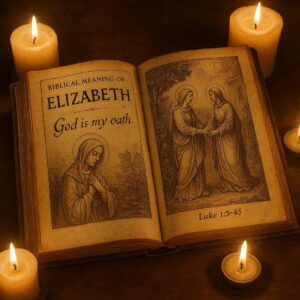
2. Etymology and Linguistic Roots: Unpacking “Elizabeth”
The name Elizabeth is a transliteration of the Hebrew name אֱלִישֶׁבַע (Elišévaʿ), which passed into Greek as Ἐλισάβετ (Elisábet) and later into Latin and English. Its meaning is a declarative statement of faith, a theophoric name (containing the name of God) that has resonated for over 3,000 years.
-
אֵלִי(Eli): This component means “My God.” It is a personal, possessive form, indicating intimacy and relationship. -
שֶׁבַע(shévaʿ): This is the number “seven,” but in Hebrew thought, seven (sheva) is deeply connected to the concept ofshava(oath) andsova(fullness, satisfaction). Seven symbolizes completion, perfection, and divine covenant (as in the seven-day week culminating in Sabbath rest).
Therefore, the most accurate and profound rendering of Elizabeth is “My God is an oath” or “My God is abundance/fulfillment.” The name encapsulates a confession: the God whom Elizabeth worships is one who keeps His promises (oath) and whose nature is to bring things to their perfect, intended fullness (seven/abundance).
The Linguistic Journey and Meaning of “Elizabeth”
| Language | Form of the Name | Literal Components | Theological Meaning |
|---|---|---|---|
| Hebrew | אֱלִישֶׁבַע (Elišévaʿ) |
Eli (My God) + Sheva (Oath/Seven) |
“My God is an oath” or “My God is fulfillment” |
| Greek | Ἐλισάβετ (Elisábet) | Translation of the Hebrew | Carries forward the covenantal meaning. |
| Latin | Elisabeth/Elisabet | Adoption from Greek | Standardized the name in Western Christianity. |
| English | Elizabeth | Evolution from Latin | The modern form, retaining the core meaning. |
This etymological foundation is not merely academic; it is the key that unlocks her entire biblical story. Elizabeth’s life becomes the living embodiment of her name—a testament that the God of the covenant is faithful to bring His promises to complete fulfillment.
3. Elizabeth in the Old Testament: The Forgotten Matriarch
Before the New Testament figure, Elizabeth first appears in the Hebrew Bible as Elisheba, the wife of Aaron (Exodus 6:23). This connection is critically important and often overlooked. As Aaron was the first High Priest of Israel, Elisheba became the first matriarch of the priestly line. She was the mother of Nadab, Abihu, Eleazar, and Ithamar. This establishes the name Elizabeth within the very heart of Israel’s worship, sacrifice, and mediatory system.
The New Testament Elizabeth is not accidentally named after this forebear. By highlighting her Aaronic lineage (Luke 1:5, “of the daughters of Aaron”), Luke the Evangelist deliberately ties his narrative to the priestly history of Israel. The New Covenant story begins not with a revolutionary outsider, but within the sanctified, hereditary priesthood of the Old Covenant. Elizabeth thus represents the righteous remnant of Israel, the faithful line through which God chooses to initiate His new work. She is the living link, embodying the purity and expectation of the priestly tradition that was always meant to point toward a greater reality.
4. Elizabeth in the New Testament: The Pivotal Bridge Between Eras
The primary narrative of Elizabeth is found in the Gospel of Luke, Chapter 1. Her story is intricately interwoven with that of Mary, creating a parallel and symbiotic narrative of two miraculous pregnancies.
A Life Marked by Righteousness and Barrenness
Luke introduces Elizabeth and her husband Zechariah with deliberate detail: “Both of them were righteous before God, living blamelessly according to all the commandments and regulations of the Lord. But they had no children because Elizabeth was barren, and both were getting on in years” (Luke 1:6-7).
This description sets up a profound tension. In the ancient Jewish world, barrenness was often perceived as a sign of divine disfavor or a curse (see the stories of Sarah, Rebekah, Hannah). Yet, the text emphatically states their righteousness. Elizabeth carries this dual burden: societal shame and personal grief, coupled with unwavering faithfulness. Her barrenness becomes a symbol of the barrenness of the age—the prophetic silence since Malachi, the unmet longing for the Messiah. Her advanced age underscores the human impossibility of her situation, setting the stage for a purely divine intervention.
The Annunciation: A Divine Reversal of Fortune
Elizabeth’s annunciation comes indirectly through her husband. While Zechariah is serving in the Temple, the angel Gabriel appears to him, announcing that Elizabeth will bear a son who must be named John. This child will be filled with the Holy Spirit and will act in the “spirit and power of Elijah” to prepare the people for the Lord (Luke 1:13-17). When Zechariah questions this due to their age, he is struck mute until the child’s birth.
This moment is the catalyst. Elizabeth, unaware of the angelic visitation at first, becomes pregnant. Her response is recorded with beautiful simplicity: “This is what the Lord has done for me when he looked favorably on me and took away the disgrace I have endured among my people” (Luke 1:25). Her words echo those of Rachel (“God has taken away my reproach” – Genesis 30:23) and Hannah. Elizabeth recognizes her pregnancy not just as a personal blessing, but as a removal of social and spiritual disgrace, a sign of God’s gracious, covenant-keeping action.
The Visitation: Prophecy, Recognition, and Joy
The narrative then pivots to Mary, who receives her own annunciation. Gabriel gives Mary a sign: “And now, your relative Elizabeth in her old age has also conceived a son; and this is the sixth month for her who was said to be barren. For nothing will be impossible with God” (Luke 1:36-37). Mary immediately travels to “a town in the hill country of Judea” to visit Elizabeth.
This meeting—the Visitation—is one of the most theologically rich scenes in Scripture. Upon Mary’s greeting, three miraculous events occur simultaneously:
-
The infant John leaps in Elizabeth’s womb.
-
Elizabeth is filled with the Holy Spirit. She becomes the first person in the New Testament to be explicitly described as Spirit-filled, and she immediately erupts in prophetic utterance.
-
Elizabeth becomes the first human to confess the identity of Jesus the Messiah. She proclaims with a loud cry: “Blessed are you among women, and blessed is the fruit of your womb! And why has this happened to me, that the mother of my Lord comes to me?” (Luke 1:42-43).
Elizabeth, through the Holy Spirit, recognizes the unborn Jesus as “my Lord.” She understands Mary’s unborn child is the Messiah. Her prophecy also blesses Mary’s faith: “And blessed is she who believed that there would be a fulfillment of what was spoken to her by the Lord” (Luke 1:45). In this moment, Elizabeth acts as a prophetess, a confirmer of God’s word, and the first Christian witness. Her home becomes the site of the first Christian liturgy, a place of Spirit-filled proclamation and joy.
The Birth of John and the Assertion of a New Destiny
After Mary’s departure, Elizabeth gives birth. On the eighth day, at the circumcision ceremony, relatives assume the child will be named Zechariah after his father. Elizabeth firmly interjects: “No; he is to be called John” (Luke 1:60). This is a bold act of obedience and authority. When the relatives protest, Zechariah confirms the name in writing, and his speech is immediately restored.
Elizabeth’s insistence on the God-given name “John” (meaning “Yahweh is gracious”) is crucial. It breaks from family tradition and asserts that this child’s identity and destiny are defined by God’s call, not human inheritance. She ensures the forerunner’s mission begins as declared. Zechariah’s subsequent prophecy, the Benedictus, confirms the destiny of their son who will “go before the Lord to prepare his ways” (Luke 1:76).
5. Theological Themes Embodied in Elizabeth
Elizabeth’s story is a compact narrative freighted with monumental theological themes.
-
Covenant Faithfulness and Divine Fulfillment: Elizabeth is the personification of her name. Her life demonstrates that “My God is an oath.” God remembered His covenant with Abraham and with the priestly line, acting at the precise moment in history (Galatians 4:4) to bring His promises to fruition. Her pregnancy is a sign that the long-awaited “fullness of time” has arrived.
-
The Theology of Barrenness and Fruitfulness: Throughout the Bible, God specializes in bringing life from barrenness (Sarah, Rebekah, Hannah, the Shunammite woman). Elizabeth continues this pattern, symbolizing God’s power to bring life, hope, and salvation out of situations of spiritual and historical barrenness. She represents Israel, seemingly barren and without a prophetic word, now miraculously fruitful with the voice that will announce the dawn.
-
The Role of the Prophetic Voice: Elizabeth, though not holding an office, operates in a profound prophetic role. Filled with the Spirit, she declares truth, recognizes the Messiah, and interprets events according to God’s perspective. She models that the Spirit’s prophetic gifting is not confined by gender, age, or social status.
-
Humility and Kenosis in the Plan of Salvation: Despite her own miraculous pregnancy, Elizabeth shows no jealousy or rivalry toward her younger relative. Instead, she humbly acknowledges the superiority of Mary’s child, calling herself unworthy of Mary’s visit. This kenosis (self-emptying) mirrors the character of the servant Messiah her own son will proclaim. She exemplifies that in God’s kingdom, the greatest joy is found in pointing others to a glory greater than our own.
6. Elizabeth in Christian Tradition, Art, and Liturgy
The Church has venerated Elizabeth as a saint. In Eastern Orthodoxy and Catholicism, she is celebrated as the “Mother of the Prophet John the Forerunner.” The Feast of the Visitation (May 31) commemorates her encounter with Mary. In art, the Visitation is a beloved subject, from medieval manuscripts to Renaissance masterpieces by artists like Giotto, Ghirlandaio, and Pontormo. These works often capture the intimate embrace, the joy, and the divine significance of the moment. Elizabeth is typically portrayed as older, often with a gesture of recognition or awe toward Mary’s womb.
7. The Psychological and Spiritual Archetype of Elizabeth
Beyond history and theology, Elizabeth represents a powerful spiritual archetype. She is the “Faithful Waiter.” She embodies the virtue of persevering in righteousness and hope despite long years of unfulfilled desire and societal judgment. She teaches that periods of “barrenness”—be they spiritual, creative, or emotional—can be seasons of preparation for a God-orchestrated fruitfulness that exceeds all expectations. Her story offers profound comfort to those who wait on God’s timing.
8. The Name Through History: Saints, Queens, and Cultural Impact
The name Elizabeth, carrying its biblical weight of faithfulness and oath, has been borne by countless influential women. From St. Elizabeth of Hungary (a model of charitable service) to Queen Elizabeth I of England (whose reign defined an era), the name has been associated with intelligence, strength, and governance. Its myriad variations—Isabel, Isabelle, Eliza, Liza, Beth, Lisa—span cultures and languages, a testament to its enduring appeal and the subconscious resonance of its meaning.
9. Personal Application: The “Elizabeth Principle” in Modern Life
The “Elizabeth Principle” can be distilled into actionable truths for contemporary believers:
-
Faithfulness in the Unseen: Cultivate integrity and devotion (“righteous before God”) even when no visible fruit is apparent.
-
Recognizing Divine Visitation: Develop spiritual discernment to perceive God’s action in everyday encounters and relationships.
-
Prophetic Encouragement: Use your voice, filled with the Spirit, to affirm God’s work in others’ lives, to speak identity and destiny.
-
Joy in Another’s Blessing: Rejoice without envy when others receive promotion or blessing, trusting in God’s unique plan for your life.
-
Asserting God-Given Identity: Have the courage to break from unhealthy traditions or expectations to uphold the truth of God’s calling.
10. Conclusion: A Tapestry of Faithfulness
Elizabeth’s story is a masterfully woven thread in the tapestry of redemption. From her priestly lineage to her Spirit-filled prophecy, she stands as the faithful bridge between promise and fulfillment. Her life proclaims that our God is indeed a God of oaths, whose timing, though often mysterious, is perfect, and whose power brings glorious fulfillment out of lifelong barrenness. She is a testament to the quiet, potent strength of faithful waiting and the explosive joy that arrives with the dawn.
11. Frequently Asked Questions (FAQs)
Q1: Was Elizabeth truly a relative of the Virgin Mary?
A: The Gospel of Luke states that Mary was Elizabeth’s “relative” (Greek sungenis), which is a general term for kin. The exact nature of their relationship is not specified. Later tradition sometimes suggests they were cousins, but the Bible does not define the degree of relation.
Q2: Why is Elizabeth’s age emphasized so much?
A: Her advanced age (and Zechariah’s) underscores the human impossibility of her pregnancy. This highlights that John the Baptist’s conception was a miraculous act of God, similar to the births of Isaac and Samson, signaling his special role in salvation history.
Q3: What is the significance of John leaping in Elizabeth’s womb?
A: This is more than a fetal movement. It is presented as a Spirit-inspired act of recognition and joy (Luke 1:41, 44). It signifies that John’s prophetic ministry of announcing the Messiah began even from the womb, fulfilling the angel’s prophecy that he would be “filled with the Holy Spirit even before his birth” (Luke 1:15).
Q4: How is Elizabeth a model for Christian women today?
A: Elizabeth models unwavering faith amidst disappointment, joyful submission to God’s will, the power of Spirit-led encouragement, and the strength to uphold God’s truth in family and social settings. She exemplifies that one’s significance in God’s plan is not defined by cultural status but by faithful obedience.
Q5: Are there any relics or traditional burial sites associated with Elizabeth?
A: Tradition holds that Elizabeth was buried in the Tomb of the Prophets in the Kidron Valley of Jerusalem, alongside Zechariah and John the Baptist. However, these are traditional sites, and their historical accuracy is not verifiable.