From the moment early humans looked at a towering tree and saw a means to reach its fruit, or gazed at the star-strewn sky and felt a pull toward the infinite, the concept of the ladder was born. More than a mere tool, it became one of humanity’s most potent and enduring spiritual symbols. It represents a profound and universal yearning: the desire to ascend, to transcend our limitations, to bridge the gap between the earthly and the divine, the mundane and the mystical, the unconscious and the enlightened Self.
The spiritual ladder is not a static image but a dynamic map of inner evolution. It speaks of effort, of progressive stages, of the arduous but rewarding climb toward greater understanding, virtue, and unity. Each rung represents a lesson, a challenge overcome, a virtue integrated. The space between rungs symbolizes the leaps of faith, the dark nights of the soul, and the periods of integration necessary for true growth.
This article is an exploration of that sacred ascent. We will climb through history, scaling the ladders erected by ancient visionaries, mystics, and philosophers. We will examine the psychological underpinnings of this symbol and, most importantly, we will provide a blueprint for constructing and climbing your own spiritual ladder. This is not a path of escape from the world, but one of deeper engagement with it—a journey that begins with the self and ultimately leads back to the world, transformed.
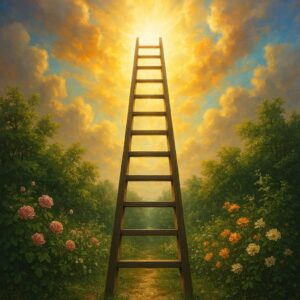
Chapter 1: The Ladder in Ancient Cosmology – Dreams of the Axis Mundi
Before written history, the ladder appeared in myth and ritual as the axis mundi—the world axis or cosmic pillar connecting Heaven, Earth, and the Underworld. It was the pathway for gods, spirits, and shamans, a symbol of communication between realms.
Jacob’s Ladder: The Biblical Bridge Between Earth and Heaven
The story in Genesis 28:10-19 is a cornerstone of Western spiritual symbolism. Fleeing his brother Esau, Jacob dreams of a ladder (sullam) set on earth, with its top reaching heaven. Angels of God are ascending and descending on it. This vision reveals several key themes:
-
Divine Connection: The ladder affirms that the divine is not utterly remote; a connection exists.
-
Two-Way Traffic: The angels ascend and descend, indicating that spiritual ascent is not a one-way journey. Blessings, insights, and responsibilities flow back to Earth.
-
A Personal Revelation: The ladder appears not in a temple, but in a barren place to a lonely, flawed individual. It signifies that the path to the divine is accessible to all, often in our most vulnerable moments.
The Shaman’s Ladder: Ecstatic Ascent in Indigenous Traditions
From Siberia to the Amazon, shamans describe using a ladder, tree, or vine to journey into the spirit worlds. This ecstatic ascent is central to healing, divination, and maintaining cosmic balance. The shaman climbs to retrieve lost souls, gain knowledge, or intercede with higher powers. The ladder here is a tool of trained consciousness, accessed through trance, drumming, or ritual. It represents the ability of the human spirit to consciously navigate non-ordinary realities for the benefit of the community.
The Egyptian Ladder to the Afterlife: Ascent of the Ba
In Egyptian funerary texts like the Book of the Dead and the Coffin Texts, spells exist to provide a ladder for the ba (soul) of the deceased to ascend to the Field of Reeds, the heavenly paradise. The god Osiris is sometimes called the “lord of the ladder.” Tomb paintings and amulets in the shape of ladders have been found, placed with the deceased to aid their climb. This underscores the ladder’s role as a psychopomp—a guide through the treacherous transition from death to the afterlife.
The Ladder in Hellenistic and Mithraic Mysteries
In the mystery religions of the Greco-Roman world, the ladder symbolized the soul’s progressive initiation and ascent through the planetary spheres to reunite with the divine source. The Mithraic cult, popular among Roman soldiers, featured a ladder with seven rungs, often associated with the seven classical planets and corresponding metals. Initiates would symbolically climb this ladder, shedding planetary influences and material attachments at each stage to achieve spiritual liberation.
The Ladder in Ancient Traditions
| Tradition | Symbol Name/Context | Primary Meaning | Key Imagery |
|---|---|---|---|
| Hebrew Bible | Jacob’s Ladder (Sullam) | Connection between God and Man; Divine Providence | Angels ascending/descending; Stone pillow at base |
| Shamanism | Spirit Ladder/Tree | Journey to Upper World for healing & knowledge | Often visualized in trance; used by initiated healers |
| Ancient Egypt | Ladder of Osiris | Ascent of the soul (ba) to the afterlife | Funerary spells; ladder amulets in tombs |
| Mithraism | Planetary Ladder | Soul’s initiation & liberation from material realms | Seven rungs (7 planets/metals); ritual ascent |
Chapter 2: Eastern Philosophies and the Ladder of Consciousness
Eastern spiritual systems offer some of the most intricate and detailed “ladders” of inner development, often framed as paths (marga) or stages of awakening.
The Chakras: The Inner Ladder of Energy
The chakra system, detailed in Tantric and yogic traditions, is a quintessential spiritual ladder within the subtle body. The seven primary chakras are rungs of ascending energy, from the root (Muladhara), concerned with survival and grounding, to the crown (Sahasrara), the locus of transcendence and unity consciousness.
-
The Climb: Spiritual practice (yoga, meditation, pranayama) aims to awaken and raise the dormant kundalini energy from the base of the spine, guiding it up this inner ladder. Each chakra cleared and balanced represents a higher level of psychological and spiritual functioning—from security, to emotion, to power, to love, to communication, to insight, and finally to bliss.
The Buddhist Noble Eightfold Path: A Ladder to Liberation
The Buddha presented a practical, ethical, and mental ladder out of suffering (dukkha). The Eightfold Path is not sequential but interdependent, forming a comprehensive guide:
-
Right View
-
Right Intention
-
Right Speech
-
Right Action
-
Right Livelihood
-
Right Effort
-
Right Mindfulness
-
Right Concentration
Mastery leads to wisdom (prajna), ethical conduct (sila), and mental discipline (samadhi), culminating in Nirvana—the ultimate “ascent” beyond cyclic existence.
The Yoga Sutras: Climbing the Rungs of Practice
Patanjali’s Yoga Sutras outline an eight-limbed (Ashtanga) path, another explicit ladder:
-
Yamas (Ethical Restraints)
-
Niyamas (Observances)
-
Asana (Posture)
-
Pranayama (Breath Control)
-
Pratyahara (Sense Withdrawal)
-
Dharana (Concentration)
-
Dhyana (Meditation)
-
Samadhi (Absorption/Enlightenment)
The sequence is developmental: establishing an ethical foundation is crucial before mastering the body, then the breath, then the mind, leading to the highest states of consciousness.
The Taoist Ladder of Being
Taoist cosmology describes a generative process from the primordial Void (Wuji) to the myriad things of the world. The “ladder” here is often implicit in the concept of refinement (lian). Through internal alchemy (neidan), the practitioner seeks to reverse this process—to refine the coarse energies of the body (jing) into vital energy (qi), then into spirit (shen), and finally back into emptiness and union with the Tao. It is an ascent through purification and harmonization.
Conclusion: The Never-Ending Ascent
The spiritual ladder is not a device to escape our humanity, but to fully realize it. It is a map of transformation, reminding us that growth is incremental, challenging, and purposeful. From Jacob’s dream to the yogi’s inner ascent, it calls us to build, rung by rung, a life of greater awareness, compassion, and unity. The true summit is not a distant heaven, but a profound state of being—right here, right now—where every step is both the path and the destination.
Frequently Asked Questions (FAQs)
Q1: Is the spiritual ladder metaphor only for religious people?
A: Not at all. While it features prominently in religious texts, the core concept—progressive personal growth, ascending through stages of consciousness, integrating shadow aspects, and striving for a higher state of being—is universal. It is used in secular psychology (e.g., Maslow), mindfulness, and modern self-development frameworks.
Q2: What if I feel like I’ve “fallen off” my spiritual ladder?
A: “Falling” is an integral part of the climb. Setbacks, periods of doubt, and perceived regression are not failures but essential lessons. The ladder is always there. The practice is to compassionately acknowledge the fall, learn from it, and begin climbing again from where you are, with greater wisdom.
Q3: How do I know which “ladder” (tradition/path) is right for me?
A: Listen to your inner resonance. Explore teachings with an open but discerning mind. A true path should promote qualities like compassion, self-awareness, and integrity, not dogmatism or superiority. Your genuine spiritual practice will feel like a “coming home,” challenging yet deeply aligning with your innate sense of truth.
Q4: Is the goal always to reach the “top”?
A: In a linear sense, yes—we aim for enlightenment, liberation, or unity. But a deeper understanding sees the climb itself as the goal. Each rung offers its own completeness. Furthermore, many traditions emphasize the responsibility to “descend”—to bring the wisdom gained back into daily life for the benefit of others.
Q5: Can I work on multiple “rungs” at once?
A: Absolutely. While some systems suggest a sequence, human growth is often non-linear. You might work on foundational ethics (a lower rung) while having profound mystical insights (a higher rung). The key is balance and honesty, ensuring that higher experiences are grounded in a stable, integrated character.