We encounter them daily, yet rarely do we pause to consider their profound silent narrative: the humble keyhole. More than a mere functional aperture for a metal key, the keyhole is one of humanity’s most potent and enduring spiritual symbols. It represents the tantalizing space between worlds—between the known and the unknown, the public and the private, the conscious and the subconscious, the mundane and the divine. It is an emblem of mystery itself, a promise that there is more beyond the obvious surface of reality, waiting for those with the correct “key” of perception, knowledge, or spiritual readiness.
This article embarks on an exhaustive exploration of the keyhole’s spiritual meaning, traversing archaeology, mythology, depth psychology, esoteric traditions, and modern metaphor. We will dissect its form, its function, and its eternal place in the human psyche as a symbol of potential transformation. To gaze through a keyhole is to engage in an act of sacred voyeurism, seeking a glimpse of a hidden truth. To possess the key is to hold the responsibility of access, choice, and revelation. Join us as we unlock the manifold meanings of this fascinating spiritual portal, exploring how an everyday object can become a master key to understanding our own inner landscapes and the hidden architecture of the universe.
Chapter 1: The Keyhole in History, Myth, and Symbolism
The spiritual significance of the keyhole is deeply rooted in our collective past. Its emergence coincides with humanity’s desire to secure, to hide, to sanctify, and to designate special spaces.
Ancient Foundations:
In ancient Egypt, the ankh, the key of life, shares a conceptual lineage with the keyhole. It was a symbol of eternal life and divine knowledge—a key to unlocking the mysteries of existence and the afterlife. Similarly, in Roman society, the goddess Cardea, mistress of hinges (cardines), presided over doorways, thresholds, and by association, the keys and keyholes that secured them. Her domain was the pivotal point upon which safety and danger turned. This established an early archetype: the keyhole as a point of ritual protection and transition, guarded by a deity.
Folklore and Fairy Tales:
European folklore is rife with keyholes as magical boundaries. Witches and evil spirits were believed to be unable to cross a threshold through a keyhole unless invited, leading to traditions of placing protective herbs or iron keys in the lock. Conversely, fairy tales like Bluebeard center on a forbidden key and keyhole, where the act of looking through or unlocking reveals a terrible secret, linking the symbol to forbidden knowledge, curiosity, and its consequences. The keyhole here is the threshold of initiation into a dark truth.
Eastern Philosophies:
In Taoist and Buddhist thought, the concept of the “gateless gate” or the “door of the non-dwelling mind” presents a metaphysical parallel. The keyhole can be seen as the narrow, focused path of mindfulness or koan contemplation that, when penetrated, leads to the vast, open space of enlightenment. It is the finite point that grants access to the infinite.
The Keyhole in Global Myth and Folklore
| Culture/Tradition | Symbolic Role of the Keyhole | Associated Concept |
|---|---|---|
| Ancient Rome | Protected threshold under Cardea’s domain. | Sanctity, Safety, Transition |
| European Folklore | A barrier against malevolent spirits; a peephole for the supernatural. | Protection, The Unseen World |
| Fairy Tales (e.g., Bluebeard) | The point of transgression for forbidden knowledge. | Curiosity, Taboo, Initiation |
| Taoism/Buddhism | Metaphor for the narrow path to enlightenment. | Mindfulness, Spiritual Passage |
| Freemasonry | The “All-Seeing Eye” is sometimes framed within a keyhole arch. | Divine Observation, Esoteric Knowledge |
Chapter 2: Architectural and Sacred Geometry: The Form as a Symbol
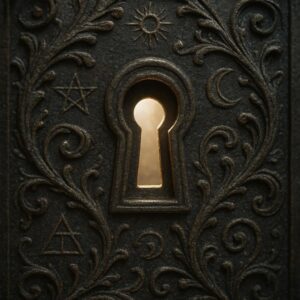
The physical shape of the keyhole is itself a sacred geometric code. Typically, it is a synthesis of two fundamental shapes: the circle and the rectangle (or square).
-
The Circle: Universally representing heaven, eternity, unity, the soul, and the cyclical nature of life. It is wholeness, the Divine, and the infinite.
-
The Rectangle/Square: Representing earth, materiality, stability, order, the four directions, and the four elements. It is the manifested, physical world.
The keyhole, therefore, is a hieros gamos (sacred marriage) of these forms. The circle sits above or within the rectangle, symbolizing spirit descending into matter, or matter providing a channel to access spirit. This is the essence of its spiritual function: it is a architectural mandala for passage between realms.
Gothic Cathedrals and Keyhole Arches:
In sacred architecture, the keyhole arch (also called a Moorish or Islamic arch) is prevalent. Its shape, reminiscent of a stylized keyhole, is prominent in mosques and Gothic cathedrals. This is no accident. Passing through such an archway is meant to be a spiritual experience—leaving one state of being and entering another, more sanctified one. The arch frames the journey, acting as a giant, communal keyhole for the soul.
The “Oculus” as Keyhole:
The oculus, the round opening at the apex of a dome (as in the Pantheon), is a celestial keyhole. It allows light—a symbol of divine illumination and consciousness—to penetrate the sacred space below. It is the eye of the structure, connecting the worshippers inside with the cosmos outside.
Chapter 3: The Key and the Keyhole: A Duality of Power and Receptivity
The keyhole cannot be understood in isolation from its counterpart: the key. This relationship forms a fundamental cosmic and psychic duality:
-
The Key (Active, Yang, Masculine Principle): Symbolizes power, agency, solution, initiation, knowledge, and freedom. It is the active force that engages.
-
The Keyhole (Receptive, Yin, Feminine Principle): Symbolizes mystery, potential, hiddenness, waiting, the unknown, and the womb of secrets. It is the receptive vessel that is engaged.
Spiritually, the journey often involves discovering that the key and the keyhole exist within us. The analytical, searching mind (the key) must learn to approach the deep, intuitive, mysterious soul (the keyhole) with respect and the right “frequency” (the correct cuts on the key). Forcing the key breaks the lock. The right key turns smoothly, revealing the inner chamber. This is a metaphor for self-knowledge, meditation, and the integration of our conscious and unconscious selves.
Chapter 4: Vision, Limitation, and the “Peeking” Soul
A keyhole offers a framed and limited view. This is central to its spiritual lesson. We cannot see the whole room; we see only a fragment. This teaches us about the nature of human perception and spiritual seeking.
-
The Limitation is the Guide: The constraints of the keyhole force focus. In meditation, we focus on the breath (a keyhole) to access the vastness of mind. In life, our specific challenges (keyholes) become the focused portals through which we grow.
-
The Danger of Assumption: Seeing only a slice can lead to misinterpretation. Spiritually, this warns against dogmatism—believing our limited, “keyhole” view of divinity or truth is the entire picture.
-
The Allure of the Hidden: The act of “peeking” speaks to the soul’s innate desire to know more, to explore the mystery. It represents hope, curiosity, and the belief that there is something worthwhile beyond the door.
Chapter 5: The Keyhole as a Portal: Gateways, Veils, and Spiritual Transit
In advanced esoteric thought, the keyhole is a direct symbol for a portal or stargate. It is a thin place in the fabric of reality where energy, consciousness, or even entities can pass between dimensions.
-
The Veil: The door itself represents the veil between worlds. The keyhole is a temporary, pinpoint thinning of that veil.
-
Astral Travel and Lucid Dreaming: Practitioners sometimes visualize a keyhole as a departure point for consciousness projection. Focusing on it helps stabilize the exit from the physical body.
-
Invocation and Evocation: In ceremonial magic, circles often have “gates” at the quarters. The keyhole symbol can be used to “unlock” these gates, allowing benevolent energies to enter or the magician’s intent to project outward.
The spiritual seeker must therefore ask: Am I using this portal with wisdom? What is my intent in seeking to look or pass through? Do I have the right key—the proper purity of heart, intention, and knowledge?
Chapter 6: Esoteric Traditions and the Keyhole Motif
-
Alchemy: The vas hermeticum (the sealed vessel) where the Great Work occurs is a kind of locked space. The keyhole represents the prima materia—the initial, hidden point of entry into the transformative process. Finding it is the first step towards turning lead into gold, both materially and spiritually.
-
Kabbalah: The Tree of Life is both a map of creation and a lock. The paths between the sephiroth are channels, and the aspirant seeks the “key” of understanding to navigate them. The keyhole could be seen as Da’at—the invisible sephirah of knowledge, the hidden junction that, once accessed, reveals the connections of the entire Tree.
-
Tarot: The Hierophant (Key 5) is often shown holding keys or with crossed keys at his feet. He is the guardian of traditional knowledge and the mediator between the divine and the human. The keyhole is the mystery school itself, and he provides the keys to its teachings. The Moon card (Key 18) depicts a path leading between towers into the unknown—a classic keyhole-shaped journey through the subconscious.
Chapter 7: Dream Analysis and the Psychology of the Keyhole
In Jungian psychology, dreams of keyholes are rich with personal symbolism.
-
Finding a Keyhole: May indicate discovering a new way to access a hidden part of the self (the unconscious) or a new opportunity in life.
-
Looking Through a Keyhole: Suggests curiosity about a hidden aspect of yourself (a repressed memory, a talent) or about someone else’s life. It can indicate a feeling of being an outsider, seeking forbidden knowledge, or voyeurism.
-
A Key That Doesn’t Fit the Keyhole: Represents a feeling of inadequacy, a failed attempt to understand oneself or solve a problem, or an approach that is not aligned with the situation.
-
A Keyhole Without a Door: Symbolizes a direct, unmediated access point to the unconscious or the spiritual realm, but one that may feel unprotected or overwhelming.
The keyhole in dreams often points to the shadow self—the parts of our personality we keep “locked away.” The dream asks us to find the key of awareness to integrate these parts.
Chapter 8: Modern Applications: From Digital Realms to Personal Ritual
The keyhole symbol has seamlessly transitioned into the digital age.
-
Digital Security: The “login” is the modern keyhole. Your password is the key. This reinforces the archetype daily: access to hidden digital spaces (email, bank accounts, social media) guarded by secret knowledge.
-
User Interface (UI) Design: The “hamburger menu” icon (three lines) is a symbolic keyhole, tapping into our subconscious understanding that clicking it will reveal hidden options and navigation.
-
Personal Ritual and Mindfulness: One can use a physical keyhole or an image as a meditation focus. Gazing at it softly, one contemplates: What is locked within me? What wisdom do I seek access to? What door am I afraid to open? This can lead to profound introspection.
Chapter 9: Crafting Your Own Keyhole Practice
To integrate this symbol into your spiritual path:
-
Create a Keyhole Altar: Place an old key, a keyhole image, a small mirror (to represent the act of looking within), and a candle (for illumination) on a small space.
-
Journaling Prompts: Use prompts like: “The door I most need to open right now is…”, “The key I already possess is my ability to…”, “What I fear to see behind the door is…”
-
Visualization Meditation: Visualize a beautiful, ornate door before you. See its keyhole. Hold a key in your hand. As you breathe, the key takes on a glow. Unlock the door and step through into a landscape that represents your inner wisdom or next stage of growth.
Chapter 10: Conclusion: Integrating the Symbol
The keyhole is a timeless map to the soul’s journey. It teaches that truth is often hidden but accessible, that the right tool is not force but aligned knowledge, and that every limitation can become a sacred portal. By honoring both the key of our will and the keyhole of life’s mysteries, we learn to navigate the thresholds of our existence with grace, unlocking the profound spiritual dimensions hidden in plain sight.
Frequently Asked Questions (FAQs)
Q1: Is seeing a keyhole in a dream a good omen?
A: It is less about omen and more about opportunity. It generally signifies that access to something hidden—knowledge, emotion, or a new phase—is possible. The context (your feelings, the outcome) determines whether it’s a positive or cautionary message.
Q2: What does it mean if I keep losing keys spiritually?
A: Spiritually, “losing keys” may indicate feeling disconnected from your personal power, the solution to a problem, or your sense of access to the divine. It can signal a period of searching or a need to develop new skills (forge a new key).
Q3: How can I use the keyhole symbol for protection?
A: Historically, iron keys left in locks or protective symbols drawn over keyholes were used. Energetically, you can visualize a brilliant light sealing the keyhole of your home or aura, or place a piece of black tourmaline or obsidian near your front door lock with that intention.
Q4: Are there any dangers in “keyhole” spirituality?
A: As with any exploration of the hidden, discretion and right intention are crucial. The “danger” lies in obsession, seeking power over others, or forcing open doors (psychic or otherwise) before you are ethically and psychologically prepared to handle what lies beyond.
Q5: What’s the connection between the “Third Eye” and the keyhole?
A: The Third Eye (Ajna chakra) is the body’s spiritual keyhole. It is the inner aperture of perception that, when “unlocked” through meditation and insight, allows vision beyond the physical, into the realms of intuition, wisdom, and higher consciousness.
Additional Resources
-
Books:
-
Man and His Symbols by Carl G. Jung – For understanding archetypal symbols like the keyhole in dreams.
-
The Symbolism of the Cross by René Guénon – Explores geometric spiritual symbols, relevant to the keyhole’s form.
-
The Book of Doors: The Keyhole as a Symbol in Art and Spirituality (Anthology) – A specialized collection of essays.
-
-
Art & Study:
-
Study the paintings of Leonora Carrington and Remedios Varo, which are rich with portal and keyhole symbolism.
-
Examine architectural photographs of Gothic cathedrals and Islamic mosques, focusing on arches and window shapes.
-
-
Practice:
-
Engage with labyrinth walking—a physical practice of moving through a defined, keyhole-like path to a center.
-
Study the Tarot cards mentioned (The Hierophant, The Moon) in depth with a focus on their gateway symbolism.
-