Imagine holding a stone that emperors once believed could grant immortality, that Mayan kings associated with the sacred breath of life, and that ancient healers used to align the soul with the cosmos. This is not a substance of fantasy, but the profound reality of jade. For millennia, across disparate continents and cultures, jade has been revered not merely for its captivating beauty—its serene greens, luminous whites, and deep blacks—but for its profound spiritual essence. It stands unique in the human story as a mineral that transcends decorative purpose to become a cornerstone of cosmology, a tool for transcendence, and a tangible manifestation of the most sacred principles. To explore the spiritual meaning of jade is to embark on a journey through time and consciousness, uncovering why this “stone of heaven” has been, and continues to be, considered a direct link between the earthly and the divine, a protector of the soul, and a master key to spiritual harmony. This article delves deep into this legacy, weaving together archaeology, anthropology, metaphysics, and timeless wisdom to reveal why jade is truly the eternal stone.
Chapter 1: The Stone of Heaven – Jade in Ancient China
In no culture is the spiritual symbiosis with jade more deeply etched than in China. For over 9,000 years, jade (玉, yù) has been considered the most precious substance on earth, far exceeding the value of gold or diamonds. Its spiritual significance is rooted in Confucian, Daoist, and folk beliefs, forming an unbroken thread in Chinese thought.
The Essence of Virtue: Confucius canonized the spiritual analogy of jade, attributing to it eleven virtues of the ideal gentleman (junzi). In the Book of Rites, he stated: “The wise have likened jade to virtue. For them, its polish and brilliancy represent the whole of purity; its perfect compactness and extreme hardness represent the sureness of intelligence; its angles, which do not cut, although they seem sharp, represent justice; the pure and prolonged sound which it gives forth when one strikes it represents music. Its color represents loyalty; its interior flaws, always showing themselves through the transparency, call to mind sincerity; its iridescent brightness represents heaven; its admirable substance, born of mountain and of water, represents the earth.”
This wasn’t mere poetry. Each physical property was a spiritual lesson: its toughness symbolized endurance and moral integrity; its smooth, warm touch embodied benevolence; its translucent clarity stood for honesty and purity of mind.
Daoist Immortality and the Elixir of Life: In Daoist philosophy, jade was the ultimate symbol of purity and the material embodiment of Qi (life force). It was considered a conduit for celestial energy and a substance that could preserve the physical body and spirit. Emperors and alchemists sought “jade essence” for elixirs, and the wealthy were buried in jade suits sewn with gold or silver thread, like the famous suits of the Han Dynasty princes, believing the stone would prevent corporeal decay and guide the soul to immortality. Jades shaped like cicadas (symbols of rebirth) were placed on tongues, and pigs (representing wealth) in hands for the afterlife.
Cosmic Symbolism and Ritual Power: From the Neolithic bi discs (representing heaven) and cong tubes (representing earth), jade objects were ritual implements to communicate with divine forces. The cong, with its square outer section and cylindrical inner channel, symbolized the ancient Chinese belief in a square earth penetrated by a circular heaven—jade was the medium linking these two realms.
The Confucian Virtues of Jade
| Physical Property of Jade | Corresponding Virtue | Spiritual Meaning |
|---|---|---|
| Smooth, Glossy Texture | Benevolence (Ren) | Kindness, warmth, and gentleness in character. |
| Dense, Hard Structure | Intelligence (Zhi) | Sharpness of mind, wisdom, and resoluteness. |
| Sharp Edges that do not Cut | Righteousness (Yi) | Justice, discipline, and moral courage without cruelty. |
| Clear, Prolonged Tone when Struck | Music & Ritual (Li) | Harmony, propriety, and the rhythm of a balanced life. |
| Flaws Visible Through Transparency | Sincerity (Xin) | Honesty, authenticity, and being true to one’s nature. |
| Brilliant Luster | Heaven | Divine connection, purity, and celestial inspiration. |
| Substance from Mountain & Water | Earth | Groundedness, nourishment, and connection to the material world. |
Chapter 2: The Breath of Life – Jade in Mesoamerican Civilizations
Across the Pacific, the Olmecs, Maya, Aztecs, and other Mesoamerican cultures independently arrived at a similar spiritual veneration for jade, which they valued above gold. To them, it was the stone of life, synonymous with water, vegetation, fertility, and ultimately, the soul’s breath.
The Cosmic Axis and Royal Power: Jade, called chalchihuitl in Nahuatl (Aztec), was associated with the heart-center of the world and the life-giving forces of water and rain. Kings and nobility wore jade mosaics, beads, and earplugs not just as status symbols, but as embodiments of their divine right to rule and their role as intermediaries with the gods. A jade bead was often placed in the mouth of the deceased—a practice eerily similar to the Chinese cicada—to symbolize the eternal breath of the soul, the ihiyotl.
The Maya and the Sacred Yax: For the Maya, jade (yax) was the ultimate sacred material, representing the color of first new growth, ripe maize, and the central direction of the world tree (Wacah Chan) that connected the underworld (Xibalba), earth, and heaven. It was the flesh of the gods. The Maize God, resurrected and reborn, was often depicted adorned in jade. Rulers like the great Pakal of Palenque were entombed in jade regalia, their faces covered with jade mosaic masks to deify them in death and ensure their rebirth. Jade was the substance of creation itself.
Chapter 3: The Bridge Between Worlds – Jade in Maori and Pacific Cultures
In Aotearoa (New Zealand), the Māori people treasure pounamu, or greenstone (a type of nephrite jade), which they consider a tangible ancestor (taonga). Its spiritual meaning is woven into identity, lineage, and connection to the land.
Te Āo Wairua (The Spiritual World): Pounamu is believed to hold mana (spiritual power) and tapu (sacredness). It is seen as a living entity with its own mauri (life force). Weapons like the mere (short club) and tools were passed down generations, carrying the mana of their owners and ancestors. Wearing pounamu, particularly the hei tiki (a stylized ancestor figure) or the hei matau (fishhook symbolizing prosperity and safe travel), is not merely adornment. It is a physical connection to the spiritual realm, a protector against harm, and a constant reminder of one’s heritage and the stories (pūrākau) of the land from which the stone came.
Chapter 4: The Anatomy of Spirit – Colors, Forms, and Symbolism
Jade’s spiritual portfolio is richly detailed by its variety. Each color and carved form carries a specific vibrational meaning.
-
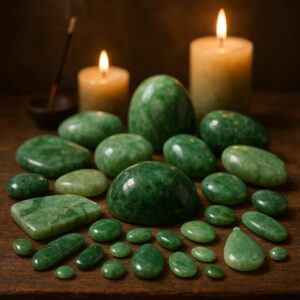
Green Jade: The quintessential color, representing the heart chakra. It embodies growth, healing, harmony, and the nurturing forces of nature. It is the stone of compassion, balance, and attracting good luck and friendship.
-
White Jade (Mutton Fat Jade): Symbolizes purity, innocence, and connection to the moon and celestial realms. It is associated with higher wisdom, spiritual peace, and cleansing. In China, it represented moral integrity.
-
Lavender Jade: A rare variety connected to the crown and third eye chakras. It fosters intuition, spiritual awareness, and inner peace. It is considered a stone of dreams and mysticism.
-
Black Jade: A powerful grounding and protective stone. It absorbs negative energy, shields the aura, and connects one to the stabilizing energies of the Earth. It symbolizes strength, resilience, and mystery.
-
Yellow/Red Jade: Linked to the solar plexus and sacral chakras, these warm hues stimulate vitality, joy, personal power, and passion.
Carved forms amplify these meanings: Dragons for power and blessing; Pi Discs for heaven and eternal cycles; Budai for abundance and happiness; Turtles for longevity; Phoenixes for transformation and renewal.
Chapter 5: The Inner Alchemy – Jade’s Metaphysical Properties
In contemporary metaphysical practice, jade is a master healer and teacher. Its spiritual applications are multifaceted:
-
Heart Healer & Emotional Balancer: Jade’s primary domain is the heart chakra. It is renowned for releasing negative emotions, soothing the mind, and encouraging one to see the self and others with compassion. It teaches the balance between giving and receiving love.
-
Dream Weaver & Intuition Enhancer: Placed under a pillow or on the third eye, jade, particularly lavender, is said to promote lucid dreaming, provide guidance through dreams, and sharpen intuitive faculties.
-
Protective Talisman: Across all traditions, jade is a supreme protector. It is believed to create a shield around the aura, guard against misfortune, and “soften” impending accidents into mere lessons. It protects during travel and spiritual work.
-
Manifestation Stone: Known as the “Dream Stone,” jade is used to clarify desires and align one’s energy to manifest them. Its connection to the heart ensures manifestations are for the highest good.
Chapter 6: Rituals, Talismans, and Spiritual Practice
Integrating jade into spiritual practice requires mindful engagement:
-
Cleansing & Charging: Regularly cleanse jade under lukewarm running water, with smoke (sage, palo santo), or by placing it on a bed of quartz crystals. Charge it by placing it in moonlight (especially full moon) or by setting a clear intention.
-
Meditation: Holding a piece of jade during meditation, particularly over the heart, can deepen the practice, foster feelings of serenity, and facilitate emotional release.
-
Gridding: Use jade stones in crystal grids to create zones of healing, protection, or loving energy in a home or sacred space.
-
Everyday Talisman: Wear jade as jewelry close to the skin (pendant over heart, bracelet on wrist) to keep its stabilizing and harmonizing energy within your personal field throughout the day.
Chapter 7: Jade in Modern Spirituality and Wellness
Today, the spiritual legacy of jade thrives. It is a staple in crystal healing, mindfulness practices, and eco-spiritual movements that honor the Earth. The modern seeker embraces jade not out of superstition, but as a tool for mindfulness—a physical anchor for intentions of peace, balance, and ethical living (wu wei). Its timeless aesthetic and profound backstory make it a bridge between ancient wisdom and contemporary self-care, reminding us of values that transcend materialism: virtue, harmony, and connection to something greater than ourselves.
Conclusion: The Unbroken Thread
Jade’s journey through human history reveals a universal quest for meaning, harmony, and connection to the divine. From the tombs of Chinese emperors to the marae of the Māori, it has served as a symbol of virtue, a vessel for the soul, and a bridge between worlds. Its enduring spiritual power lies not in magic, but in its ability to mirror humanity’s highest ideals—purity, resilience, compassion, and eternal life—back to us, making the intangible tangible. To hold jade is to hold a piece of this timeless conversation between earth and spirit.
FAQs
Q1: What is the difference between jadeite and nephrite in spiritual terms?
A: Both are “true jade” spiritually. Nephrite, with its fibrous, tougher structure, is often associated with nurturing, long-lasting strength, and deep Earth connection. Jadeite, with its broader color range and crystalline vibrancy, is sometimes linked to more active manifestation, clarity, and celestial energy. However, their core spiritual properties of heart-healing, protection, and harmony remain consistent.
Q2: How do I know if my jade is “real” and spiritually active?
A: Authentic natural jade (nephrite or jadeite) carries the energy. Be wary of glass or plastic imitations. Learn its physical tests (coolness, hardness, subtle granularity under magnification). Most importantly, your intuition is key. A genuine piece will often evoke a feeling of calm or resonance. Purchase from reputable dealers.
Q3: Can jade have negative spiritual effects?
A: Jade is overwhelmingly considered a benevolent, gentle stone. However, as a powerful absorber, it can become saturated with negative energy if not regularly cleansed, potentially making it feel “heavy” or inactive. Regular cleansing prevents this.
Q4: Which color of jade is the most powerful?
A: Spiritual “power” is subjective to intention. Green jade is the all-purpose heart healer. White jade is powerful for purity and spiritual connection. Black jade is powerfully protective. The most powerful piece is the one whose color and form you are most drawn to for your specific need.
Q5: How long does it take for jade’s spiritual effects to be felt?
A: This varies by individual sensitivity. Some feel an immediate sense of calm upon holding it. For deeper, lasting shifts in energy or emotional patterns, consistent interaction (wearing, meditating with) over days or weeks is typically recommended.