Imagine a place where the Earth itself breathes warmth into water, where mineral-rich currents rise from unfathomable depths to meet the cool, open air in a veil of mystic steam. This is not merely a geological phenomenon; it is one of the planet’s most profound natural sanctuaries. For millennia, across every inhabited continent, humans have been drawn to hot springs not just for physical relief, but for spiritual transformation. They are universally perceived as liminal spaces—thresholds between the deep, unseen heart of the world and our conscious reality, between the body’s ailments and holistic wellness, between a cluttered mind and a spirit of clarity.
This article is a deep, immersive journey into the spiritual meaning of hot springs. We will voyage through time, from the oracle temples of ancient Greece to the volcanic onsen of Japan, and through space, exploring the elemental theology that positions these springs as sacred convergence points. We will delve into the science that explains why healing the body can feel so much like healing the soul, and provide practical guidance for those seeking a transformative experience. This is an exploration of why, when we sink into a natural thermal pool, we often feel we are returning to something primal, sacred, and deeply remembered.
Chapter 1: The Earth’s Womb – Geological Genesis as Spiritual Metaphor
To understand the spiritual resonance of hot springs, one must first appreciate their earthly origin. They are not random puddles of warm water; they are the visible, tangible evidence of the living, breathing, and dynamic planet we inhabit.
Geologically, most hot springs are born from rainwater or snowmelt that seeps deep into the Earth’s crust, sometimes miles down. Here, it is heated by the proximate magma of the planet’s mantle or by the natural geothermal gradient. This heated water becomes less dense, expands, and begins its arduous journey back to the surface through cracks and fissures in the bedrock. Along the way, it dissolves a rich cocktail of minerals—silica, calcium, magnesium, lithium, sulfate, and more—each imparting unique properties and often brilliant colors to the springs.
The Spiritual Metaphor is Inescapable: This process is a perfect natural allegory for spiritual cycles. The water descends (the soul’s journey inward or into challenge), is transformed by fire and pressure (the trials and alchemy of spiritual growth), is enriched by its journey (gaining wisdom), and returns to the surface, purified and empowered, to nourish and heal (the enlightened spirit sharing its gifts). The spring becomes a symbol of rebirth, resilience, and the hidden, nurturing energy at the core of existence. It is a literal manifestation of the Earth’s life-giving, interior power becoming accessible, teaching that profound strength and healing often come from the deepest, most hidden places within.
Chapter 2: Historical Springs of Faith – A Global Pilgrimage
The human attraction to hot springs is as old as civilization itself. They have been centers of worship, healing, and community, forming the bedrock of spiritual traditions worldwide.
Japan: Onsen and the Kami of the Water
In Japanese Shinto belief, nature is pervaded by sacred spirits known as kami. Water, especially flowing, pure, or hot spring water, is considered a powerful purifier (misogi). Onsen (hot springs) are revered as dwelling places of water kami or as gifts from the mountain deities. Bathing is not merely hygienic; it is a ritual act of cleansing the mind, body, and spirit (harae). The practice involves washing thoroughly before entering the shared, mineral-rich water to soak in contemplative silence, allowing the kami’s blessing to restore harmony and ward off misfortune. Sites like Dogo Onsen (claimed to be 3,000 years old) are living cultural treasures.
The Classical World: Baths, Oracles, and Asclepius
The Ancient Greeks and Romans seamlessly blended the therapeutic with the spiritual. The Temple of Asclepius at Epidauros was a famed healing center where thermal and cold springs were used alongside dream incubation (enkoimesis) in sacred abatons. Patients would bathe, make offerings, and sleep in the temple, believing the healing god Asclepius would visit them in dreams to prescribe a cure. In Italy, the Etruscans and later Romans built vast bath complexes (thermae) over natural springs, which served as social, political, and spiritual hubs—places for cleansing, conversation, and connecting with the nymphs and deities associated with the waters.
The Americas: Sacred Vapors and Vision Quests
For many Native American tribes, geothermal areas were (and are) profoundly sacred. The Kootenai and Salish peoples of the Pacific Northwest used places like Montana’s Big Hot Springs for healing and vision quests. The steam vents were seen as the breath of the Earth Spirit, a direct conduit for prayers to reach the Creator. In the Southwest, Pueblo peoples regarded hot springs as portals to the underworld, places of emergence and spiritual power, using them for purification rites before ceremonies.
Celtic & Nordic Traditions: Wells of Healing and Prophecy
Across pre-Christian Europe, hot and cold springs were guarded by local deities or nymphs. The Celts made offerings of coins, cloth, or carvings at “clootie wells” to petition for healing. The hot springs of Bath, England (Aquae Sulis), were dedicated to the Celtic goddess Sulis, conflated by the Romans with Minerva, as a deity of wisdom, healing, and the life-giving sun. In Norse mythology, the hot spring Hvergelmir, roaring in the primordial void of Ginnungagap, was the source of all living waters and a cosmic, generative force.
Spiritual Themes Associated with Hot Springs Across Cultures
| Culture/Region | Example Site | Primary Deity/Spirit | Core Spiritual Practice | Symbolic Meaning |
|---|---|---|---|---|
| Shinto Japan | Dogo Onsen, Beppu | Suijin (Water Kami), Mountain Kami | Misogi (Ritual Purification), Silent Soaking | Cleansing of spiritual pollution, restoration of harmony with nature. |
| Ancient Greece | Sanctuary of Asclepius, Epidauros | Asclepius (God of Medicine), Hygieia | Dream Incubation, Ritual Bathing, Offerings | Healing as divine intervention, connection through dreams. |
| Roman Empire | Bath (Aquae Sulis), England | Sulis Minerva (Fusion deity) | Public Bathing, Votive Offerings, Prayer | Social and spiritual renewal, honoring wisdom and healing. |
| Native American | Hot Springs, Montana | Earth Spirit, Creator | Vision Quests, Prayer in Steam, Purification | Direct communication with Spirit, seeking guidance and strength. |
| Celtic Tradition | Clootie Wells, Scotland | Local Goddess/Nymph (e.g., Brigid) | Tying Cloots (cloth strips), Coin Offerings | Petition for healing, linking the ailment to the decaying offering. |
Chapter 3: Elemental Alchemy – Water, Fire, Earth, and Air
Hot springs represent a rare and powerful confluence of the classical elements, making them potent arenas for elemental alchemy within spiritual practice.
-
Water: The primary element, universally symbolic of emotion, intuition, the subconscious, purity, and flow. It carries the healing minerals and the memory of its deep journey.
-
Fire: The hidden, subterranean heat that transforms the water. Symbolic of will, passion, transformation, purification, and the life force itself. In a hot spring, fire is contained within water—a powerful union of opposites.
-
Earth: The vessel and the source. The rocks and clay that contain the spring and provide the minerals. Symbolic of the body, grounding, stability, and nurturing. It is the physical manifestation and the provider of healing substances.
-
Air: The steam that rises from the water’s surface, carrying the scent of minerals and sulfur. Symbolic of the mind, intellect, breath (prana), and spirit. It is the element of communication and the medium through which the spring’s essence becomes atmospheric.
Sitting in a hot spring, you are within this alchemical crucible. Your body (Earth) is immersed in the warm, mineral-rich Water, which is heated by the planet’s inner Fire, while you breathe in the steam-laden Air. This holistic immersion is believed to rebalance these elemental forces within the individual, promoting a state of deep harmony where spiritual insights can surface as easily as the bubbles from the spring’s source.
Chapter 4: The Physiology of Spirit – How Healing the Body Opens the Soul
The spiritual experience of a hot spring is not purely metaphysical; it is deeply rooted in physiological responses that create the ideal conditions for spiritual receptivity.
-
Heat & Floatation: The buoyancy of water relieves the body of 90% of its weight, physically releasing the burden of gravity on joints and muscles. The heat causes vasodilation, widening blood vessels to improve circulation, deliver oxygen, and flush metabolic toxins like lactic acid. This profound physical release is often directly perceived as a release of emotional or energetic “weight.”
-
Mineral Absorption: Minerals like magnesium (a natural muscle relaxant and nervous system calmer), lithium (associated with mood stabilization), and calcium are absorbed through the skin. This can lead to measurable reductions in stress hormones like cortisol and an increase in feel-good endorphins, creating a calm, receptive biochemical state.
-
The Relaxation Response: The combination of heat, floatation, and mineral effects triggers the parasympathetic nervous system—the “rest and digest” mode. Heart rate slows, blood pressure lowers, and frenetic brainwave activity (beta waves) gives way to calm, meditative alpha waves. In this quieted mental space, the chatter of the ego subsides, allowing for deeper introspection, intuition, and a sense of connection that feels inherently spiritual.
-
Sensory Deprivation & Integration: In the quiet, warm embrace of the spring, external sensory input (noise, visual clutter) is minimized. This focused environment turns awareness inward, facilitating meditation, mindfulness, and a break from the cognitive overload of modern life. It becomes a natural sensory deprivation chamber, ideal for spiritual centering.
In essence, the hot spring performs a “hard reset” on the nervous system, creating the serene, pain-free, and open physiological foundation upon which profound spiritual experiences are often built.
Chapter 5: Rituals of Immersion – From Shinto Misogi to Modern Practice
To move beyond a simple soak into a sacred experience, intentional ritual is key. Here are practices from tradition and modern adaptation:
-
The Purification Preamble (Inspired by Misogi): Before entering the main pool, meticulously wash your body. View this not as mere cleaning, but as a symbolic act of washing away external worries, stresses, and negativity. Let the water carry away what no longer serves you.
-
Setting an Intention: As you step into the thermal water, set a silent intention. It could be for healing, clarity, release, gratitude, or connection. Hold this intention in your heart as you immerse.
-
Conscious Breathing (Pranayama): Sync your breath with the experience. Inhale deeply, drawing in the warm, steamy air and a sense of peace. Exhale slowly, releasing tension physically and mentally. Imagine your breath mingling with the rising steam, carrying your prayers upward.
-
Elemental Acknowledgement: Spend a moment mentally honoring the elements present. Feel the Earth supporting you, the Water enveloping you, the Fire warming you, and the Air you breathe. Acknowledge the gift.
-
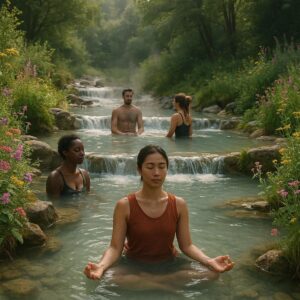
Silent Soaking & Observation: Practice mindful silence. Observe the sensations on your skin, the sound of water, the play of light on steam. When thoughts arise, gently return your focus to the physical sensations—the ultimate mindfulness anchor.
-
Closing with Gratitude: Upon leaving, offer a word of thanks, either silently, aloud, or with a small, eco-friendly offering (a flower, a pinch of grain). This completes the ritual cycle of receiving and giving back.
Chapter 6: The Psychology of Thermal Immersion – Letting Go in Liquid Warmth
Psychologically, the hot spring acts as a symbolic return to the womb—the ultimate safe, warm, and nurturing environment. This regression in the service of the ego allows for deep psychological restoration. The water provides containment, a secure boundary that makes it safe to emotionally “let go.” The heat facilitates release, both physically (of muscle armor) and emotionally (of stored trauma or stress). This process can lead to catharsis, insight, and a renewed sense of self, experienced as spiritual awakening or renewal.
Chapter 7: A Traveler’s Guide to Sacred Springs – Intentional Immersion
Choosing a spring for a spiritual journey involves more than checking temperature ratings.
-
Research the History: Seek out springs with known historical or cultural significance. This adds a layer of collective energy and narrative to your visit.
-
Consider the Setting: A rustic spring in a natural canyon often offers a more contemplative atmosphere than a developed resort pool. Nature amplifies the spiritual connection.
-
Respect Local Customs: Always follow posted rules and local traditions. At Japanese onsen, wash thoroughly before entering and use the small towel for modesty, not in the water. At silent retreat springs, honor the quiet.
-
Visit During Off-Hours: For a private, meditative experience, go at dawn, dusk, or on weekdays.
-
Disconnect to Reconnect: Leave your phone in your locker. Be fully present.
Chapter 8: Creating Your Own Sanctuary – Bringing the Sacred Spring Home
You can cultivate the spiritual essence of a hot spring in your daily bath.
-
Set the Space: Use dim lighting, candles (fire), crystals (earth), essential oils like lavender or eucalyptus (air), and of course, warm water.
-
Use Mineral Salts: Add Epsom salts (magnesium sulfate), Dead Sea salts, or clay to mimic the mineral-rich waters.
-
Ritualize Your Bath: Apply the same principles of intention-setting, purification, conscious breathing, and gratitude in your home tub. It is the mindfulness, not the geography, that makes it sacred.
Conclusion: Returning to the Source
Hot springs are the Earth’s ancient sacred sites, where her inner fire meets healing water, creating portals for human transformation. They teach us that healing is a holistic alchemy of elements, that true cleansing must touch the spirit, and that by immersing ourselves in nature’s primal wisdom, we can remember our own wholeness. To seek out a hot spring is to answer a call to return—to the source of life, to the core of our being, and to a timeless, warm silence that has nurtured seekers since the dawn of time.
Frequently Asked Questions (FAQs)
Q1: Do I need to follow a specific religion to experience the spiritual benefits of a hot spring?
A: Absolutely not. While many traditions have sacred practices around springs, the core experience—of elemental connection, physiological relaxation, and mindful immersion—is universal and accessible to anyone with an open and intentional mindset.
Q2: What’s the difference between a spiritual experience in a natural hot spring versus a man-made hot tub?
A: While you can create a sacred ritual in any setting, natural springs carry the geologically transformative journey of the water, the unique mineral profile, and the energy of a place revered for millennia. The connection to the living Earth is more direct and potent.
Q3: How long should I soak to have a meaningful experience?
A: Quality matters more than duration. Even 20 minutes of fully mindful, intentional immersion can be transformative. Listen to your body; typically, 15-30 minutes is recommended for a single soak, with cool-down breaks in between.
Q4: Are there any spiritual precautions I should take?
A: The main principle is respectful intention. Enter the space as you would any sacred site: with humility, gratitude, and a focus on cleansing and renewal. Avoid treating it as merely a recreational party spot if you are seeking deeper meaning.