Imagine if every word you spoke was an incantation, its syllables echoing with the wisdom of millennia. What if your daily greetings, your expressions of love, your cries of despair were not arbitrary sounds, but vessels carrying the condensed spiritual insights of countless generations? This is not a fantasy, but a hidden dimension of our reality, accessible through the study of etymology—the investigation of word origins. However, when we merge etymology with an inquiry into spiritual meaning, we move beyond mere academic history into the realm of metaphysical archaeology. We begin to excavate the soul of language itself.
In an age of digital shorthand and emoji, words can feel disposable. Yet, buried within their histories are maps of human consciousness, records of our ancestors’ most profound encounters with the divine, the self, and the cosmos. Each word is a fossilized intuition. To trace a word back to its root is to witness the moment of spiritual perception that demanded its creation. This article is an expedition into that numinous territory. We will explore how the spiritual concepts that define human experience across cultures—soul, breath, God, light, heart, sin, connection—are encoded in the very words we use to describe them. We will discover that language is not merely a tool for communication, but a living, breathing testament to humanity’s perennial search for meaning, a sacred text written not in one volume, but collectively across all tongues.
The Primordial Word: Language as a Sacred Vessel
Across spiritual traditions, the act of creation is synonymous with the act of speaking. In the Genesis narrative, God says, “Let there be light,” and there is light. The world is spoken into existence. This concept finds resonance in the Hindu tradition, where the primordial vibration Om (or Aum) is the source of all manifest reality. The Gospel of John opens with, “In the beginning was the Word (Logos), and the Word was with God, and the Word was God.” Here, the Logos is both the rational principle ordering the cosmos and the divine medium of creation.
This points to a universal intuition: that sound, word, and language are fundamental to reality’s structure. Etymology, then, becomes the process of reverse-engineering this creative act. If the universe was spoken, then by studying the roots of words, we are listening to the echoes of that original utterance as it has been refracted through human experience.
Consider the word “spirit” itself. It comes from the Latin spiritus, meaning “breath.” But this Latin term is itself a translation of the Greek pneuma (πνεῦμα) and the Hebrew ruach (רוח)—both meaning “breath,” “wind,” or “spirit.” At the very foundation of the concept lies a direct, physical experience: the breath. The breath is invisible, yet it is the essence of life. It enters and leaves the body, it can be gentle or powerful like the wind. Our ancestors, in their search for a word to describe the invisible essence of life, the animating force within, looked to the most immediate metaphor: the breath. Thus, the etymology of “spirit” encapsulates a whole spiritual ontology—the understanding that the life-force is an intangible, air-like presence.
The Etymological Tree: Roots, Branches, and Spiritual DNA
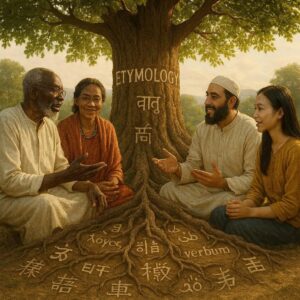
To understand spiritual etymology, we must visualize language as a great, living tree.
-
The Root (Proto-Languages): Deep underground, in the substratum of history, lie the proto-languages (like Proto-Indo-European, or PIE). These are hypothetical, reconstructed ancestors of language families. A PIE root is like a spiritual seed—a compact bundle of meaning and sound from which countless words will grow. For example, the PIE root *dyeu- meant “to shine” and, in extended use, “sky, heaven, god.” This single root is the spiritual DNA for a vast family of concepts.
-
The Trunk & Major Branches (Ancient Languages): As the root grows, it forms trunks—the great ancient languages like Sanskrit, Greek, Latin, and Hebrew. These languages served as the primary vessels for early philosophical and theological thought. They codified spiritual insights into stable forms. The PIE root *dyeu- becomes Zeus (Greek sky-father), Deus (Latin for god), Deva (Sanskrit for “shining one,” a god), and even the first part of the Latin Ju-piter (Father God). The connection between “shining,” “sky,” and “divinity” is preserved.
-
The Twigs and Leaves (Modern Languages): Finally, we reach the modern languages: English, Spanish, Hindi, German, etc. These are the twigs and leaves. A modern English word like “divine” comes from Latin divinus, from divus (god), tracing back to that same PIE *dyeu-. The word “Tuesday” is from Old English Tiwesdæg, “Tiw’s day.” Tiw was a Germanic sky god, another descendant of *dyeu-. So, every Tuesday, you inadvertently speak the name of an ancient sky god.
This tree model shows that words are not arbitrary labels but living entities with lineage. Their histories are narratives of spiritual cognition.
Table: The Spiritual Etymology of “Divinity” from a Single PIE Root
| PIE Root | Meaning | Greek Branch | Latin Branch | Sanskrit Branch | Germanic Branch | Modern English Derivatives |
|---|---|---|---|---|---|---|
| *dyeu- | To shine; sky, heaven, god | Zeus (supreme god) dios (“godly”) |
Deus (god) Divus (divine) Jupiter (from Dieu-pater, “God-Father”) |
Deva (देव) “shining one,” a god Dyaus (द्यौस्) “sky, heaven” |
Tiw/Tyr (war/sky god) Old English Tiwesdæg |
Divine, Deity, Deify Tuesday Jovial (from Jupiter) |
Divine Breath: Pneuma, Ruach, and the Animated Word
Let us delve deeper into the triad of spiritus, pneuma, and ruach. This convergence across Hebrew, Greek, and Latin is not a coincidence; it is a convergence of spiritual experience.
-
Ruach (רוח): In the Hebrew Bible, ruach is the creative, dynamic breath of God. It “hovers over the face of the waters” in Genesis 1:2. It is the force that animates the prophets, the source of wisdom and life. Ruach is never abstract; it is always an active, powerful presence—a wind, a breath, a life-giving force.
-
Pneuma (πνεῦμα): The Greek Septuagint translated ruach as pneuma. In Greek philosophy and the New Testament, pneuma carries forward this meaning. It is the rational soul, the Holy Spirit (Pneuma Hagion), the principle of animation distinct from the physical body (soma) and the emotional soul (psyche). It is the highest part of a person, capable of connecting with the divine.
-
Spiritus: Latin adopted this concept, making spiritus a central term in Christian theology. From it, we get “spirit,” “inspiration” (breathing in), “expiration” (breathing out, and also death), “respiration,” and even “conspiracy” (breathing together).
The spiritual meaning unlocked here is profound. The universal human intuition is that life is more than mechanical function; it is an indwelling animating principle, perceived as breath-like. Etymology reveals that our words for the most sacred aspect of our being are grounded in the most essential bodily function. It is a perfect metaphor: as breath unites the inner and outer worlds, so does spirit unite the individual with the cosmic.
The Logos: From Sacred Principle to Modern Logic
One of the most significant journeys in spiritual etymology is that of the Greek word Logos (λόγος). Its evolution mirrors the West’s shift from a mytho-poetic to a rationalistic worldview.
-
Original Meaning: Heraclitus (c. 500 BCE) used Logos to mean the underlying, divine order and reason that governs the cosmos. It is the principle behind all flux, the “Word” or “Account” of reality. It was inherently spiritual and metaphysical.
-
Theological Apotheosis: In the Gospel of John, as noted, Logos is identified with Christ—the divine reason and creative word made flesh. This fused Greek philosophical concept with Judeo-Christian revelation, making it central to Christian metaphysics for centuries.
-
Secularization and Fragmentation: Over time, the holistic, spiritual Logos was fragmented. It gave rise to:
-
Logic (the study of valid reasoning)
-
-logy suffixes (biology, theology, psychology—the “study of”)
-
Log (a record or account)
-
The spiritual meaning here is one of fragmentation and specialization. The original Logos was a unifying spiritual principle. Modern derivatives represent the breaking apart of that unity into discrete fields of study. To know the etymology of “logic” is to remember that it was once part of a vast, sacred whole. It invites us to reunite reason with reverence, to see logic not as a cold tool, but as a branch of the original divine Logos.
The Hidden Heart: Kardia, Cœur, and the Center of Being
In modern parlance, the “heart” is the seat of emotion, opposed to the “head” as the seat of reason. Etymology reveals a much richer, more unified spiritual understanding.
-
Kardia (καρδία): The Greek word for heart. In the New Testament, it does not merely represent feelings. It is the center of the whole person—intellectual, spiritual, and volitional. “Blessed are the pure in heart (kardia), for they shall see God.” (Matthew 5:8). The “heart” here is the unified core of one’s being, the seat of conscience and spiritual perception.
-
Cor (Latin): The Latin equivalent. It gives us courage (from Old French corage, “heart, innermost feelings”), cordially, concord (hearts together), discord (hearts apart), and even record (to bring back to heart, to remember).
-
Cœur (French): Directly from cor. It retains the sense of center, as in the cœur of a city or a lettuce.
The spiritual etymology shows that the heart was historically understood not as the sentimental organ, but as the integrative center of human identity. To be “courageous” was to act from one’s center. To be “in discord” was to have one’s core out of alignment with another’s. This invites a spiritual practice of moving from a fragmented self (head vs. heart) to an integrated one, where thought, feeling, and intention arise from a unified center.
Conclusion: The Living Language
Etymology is not dusty history; it is spiritual memory. Each word we speak is a palimpsest, its oldest layers bearing the impressions of our ancestors’ most sacred encounters. By listening to the soul of language, we recover a lost unity, seeing the divine breath in “spirit,” the cosmic order in “logic,” and the integrative center in “courage.” We realize that language itself is a living scripture, perpetually revealing that our search for meaning is woven into the very fabric of how we name our world.
Frequently Asked Questions (FAQs)
Q1: Is this a form of word magic or claiming that words have inherent power?
A: Not in a superstitious sense. It’s about recognizing that words are carriers of accumulated human consciousness and intuition. Understanding their roots can unlock deeper layers of meaning that influence our perception, which is a kind of psychological and spiritual power.
Q2: Can spiritual etymology be applied to any word?
A: While all words have history, the most fruitful applications are to abstract concepts—love, truth, faith, soul, evil, time, beauty—as these are where human cultures have invested their deepest philosophical and spiritual ponderings. Concrete words (like “table” or “car”) have less spiritual resonance in their etymology.
Q3: Doesn’t the meaning of words change? Why dwell on the past?
A: Meanings absolutely evolve, and that’s part of language’s life. However, the original meaning often acts as a subconscious foundation or a revealing metaphor. Knowing that “disaster” comes from Latin dis- (bad) and aster (star), implying “ill-starred,” adds a layer of cosmic resonance to the modern word that pure contemporary usage lacks.
Q4: How can I practice this in my daily life?
A: Pick one meaningful word each week. Use a robust etymological dictionary (like the Online Etymology Dictionary). Trace its roots. Meditate on the connection between its original metaphorical image and its current meaning. Journal about what this reveals about how people once experienced the concept.
Q5: Are there risks in over-interpreting etymologies?
A: Yes. The “etymological fallacy” is the mistake of believing the original meaning is the only or true meaning. Spiritual etymology is about enrichment, not prescription. It adds depth; it doesn’t dictate correct usage.
Additional Resources
-
Books:
-
The Origins of English Words: A Discursive Dictionary of Indo-European Roots by Joseph T. Shipley.
-
The Greek & Latin Roots of English by Tamara M. Green.
-
The Spiritual Emerson: Essential Works by Ralph Waldo Emerson (for his transcendentalist views on language).
-
-
Digital Tools:
-
Online Etymology Dictionary (www.etymonline.com): The premier free resource for English word origins.
-