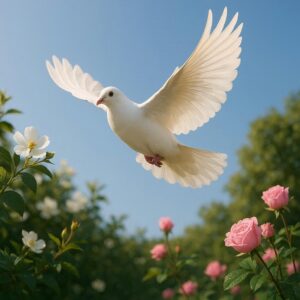
Across the silent expanse of human history, few symbols have soared as high and permeated as deeply into our collective psyche as the dove. More than just a bird, it is a living hieroglyph, etched against the sky, carrying meanings that transcend language, culture, and epoch. It is the flutter of hope after the flood, the visible breath of the divine, the gentle embodiment of love, and the quiet representation of the soul itself. Why does this particular creature, white wings beating in the light, resonate with such universal spiritual potency? This article embarks on a comprehensive journey to unravel the intricate tapestry of the dove’s spiritual meaning. We will traverse ancient temples and biblical narratives, ascend into mystical experiences, and decode the symbolic anatomy of this messenger bird. Our exploration seeks not just to list its associations, but to understand the why behind its enduring power as a bridge between the earthly and the ethereal, offering an exclusive and detailed map to one of humanity’s most cherished spiritual symbols.
Chapter 1: Primordial Whisper – The Dove in Ancient Mythology and Prehistory
Long before organized religion, the dove cooed in the sacred groves of human imagination. Its spiritual significance is rooted in some of our oldest stories and intuitions.
In ancient Mesopotamia, the dove was intimately linked with Ishtar (Inanna), the great goddess of love, war, and fertility. Here, the dove’s symbolism was multifaceted—representing both the tender aspects of love and the potent, generative forces of nature. It was seen as a sacred vessel of the goddess’s life-giving energy.
The Greek world revered the dove as a creature of profound sanctity. It was the sacred companion of Aphrodite (Venus to the Romans), the goddess born from sea-foam. The dove drew her chariot, symbolizing how love elevates and transports the spirit. Its association with Aphrodite cemented its link to feminine grace, beauty, and the irresistible call of the heart. Furthermore, doves were the oracular birds at the famed sanctuary of Dodona, where the rustling of their wings and their flight patterns were interpreted as the voice of Zeus, connecting the bird to prophecy and divine communication.
Perhaps the most foundational ancient myth comes from the Near East: the Great Flood narrative. A version appears in the Epic of Gilgamesh, where Utnapishtim releases a dove (and a raven) to find receding waters. This prefigures the iconic Biblical story, establishing the dove as a scout for salvation, a bearer of hope, and the proof of a new beginning—themes that would become central to its spiritual identity.
The Dove in Ancient Pantheons
| Civilization | Deity/Association | Primary Spiritual Meaning |
|---|---|---|
| Mesopotamia | Ishtar/Inanna | Sacred Love, Fertility, Feminine Divine Power |
| Greece | Aphrodite | Romantic Love, Beauty, Soulful Ascent |
| Greece | Zeus at Dodona | Prophecy, Divine Will, Oracle |
| Near East | Flood Myths (Gilgamesh) | Hope, Salvation, New Genesis |
Chapter 2: Covenant and Grace – The Dove in Judeo-Christian Tradition
The dove finds one of its most profound and detailed spiritual homes within the Judeo-Christian tradition, evolving from a sign of renewal to an emblem of divine presence.
In the Hebrew Bible (Tanakh), the dove’s most famous moment is in the story of Noah’s Ark (Genesis 8:6-12). After the floodwaters recede, Noah sends out a raven, which does not return, and then a dove. The dove returns twice—first with nothing, then with a fresh olive leaf. On its third flight, it does not return, signaling the earth is habitable. Here, the dove becomes the agent of God’s mercy, the proof of His covenant. The olive branch in its beak transforms into a timeless dual symbol: of peace (the end of God’s wrath) and renewal (new life sprouting from the deep). This single image codifies the dove as a universal icon of hope.
Later, in the Song of Songs, the beloved is often compared to a dove, emphasizing purity, innocence, and beloved companionship. “My dove, my perfect one, is unique,” (Song of Songs 6:9) speaks to the soul’s singular beauty in the eyes of the divine.
This symbolism crescendos in the New Testament. During the baptism of Jesus in the Jordan River by John the Baptist, a pivotal theophany occurs: “…and the Holy Spirit descended on him in bodily form like a dove…” (Luke 3:22). This moment is the theological cornerstone for the dove’s highest Christian meaning. It is no longer just a bird representing an idea; it is the chosen visible form for the third person of the Trinity. The dove becomes the embodiment of the Holy Spirit—the spirit of God that brooded over the waters of creation (Genesis 1:2), now brooding over the new creation in Christ. It signifies divine approval, anointing for ministry, and the gentle, guiding presence of God in the world.
Chapter 3: The Breath of the Divine – The Dove as the Holy Spirit
The Christian identification of the dove with the Holy Spirit deserves its own deep contemplation. Why a dove? Theologians and mystics have pondered this for millennia, finding rich layers of meaning in this correlation.
The dove embodies the gentle and approachable nature of the Spirit. Unlike the fearsome manifestations of God in wind, fire, or earthquake (1 Kings 19:11-12), the dove appears in softness and peace. This reflects the Spirit’s work as Comforter (Paraclete) and gentle guide (John 14:26). It is non-threatening, inviting, and accessible.
It represents purity and innocence. The Holy Spirit is holy—set apart and pure. The white dove reflects this flawless, sinless nature, descending upon Jesus, the sinless one. It symbolizes the cleansing power of the Spirit, who convicts and washes believers spiritually.
The dove is a symbol of new creation. Just as the dove signaled the new world after the flood, the Holy Spirit is the agent of spiritual rebirth. “Therefore, if anyone is in Christ, he is a new creation; the old has gone, the new has come!” (2 Corinthians 5:17). This renewal is the Spirit’s work.
Furthermore, the dove signifies peace with God. Its arrival at Jesus’ baptism marks the Son in whom the Father is “well pleased,” resolving the discord of sin. The Spirit brings the peace of reconciliation (Romans 5:1).
Finally, it represents love. The dove’s association with Aphrodite is transmuted; here, it becomes the symbol of agape—the selfless, divine love poured into hearts by the Holy Spirit (Romans 5:5). The dove, therefore, is the perfect pictorial representation of the Spirit’s attributes: gentle, pure, life-giving, peace-bringing, and loving.
Chapter 4: Soul Bird and Cosmic Messenger – The Dove in Eastern and Indigenous Wisdom
The dove’s spiritual flight is not confined to the West. In Hinduism, doves are often associated with Kamadeva, the god of love, much like Aphrodite. They symbolize conjugal fidelity, love, and the longing of the soul. In some stories, they represent devoted lovers, their bond seen as sacred. The cooing of the dove is sometimes poetically linked to the yearning of the individual soul (atman) for union with the universal soul (Brahman).
In Japanese Shinto and broader East Asian traditions, doves are considered messengers of the gods (kami) and are particularly associated with Hachiman, the god of war and agriculture—an interesting duality where the dove might symbolize the peace sought after conflict or the fertility of the land. White doves are seen as auspicious, carrying prayers to the divine realm.
Native American tribes hold varied views. Among some Pueblo peoples, the dove is a bird of fertility and germination, its call summoning the rain needed for crops. In other traditions, its gentle nature makes it a symbol of peace and gentleness of spirit, a guide to resolving conflict within the community.
These perspectives globally reinforce the dove as a psychopomp (soul guide) and a mediator. It travels between realms—earth and sky, human and divine, war and peace, drought and fertility—carrying the essence of what is needed to restore balance and harmony. It is a universal symbol of the interconnectedness of all life and the spiritual messages present in the natural world.
Chapter 5: Profane to Sacred – The Dove in Greco-Roman, Love, and Secular Contexts
Expands on the Greco-Roman roots, tracing the dove’s path from Venus’s chariot to the universal symbol of romantic love and pacifism in the modern era. Discusses its use in heraldry, as a political symbol (e.g., Picasso’s Dove of Peace for the World Peace Congress), and in secular weddings.
Chapter 6: Mystic Messenger – The Dove in Dreams, Visions, and Personal Spirituality
Explores the dove as a powerful archetype in Jungian psychology (anima, spirit, transcendence). Provides a detailed guide to interpreting dove appearances in dreams and meditative visions—what does it mean if it lands on you, flies away, is injured, etc.? Discusses it as a sign of spiritual reassurance, a call to peace, or a nudge from the higher self.
Chapter 7: Anatomy of the Symbol – How Form Informs Spirit
A detailed analysis of the dove’s physical attributes and how they inform its meaning:
-
White Plumage: Purity, light, spiritual attainment.
-
Soft Coo: Gentle communication, the inner voice, mourning (turtledove).
-
Flight and Wings: Ascension of the spirit, freedom, connection to the heavens.
-
Monogamous Nature: Fidelity, devoted love, sacred partnership.
-
Non-predatory: Innocence, harmlessness, trust.
Chapter 8: The Dove in Modern Consciousness – From Activism to Inner Peace
*Examines the dove’s role in 20th and 21st-century spiritual but non-religious movements. Its use in mindfulness and wellness as an icon for inner peace. Its powerful presence in environmental spirituality, representing ecological harmony. The chapter analyzes how this ancient symbol has been adapted for contemporary quests for meaning.*
Conclusion: The Unifying Sky
From the clay tablets of Mesopotamia to the baptismal fonts of Christianity, from love sonnets to peace marches, the dove has flown on steady wings. Its enduring spiritual power lies in its ability to embody our highest aspirations: for peace that follows storm, for love that transcends the mundane, for a spirit that connects us directly to the divine, and for a soul that yearns for its true home. It is not one symbol but a symphony of meanings, a single, gentle note that harmonizes across the chorus of human belief. In the end, the spiritual meaning of the dove is the meaning we most need to remember: that hope returns, love descends, and the spirit of peace is always within reach, waiting to alight upon an open heart.
FAQs on the Spiritual Meaning of the Dove
Q1: What does it mean spiritually when a dove visits you?
A visitation from a dove is widely considered a profound sign. It often indicates a message of peace, reassurance, or comfort from the spiritual realm. It can signal the end of a difficult period, a reminder to embrace love and gentleness, or a sign that you are being guided and protected by spiritual forces (like the Holy Spirit or your guardian angels).
Q2: What is the difference between a dove and a white pigeon in spirituality?
In spiritual symbolism, they are often used interchangeably, especially since many “white doves” released in ceremonies are actually homing pigeons. Both carry meanings of peace, love, and spirit. Culturally, “dove” tends to carry the heavier symbolic weight due to religious and poetic history, while “pigeon” is seen as more mundane. However, a white pigeon appearing meaningfully can certainly be interpreted with the same spiritual significance.
Q3: What does a dove symbolize in dreams?
Dreaming of a dove typically relates to your inner state. A calm, white dove often represents inner peace, spiritual guidance, or a resolution to conflict. A flying dove may symbolize hope or your soul’s aspirations. An injured dove could indicate wounded peace or a neglected gentle aspect of yourself. Context within the dream is crucial for personal interpretation.
Q4: Why is the dove a symbol of the Holy Spirit and not another bird?
The dove was chosen for its specific attributes that align perfectly with the nature of the Holy Spirit as described in scripture: gentleness (Matthew 10:16), purity, its role as a bringer of new life (the olive leaf), and its association with love and devotion. It provided a tangible, peaceful image for a spiritual reality that is otherwise intangible.
Q5: What does a pair of doves symbolize?
A pair of doves amplifies the symbolism of love, partnership, and fidelity. They represent devoted love, marital harmony, and the sacred union of two souls. In a broader sense, they can symbolize peace between two parties, duality in harmony (yin/yang), or the coming together of spirit and matter.