Imagine a bleak winter morning, the world rendered in monochrome shades of grey and white. The air is silent, the trees skeletal. In this hushed, dormant landscape, a sudden, electrifying flash of crimson pierces the gloom. A male Northern Cardinal alights on a barren branch, its vibrant plumage a defiant proclamation against the pallor. Its sharp, whistling song seems to cleave the stillness, a rhythmic “cheer, cheer, cheer” or “birdie, birdie, birdie.” For many, this encounter transcends mere ornithological appreciation. It strikes a deep, resonant chord in the human spirit, evoking a sense of surprise, joy, and an inexplicable feeling of connection—as if a message has been delivered.
This visceral response is the gateway to exploring one of the most poignant and widespread spiritual symbols in modern Christian and spiritually-inclined circles: the red cardinal as a bearer of biblical meaning and divine comfort. While the cardinal is never mentioned by name in the Bible (its New World habitat placed it beyond the knowledge of the biblical authors), its symbolism has been richly woven from the threads of Scripture, tradition, and human experience. It has become what we might call a “living metaphor,” a creature whose very nature—its color, its song, its behavior—echoes foundational biblical themes. This article embarks on a detailed, scholarly, yet deeply human exploration of this phenomenon. We will journey through Scripture, theology, history, and personal testimony to understand why this particular bird has become a scarlet sentinel for so many, watching over memories, inspiring hope, and whispering of an unseen, loving presence.
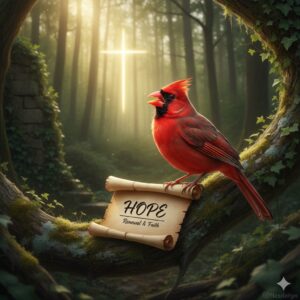
2. Biblical Foundations: Birds, Blood, and the Breath of Life
To build a framework for the cardinal’s meaning, we must first examine the biblical raw materials from which its symbolism is constructed: the overarching significance of birds, the profound theology of blood, and the divine breath that animates all life.
Birds as Biblical Agents and Symbols: Throughout the Bible, birds play multifaceted roles. They are part of God’s good creation (Genesis 1:20-23), symbols of God’s providential care (Matthew 6:26), and sometimes, agents of His provision (as with the ravens feeding Elijah in 1 Kings 17:4-6). The “fowls of the air” are listeners to Jesus’s parables (Luke 8:5) and inhabitants of the mustard tree (Luke 13:19). In the Psalms, the soul longs for God “as the hart panteth after the water brooks,” but wings are also a recurring motif for refuge: “Hide me under the shadow of thy wings” (Psalm 17:8). Birds, therefore, occupy a space in the biblical imagination as creatures under God’s attentive eye, capable of symbolizing dependency, freedom, and spiritual aspiration.
The Theology of Blood: Life, Atonement, and Covenant: The color red in the Bible is inextricably linked to blood, and blood is synonymous with life itself. “For the life of the flesh is in the blood,” states Leviticus 17:11. This life-force of the creature belonged to God. Crucially, this same verse continues, “and I have given it for you upon the altar to make atonement for your souls; for it is the blood that makes atonement by reason of the life.” Blood becomes the sacred medium of sacrifice, the means by which sin is covered and covenant relationship with God is established. The blood of the Passover lamb delivered Israel from death (Exodus 12). The blood of sacrifices sealed the Mosaic covenant (Exodus 24:8). This entire system finds its ultimate fulfillment in the New Testament declaration: “…without shedding of blood is no remission [of sins]” (Hebrews 9:22), pointing directly to the sacrificial death of Jesus Christ. His blood is called the “blood of the new testament” (Matthew 26:28), effecting eternal redemption. Thus, the color red carries a profound duality: it represents the vital life-force given by God and the sacrificial, atoning death required to restore that life when severed by sin.
Ruach and Nefesh: The Breath of Life: Beyond blood, the Bible speaks of a more intangible animating principle: breath or spirit. The Hebrew word ruach (wind, breath, spirit) and nefesh (soul, life, creature) are central. In Genesis 2:7, “the LORD God formed man of the dust of the ground, and breathed into his nostrils the breath of life; and man became a living soul (nefesh).” Life is an impartation of divine breath. This connects to the Holy Spirit (the same word, Ruach), the giver and sustainer of life. The vibrant, lively cardinal, with its vital energy and spirited song, becomes a natural emblem of this God-given animation—a creature pulsating with the ruach that God has bestowed upon all living things.
3. The Color Scarlet in Scripture: From Sin to Salvation
The cardinal’s most striking feature is its color, a brilliant scarlet or crimson. This hue has a complex and transformative symbolic journey within the Bible.
Scarlet as the Stain of Sin: The prophet Isaiah delivers a sobering word from the Lord: “Come now, and let us reason together… though your sins be as scarlet, they shall be as white as snow; though they be red like crimson, they shall be as wool” (Isaiah 1:18). Here, scarlet is the deep-set, fast-dye stain of human iniquity. It is a color of moral failure, vivid and glaring against the purity of God’s standard. This association is reinforced in the Book of Revelation, where the great harlot Babylon is arrayed in “purple and scarlet” (Revelation 17:4).
Scarlet in the Fabric of Sanctuary and Grace: Paradoxically, this same color of sin is woven into the very fabric of God’s dwelling place and plan of salvation. God commanded that the tabernacle include curtains of “scarlet, and fine twined linen” (Exodus 26:1). The purification rites for a leper involved “scarlet” (Leviticus 14:4). Most significantly, the scapegoat ritual on the Day of Atonement involved a scarlet thread, symbolically transferring the sins of the people (Leviticus 16:21-22; see also Isaiah 1:18’s link). Scarlet thread appears in the story of Rahab, marking her house for salvation during Jericho’s destruction (Joshua 2:18).
This duality is critical. Scarlet does not merely represent sin; it represents sin placed upon the vehicle of atonement. It is the color of transgression made visible so that it can be borne away. The symbol undergoes a transformation: from the stain on us to the sign of our covering. In the Christian interpretive tradition, this points directly to Jesus, who “bore our sins in his own body on the tree” (1 Peter 2:24). The scarlet is upon Him, the sacrificial Lamb, so that we might be made white as snow.
Thus, when the cardinal’s red plumage is seen through a biblical lens, it can evoke this full narrative arc: a recognition of human frailty, a remembrance of the costly sacrifice that addresses it, and the resulting promise of cleansing and renewal.
4. The Cardinal as a Modern Symbol: How a Bird Became a Spiritual Messenger
The fusion of these biblical themes with the cardinal’s natural history in popular spirituality is a fascinating study in emergent meaning. Several key attributes of the bird itself catalyzed this symbolic association:
Its Vibrancy and Conspicuousness: The male cardinal’s year-round, non-migratory brilliance makes it a constant, startling presence. In spiritual terms, this translates to the enduring, ever-present hope and vitality of faith, even in life’s bleakest “winters.” It is a visual parable of perseverance.
Its Song and Communication: The cardinal’s clear, whistle-like song is a year-round feature. This aligns with themes of praise, proclamation, and the “good news.” Its song can be interpreted as a call to worship or a reminder to maintain a joyful, praising spirit in all seasons.
Pair Bonding and Family: Cardinals often form strong, lasting pair bonds and may raise multiple broods together. The female, while more subdued in her tan and red-tinged plumage, is an equal partner. This has led to the cardinal symbolizing lasting love, devoted relationships, and family harmony, reflecting the biblical ideal of covenant love.
The “Visitor” Phenomenon: Anecdotes abound of cardinals appearing at significant moments—during grief, prayer, or times of decision. They often linger conspicuously at windows or in yards. This behavior has cemented its role as a “divine messenger” or a sign of comfort from the Holy Spirit or departed loved ones. The idea is not that the bird is the loved one, but that a compassionate God may use His creation to tangibly remind us of His love and the communion of saints.
5. Theological Perspectives: Divine Presence, Providence, and Remembrance
From a theological standpoint, the cardinal’s symbolism can be viewed through several coherent frameworks:
A Sign of General Grace and Providence: Theologians speak of God’s general grace—His benevolent, sustaining care for all creation, reflected in the natural order (Matthew 5:45). The cardinal, in its beauty and design, is a testament to this. Its appearance can serve as a gentle, universal reminder of God’s creative artistry and His faithful upholding of the world. It points to the Creator behind the creation (Romans 1:20).
A Particular Token of Comfort: Beyond general grace, many believers testify to what might be seen as a particular token of comfort. In moments of acute sorrow or prayer, the unexpected appearance of a cardinal can feel like a direct, personal reassurance of God’s nearness (Psalm 34:18). This falls under the category of personal spiritual experience, where God, who numbers the hairs on our head (Matthew 10:29-31), uses means within His creation to minister to His children.
The “Cloud of Witnesses” and Remembrance: The association with departed loved ones is powerful, though it requires careful theological navigation. The Bible does not teach transmigration of souls. However, it does affirm the great “cloud of witnesses” (Hebrews 12:1) and the living state of those who have died in Christ. The cardinal, then, can function as a symbolic prompt for remembrance and hope. It does not signify the presence of the loved one’s spirit in the bird, but rather, it triggers a memory that stirs hope in the resurrection and the eternal life promised to believers. It is a natural symbol pointing to a supernatural reality.
An Emblem of the Holy Spirit: Some see in the cardinal’s fiery color a symbol of the Holy Spirit, who descended at Pentecost as “tongues of fire” (Acts 2:3). The Spirit is Comforter, Advocate, and the giver of life and vitality—all themes mirrored in the cardinal’s symbolic roles.
6. Personal Narratives and Cultural Resonance
The power of this symbol is most evident in personal testimony. Across countless books, blogs, and conversations, similar stories emerge:
-
A woman, grieving her mother, prays for a sign of peace. A cardinal taps at her window for three consecutive mornings.
-
A man feeling spiritually desolate on a winter hike stops, and a cardinal’s song breaks through his melancholy, lifting his heart in sudden, unexpected praise.
-
Families adopt the cardinal as a symbol of a lost child or parent, finding solace in its visits on anniversaries or holidays.
These narratives form a modern, oral tradition of comfort. They are not doctrinal assertions but lived experiences of meaning-making, where God’s creation intersects with human need in profoundly personal ways. The cultural resonance is seen in the proliferation of cardinal-themed sympathy cards, jewelry, and artwork in Christian and spiritual markets, all speaking a silent language of hope, memory, and enduring love.
7. Contrast with Other Spiritual Traditions
Placing the Christian/biblical interpretation of the cardinal in a wider context illuminates its specificity. In Native American traditions of the regions where cardinals are native, the bird is often seen as a bringer of good fortune, a symbol of relationships, and sometimes a carrier of messages from the spirit world, but not tied to a biblical theology of blood atonement. In some Far Eastern traditions, red birds can symbolize luck, joy, or the sun. The uniquely Christian interpretation is filtered through the distinct lens of Scripture—the scarlet thread of sin and salvation, the theology of sacrifice, and the hope of resurrection in Christ. This provides a rich, narrative depth that is particular to the biblical worldview.
8. Scientific Marvel: The Northern Cardinal’s Natural History
Appreciating the symbol is enriched by understanding the symbol-bearer. The Northern Cardinal (Cardinalis cardinalis) is a fascinating creature:
-
Diet: It feeds on seeds, grains, and insects, its strong beak perfectly adapted for cracking husks.
-
Territory: It is fiercely territorial, with males defending their domain year-round.
-
Molting: Unlike many birds, it does not molt into a dull plumage; its brilliance is constant.
-
Range: Originally more southerly, its range has expanded northward due in part to bird feeders and habitat change.
This scientific reality does not diminish its spiritual symbolism; it grounds it. The God of the Bible is the God of both nature and grace. The cardinal’s resilience, its designed adaptations, and its ecological role all speak of the intricate wisdom of the Creator, adding another layer of awe to the encounters people have with it.
9. A Table of Symbolic Correspondences
The table below synthesizes how the cardinal’s natural attributes have been mapped onto biblical and spiritual themes.
| Cardinal Trait | Biblical/Spiritual Symbolism | Supporting Scriptural Themes |
|---|---|---|
| Vibrant Red Plumage | The blood of Christ (atonement); Vitality of faith; The fire of the Holy Spirit. | Leviticus 17:11; Isaiah 1:18; Hebrews 9:22; Acts 2:3. |
| Year-Round Presence | God’s constant faithfulness; Hope in all seasons of life; Everlasting love. | Lamentations 3:22-23; Jeremiah 31:3; Psalm 23:4. |
| Clear, Whistling Song | Praise and thanksgiving; Proclamation of good news; A call to joyful worship. | Psalm 96:1-2; Psalm 98:4-6; Ephesians 5:19-20. |
| Strong Pair Bonding | Covenant love; Fidelity in marriage and family; Devotion. | Malachi 2:14-16; Ephesians 5:25-33; 1 Corinthians 13:7-8. |
| Appearance as a “Visitor” | Divine comfort and presence; Remembrance of loved ones; A prompt to hope. | Matthew 11:28-30; 2 Corinthians 1:3-4; Hebrews 12:1; 1 Thessalonians 4:13-14. |
| Non-Migratory Nature | Steadfastness; Rootedness in faith; Resilience. | 1 Corinthians 15:58; Colossians 2:6-7; James 1:12. |
10. Nurturing a Sanctuary: Inviting the Sacred into Our Spaces
For those drawn to this symbolism, creating a cardinal-friendly environment can be a tangible act of cultivating awareness. Planting native shrubs like dogwood or serviceberry for shelter and food, providing a clean water source, and offering black oil sunflower seeds in a sturdy feeder can invite these “scarlet sentinels” into one’s daily view. This stewardship turns a yard into a potential sanctuary—a place where the beauty of creation can continually whisper of the Creator. It is an active participation in the cycle of care, a way to remain open to the moments of unexpected grace that a flash of crimson can bring.
11. Conclusion: The Echo of a Song
The red cardinal, though absent from the biblical text, has flown into the heart of modern spiritual experience, its scarlet wings brushing against themes as deep as sin and redemption, as enduring as faithful love, and as comforting as divine presence. It stands as a testament to the human capacity to find meaning in God’s creation, a living symbol woven from the threads of Scripture, natural wonder, and personal encounter. It reminds us that hope can be vivid and vocal, that memory is linked to promise, and that even in life’s winter, a song of cheer persists—an echo of a deeper, eternal song of salvation.
12. Frequently Asked Questions (FAQs)
Q1: Is the red cardinal mentioned in the Bible?
A: No, the Northern Cardinal is a bird native to the Americas and was unknown to the biblical authors. Its symbolism is derived from its characteristics (color, song) interpreted through biblical themes.
Q2: Does a cardinal appearing mean a deceased loved one is visiting me?
A: Biblically, human spirits do not inhabit animals. However, many Christians and spiritual individuals interpret a cardinal’s timely appearance as a God-sent sign to remember that loved one and the hope of eternal life, or as a symbol of comfort from the Holy Spirit. It is a symbol of connection and hope, not literal transmigration.
Q3: What is the difference between a male and female cardinal’s symbolism?
A: Both carry the core symbolism. The brilliant male often emphasizes vitality, presence, and the more outward signs of faith. The subtler, still red-tinged female can symbolize the foundational, nurturing aspects of faith, love, and devotion. Together, they powerfully represent covenant partnership.
Q4: Is it wrong or superstitious to believe cardinals are signs?
A: It becomes problematic if one attributes divine power to the bird itself or engages in fortune-telling. However, viewing God’s creation as a means through which He can encourage and remind us of His truths is aligned with a biblical view of His sovereignty and general revelation. The sign points to God, not to itself.
Q5: Are there other birds with biblical symbolism?
A: Yes. Doves represent the Holy Spirit and peace (Matthew 3:16). Ravens symbolize God’s provision (1 Kings 17:6). Eagles represent renewal and strength (Isaiah 40:31). The cardinal’s modern symbolism is unique in its specific connection to themes of blood, remembrance, and year-round hope.
13. Additional Resources
-
Biblical Studies:
-
Dictionary of Biblical Imagery (InterVarsity Press). An excellent resource for exploring symbols, themes, and metaphors throughout Scripture.
-
The Symbolism of Color in Scripture by Leon L. Legrand. A focused theological study.
-
-
Ornithology & Spirituality:
-
The Gospel of the Redbird by Paula D’Arcy. A personal narrative exploring grief and spiritual encounter through nature.
-
All Things Bright and Beautiful: Birding, Faith, and Healing by James McCormac. Connects bird appreciation with spiritual reflection.
-
-
Theology of Creation:
-
The Lost World of Genesis One by John H. Walton. Offers a framework for understanding God and creation.
-
Care of Creation by R.J. Berry. Discusses Christian environmental stewardship.
-
-
Online Resources:
-
The Cornell Lab of Ornithology (AllAboutBirds.org). For comprehensive scientific data on the Northern Cardinal.
-
The Bible Project (BibleProject.com). Offers short, insightful videos on biblical themes, including sacrifice, covenant, and the Holy Spirit.
-