Imagine standing before a breathtaking, intricate mosaic, viewing it only through a small, frosted window. You perceive the general shapes and colors, a hint of the grand narrative, but the texture of each tile, the subtle interplay of light, and the full majesty of the artist’s vision remain obscured. This is the experience of reading the Bible solely in translation. While our English Bibles are faithful and invaluable gifts, they are, by necessity, interpretations—attempts to convey the meaning of a profoundly different ancient language into modern thought forms.
Biblical Hebrew is not merely a set of labels for spiritual concepts; it is a dynamic, verb-oriented, concrete language that invites the reader into a multi-sensory, experiential understanding of God, humanity, and creation. Each word is a world, rich with cultural, historical, and theological nuance that often defies a single English equivalent. To explore these words is to move from the frosted window into the room itself, to run your fingers over the mosaic tiles of divine revelation. This article is an invitation to that journey. We will delve into the very fabric of biblical thought, exploring key Hebrew words and their expansive meanings, not to accumulate academic knowledge, but to deepen our encounter with the living Word of God.
The Nature of Biblical Hebrew: A Language of Concrete Action
Unlike abstract Greek or conceptual English, Biblical Hebrew is fundamentally a language of the senses and action. It prefers the tangible over the theoretical. For example, Hebrew does not have a word for “religion” as an abstract system of belief. Instead, it speaks of “the fear of the LORD” (Yirat YHWH, יִרְאַת יְהוָה), a concept involving awe, reverence, and practical obedience. It doesn’t conceptualize “faith” as mere intellectual assent but as “faithfulness,” “steadfastness,” or “firmness” (Emunah, אֱמוּנָה), rooted in the same word as “Amen.”
Hebrew thought is holistic, seeing the human person not as a composite of separate parts (body, soul, spirit) but as a unified whole with different aspects or orientations. This concrete nature means that words often carry a range of meanings that seem disparate to us but are connected by a core, tangible idea. Understanding this “concrete core” is the key to unlocking Hebrew meaning.
The Power of Roots: Tri-Literal Consonants as Building Blocks
The foundational genius of Biblical Hebrew lies in its root system. Almost every word is built upon a core of (usually) three consonants, known as the tri-literal root. This root conveys a basic, often physical, idea. By applying vowel patterns and adding prefixes or suffixes, a whole family of related words springs from this single root.
For instance, take the root כ-ת-ב (K-T-V), whose core idea is “writing.”
-
-
-
KaTaV (כָּתַב) = He wrote (verb)
-
KToVet (כְּתוֹבֶת) = Inscription (noun)
-
MiKTaV (מִכְתָּב) = A letter, something written (noun)
-
KTuVim (כְּתוּבִים) = The “Writings,” the third section of the Hebrew Bible (noun)
-
-
This system creates a dense web of meaning throughout the Scriptures. When you recognize a root, you begin to see conceptual connections between verses and books that are invisible in translation. The root ש-פ-ט (Sh-P-T), for example, means to judge, govern, or bring justice. It gives us:
-
-
-
ShoPheT (שֹׁפֵט) = A judge, ruler (e.g., the Book of Judges)
-
MiShPaT (מִשְׁפָּט) = Judgment, justice, ordinance
-
-
A word’s meaning is always shaped by its immediate context and the wider context of its root family. This root-based architecture makes Hebrew a remarkably poetic and conceptually unified language.
Key Conceptual Words and Their Expansive Meanings
Let us now turn to some of the most theologically significant words in the Hebrew Bible. We will explore their root, their concrete core, and the expansive semantic range they cover, which is often collapsed into a single, inadequate English word.
Chesed (חֶסֶד): Beyond “Lovingkindness” – The Covenant Bond
Often translated as “lovingkindness” (KJV), “steadfast love” (ESV), “mercy,” or “faithful love,” Chesed is one of the most profound words in Scripture. It describes the loyal, faithful, and merciful love that exists within a covenant relationship. It is not a fleeting emotion but a binding commitment to act for the good of another.
-
-
-
Concrete Core: While its exact etymology is debated, Chesed implies a strength, loyalty, and mutual obligation. It is the glue that holds a covenant together.
-
Expansive Meaning: It can manifest as kindness, mercy, loyalty, grace, and unwavering love. It is the defining characteristic of God’s relationship with Israel (e.g., Exodus 34:6-7) and is expected to be mirrored in human relationships (e.g., Micah 6:8).
-
Key Insight: Chesed is often paired with Emet (אֱמֶת, “truth, faithfulness”). Together (Chesed v’Emet, חֶסֶד וְאֱמֶת), they describe a love that is both passionately committed and utterly reliable. When Boaz acts as Ruth’s go’el (kinsman-redeemer), he is embodying chesed (Ruth 3:10).
-
-
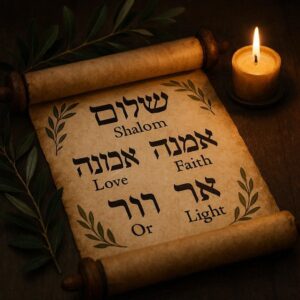
Shalom (שָׁלוֹם): Beyond “Peace” – Wholeness and Completion
The common translation “peace” can mislead us into thinking of Shalom as merely the absence of conflict or a state of inner tranquility. Its meaning is vastly more positive and comprehensive.
-
-
-
Concrete Core: The root ש-ל-ם (Sh-L-M) means wholeness, completeness, soundness, and health. Related words include Shalem (complete, whole), Shalem (to pay, to make complete), and Tashlumim (payment).
-
Expansive Meaning: Shalom is a state of universal flourishing, wholeness, and delight. It is harmony in relationships (with God, others, and self), physical well-being, prosperity, justice, and safety. It is how things ought to be. To inquire after someone’s shalom (as in “How are you?” – Mah Shlomcha?, מַה שְּׁלוֹמְךָ?) is to ask about their total welfare.
-
Key Insight: Shalom is the ultimate goal of God’s redemptive plan. The Messiah is the “Prince of Shalom” (Isaiah 9:6), whose reign brings complete restoration. True shalom is inseparable from righteousness and justice (Psalm 85:10).
-
-
Nephesh (נֶפֶשׁ): Beyond “Soul” – The Whole Living Being
The translation “soul” often evokes a purely spiritual, immaterial essence trapped in a body—a Greek Platonic idea, not a Hebrew one. Nephesh is far more holistic.
-
-
-
Concrete Core: Its root is related to breath or throat. At its most basic, a nephesh is a “breathing creature.”
-
Expansive Meaning:
-
The Whole Person: “My nephesh” often simply means “me” or “myself” (Psalm 103:1).
-
Life or Life Force: “The nephesh of the flesh is in the blood” (Leviticus 17:11).
-
Desires and Appetites: The nephesh can hunger, thirst, and crave (Deuteronomy 12:20).
-
Emotional Center: It can be grieved, delighted, or lovesick (Song of Solomon).
-
-
Key Insight: A human is not having a nephesh; a human is a living nephesh (Genesis 2:7). This underscores the Hebrew view of the human as an animated body, not an incarnated soul. Salvation is thus pictured as the redemption and restoration of the whole nephesh.
-
-
Ruach (רוּחַ): Beyond “Spirit” – Wind, Breath, and Powerful Presence
Like Nephesh, Ruach is often spiritualized. Its meanings flow from a tangible, observable phenomenon.
-
-
-
Concrete Core: Ruach means wind, breath, or air in motion.
-
Expansive Meaning:
-
Physical Wind: The ruach that parted the Red Sea (Exodus 14:21).
-
Human Breath/Spirit: The life-breath given by God (Genesis 6:17). Also, the seat of emotions and mind (a troubled ruach, Genesis 41:8).
-
Divine Spirit: The Ruach Elohim—the powerful, dynamic presence and agency of God at work in creation (Genesis 1:2), in empowering leaders (Judges 3:10), and in inspiring prophets.
-
-
Key Insight: The Ruach HaKodesh (Holy Spirit) is not an abstract force but the powerful, personal breath/wind of God bringing life, power, prophecy, and transformation (Ezekiel 37:9-10, Joel 2:28-29).
-
-
A Comparison of Key Hebrew Concepts and Their English Translations
| Hebrew Word (Root) | Common English Translations | Concrete Core Idea | Expansive Biblical Meaning |
|---|---|---|---|
| Chesed (חֶסֶד) | Lovingkindness, Steadfast Love, Mercy | Covenant Loyalty, Strength | The active, faithful, merciful love that fulfills relational obligations; the defining quality of God’s covenant relationship. |
| Shalom (שָׁלוֹם) | Peace | Wholeness, Completeness | Universal flourishing, harmony, well-being, prosperity, justice, and safety—the way creation is meant to be. |
| Nephesh (נֶפֶשׁ) | Soul, Life, Person | Throat, Breath, Breathing Creature | The whole living being; the self; life force; the seat of appetite, emotion, and desire. |
| Ruach (רוּחַ) | Spirit, Wind, Breath | Wind, Air in Motion | The wind; human breath/spirit; the powerful, dynamic presence and activity of God. |
| Kavod (כָּבוֹד) | Glory, Honor | Weight, Heaviness, Substance | Tangible importance, splendor, and majesty; the manifest presence of God that has substance and impact. |
| Yada (יָדַע) | To Know | To Know by Experience | Intimate, relational, and experiential knowledge (e.g., “Adam knew Eve”); to choose and be in relationship with. |
| Shama (שָׁמַע) | To Hear | To Hear with Attention | To listen intelligently, to understand, to obey, and to take action based on what is heard. |
Kavod (כָּבוֹד): Beyond “Glory” – Tangible Weightiness
We speak of God’s “glory,” but Kavod moves beyond light or radiance to something almost physical.
-
-
-
Concrete Core: The root כ-ב-ד (K-B-D) means to be heavy, weighty, or significant. The liver, a heavy organ, is the Kaved (כָּבֵד).
-
Expansive Meaning: Something with kavod has substance, importance, and honor. A wealthy or influential person has kavod. God’s kavod is His manifest, weighty, awe-inspiring presence—so tangible it can be seen (Isaiah 6:3, Exodus 40:34-35) and can even fill a physical space.
-
Key Insight: To “give glory to God” (tenu laYHWH kavod, תְּנוּ לַיהוָה כָּבוֹד) is to acknowledge and ascribe to Him the ultimate weightiness, significance, and honor He inherently possesses (Psalm 29:1-2). Our English “glory” often misses this sense of substantive, awe-inspiring presence.
-
-
Yada (יָדַע): Beyond “To Know” – Intimate, Experiential Knowledge
Hebrew knowledge is not primarily intellectual. Yada is knowledge gained through the senses, experience, and intimate relationship.
-
-
-
Concrete Core: It implies direct, personal encounter and familiarity.
-
Expansive Meaning: It ranges from simple awareness (Proverbs 24:12) to deep understanding (Isaiah 1:3) to the most intimate relational knowledge, as between a husband and wife (Genesis 4:1). For God to “know” someone is for Him to choose them, be in covenant with them, and care for them intimately (Amos 3:2, Jeremiah 1:5).
-
Key Insight: “The fear of the LORD is the beginning of knowledge (da’at, דַּעַת, from yada)” (Proverbs 1:7). True knowledge of God begins not with facts, but with a relational posture of awe and obedience. Eternal life is defined as knowing God (John 17:3, a concept deeply rooted in Hebrew thought).
-
-
Shama (שָׁמַע): Beyond “To Hear” – To Listen, Obey, and Act
The famous Shema prayer begins, “Hear (Shama, שְׁמַע), O Israel…” (Deuteronomy 6:4). This is not an invitation to merely perceive sound.
-
-
-
Concrete Core: It means to hear with intelligence, attention, and focus.
-
Expansive Meaning: Shama inherently includes the idea of response. To hear God’s word is to obey it. The same word is used for both concepts. “To obey is better than sacrifice” (1 Samuel 15:22) is essentially “to shama is better…”
-
Key Insight: Biblical hearing is an engaged, active faculty. It is the foundation of the covenant relationship. Israel’s failure is often described as having ears but not hearing (Isaiah 6:9-10). True shama results in action.
-
-
The Divine Names: Windows into God’s Character
In Hebrew thought, a name reveals essence and character. The various names of God in Scripture are not mere titles but profound revelations of who He is and how He relates to His creation.
YHWH (יהוה): The Covenant, Personal God
The Tetragrammaton (YHWH) is the personal, covenant name of God, revealed to Moses at the burning bush (Exodus 3:14-15). Its exact pronunciation (“Yahweh” is the scholarly consensus) was considered too sacred to utter, leading to the substitution “Adonai” (My Lord) in reading.
-
-
-
Meaning: Derived from the verb “to be” (hayah, הָיָה), it speaks of God’s self-existence, aseity, and dynamic presence. “I AM WHO I AM” implies “I will be who I will be”—He is the unchanging God who is always present with His people to fulfill His promises.
-
Significance: This name is used in the context of God’s intimate, covenantal relationship with Israel. It is the name of redeeming grace and faithful presence.
-
-
Elohim (אֱלֹהִים): The Sovereign, Mighty One
Elohim is a plural noun (though usually used with singular verbs), a common Semitic term for deity, emphasizing God’s majesty, power, and sovereignty as the Creator.
-
-
-
Meaning: It highlights God’s strength and His role as the supreme Judge and Ruler over all creation.
-
Significance: It is the primary name used in Genesis 1, highlighting God’s transcendent power as Creator. The shift to YHWH Elohim in Genesis 2:4 signals the combination of sovereign power with personal, relational engagement with humanity.
-
-
El Shaddai (אֵל שַׁדַּי): The All-Sufficient, Nurturing God
Frequently translated “God Almighty,” Shaddai may be connected to the word for mountain (shad, שַׁד) or breast (shad, שָׁד), suggesting strength, stability, and nurturing provision.
-
-
-
Meaning: The God of the Mountain (supreme power) or the God who Nourishes and Satisfies.
-
Significance: This is the primary name used with the patriarchs (Abraham, Isaac, Jacob), emphasizing God’s power to bless, fulfill promises, and provide abundantly, even in seemingly impossible situations (Genesis 17:1, 28:3).
-
-
Theological Themes Through Hebrew Words
Sin: Three Key Hebrew Words
The Bible uses a rich vocabulary for sin, each highlighting a different facet.
-
-
-
Chatta’ah (חַטָּאָה): This most common word means “to miss the mark,” like an archer missing the target. It is failing to live up to God’s standard.
-
Pesha (פֶּשַׁע): Translates to “transgression” or “rebellion.” It is a willful, knowing breach of relationship, an act of defiance.
-
Avon (עָוֹן): Often translated “iniquity,” it comes from a root meaning to bend, twist, or pervert. It is the ingrained crookedness or guilt resulting from sin.
Understanding these nuances gives depth to passages like Isaiah 53:5, where the suffering servant is pierced for our pesha (rebellions) and crushed for our avon (iniquities).
-
-
Redemption: Ga’al (גָּאַל) and Padah (פָּדָה)
The concept of redemption is central, pictured through two powerful words.
-
-
-
Ga’al: The role of the go’el (kinsman-redeemer). This was a family member who had the responsibility to buy back family land, marry a childless widow (levirate marriage), or avenge a wrong. It is a deeply personal, familial redemption (Book of Ruth, Leviticus 25). God is Israel’s Go’el (Isaiah 41:14).
-
Padah: A more general term for ransom or deliverance, often involving a payment or substitution. It emphasizes the cost of redemption (Deuteronomy 7:8).
-
-
Worship: Avodah (עֲבוֹדָה) and Shachah (שָׁחָה)
-
-
-
Avodah: Means work, service, or labor. Worship is not a passive event but active service to God. The Tabernacle/Temple “service” was the avodah. This connects worship to the work of our daily lives (Romans 12:1).
-
Shachah: To bow down, to prostrate oneself. It is the physical posture of submission, reverence, and homage before a superior, expressing the heart’s attitude toward God (Psalm 95:6).
-
-
Practical Tools for Deeper Study
-
-
-
Use Interlinear Bibles and Lexicons: Resources like Blue Letter Bible or BibleHub allow you to see the Hebrew text alongside transliteration and Strong’s Concordance numbers, linking to lexicons like Brown-Driver-Briggs (BDB) or the Theological Wordbook of the Old Testament (TWOT).
-
Consult Word Study Books: Vine’s Complete Expository Dictionary of Old and New Testament Words (for a start) or more advanced works like the Theological Dictionary of the Old Testament (TDOT).
-
Read Multiple Translations: Compare translations like the ESV (literal), NIV (balanced), NLT (dynamic), and JPS Tanakh (Jewish perspective) to see how different committees handle difficult Hebrew concepts.
-
Learn the Hebrew Alphabet: Even a basic ability to recognize the Aleph-Bet and sound out words can transform your engagement with tools and resources.
-
Listen to Teaching: Seek out sermons and lectures from scholars who specialize in biblical languages and Hebrew thought.
-
-
Conclusion: A Lifetime of Discovery
Our journey into the world of Biblical Hebrew words reveals that Scripture is not a flat document but a deep well of living water. To study chesed, shalom, nephesh, and the divine names is to move from a black-and-white sketch into a vibrant, multidimensional landscape of meaning. This exploration enriches our reading, deepens our theology, and, most importantly, fosters a more intimate and accurate knowledge of the God who chose to reveal Himself in the concrete, poetic, and powerfully relational language of the Hebrews. The task is not for scholars alone; it is an invitation to every serious reader of the Bible—a lifetime of discovery awaits in the very words of God.
Frequently Asked Questions (FAQs)
Q1: Do I need to learn Hebrew to understand the Bible properly?
A: No, you can have a deep, saving, and transformative understanding of Scripture through faithful translations and the illumination of the Holy Spirit. However, learning even a little Hebrew is like getting a high-definition lens for that understanding; it resolves ambiguities, reveals connections, and deepens appreciation in profound ways.
Q2: What’s the best Hebrew word study resource for a beginner?
A: A great starting point is The Bible Project’s video word studies (free online). For a book, Walking in the Dust of Rabbi Jesus by Lois Tverberg or The Hebrew Word Picture by Frank T. Seekins offer accessible introductions. For a more robust tool, The Strongest Strong’s Exhaustive Concordance or the digital Blue Letter Bible app are excellent.
Q3: Why are there so many different English translations for a single Hebrew word?
A: Because Hebrew words have a range of meaning (a “semantic range”) that no single English word can capture. Translators must choose the English word they believe best fits the context, sometimes emphasizing one facet of the meaning over another. Comparing translations highlights this richness.
Q4: What is the most important Hebrew word to know?
A: While all are significant, YHWH (יהוה) is foundational, as it is God’s personal, covenant name. Understanding chesed (His covenant love) and shalom (His ultimate goal) are also profoundly transformative for one’s theology.
Q5: How does understanding Hebrew affect the reading of the New Testament?
A: Immensely. The New Testament authors (except Luke) were Jews whose minds were saturated with Hebrew Scripture (the Old Testament) and its concepts. They wrote in Greek, but they thought in Hebrew. Understanding Hebrew background clarifies teachings on “soul,” “spirit,” “righteousness,” “peace,” “redemption,” and Jesus’ titles like “Son of Man” and His “I AM” statements.
Additional Resources
-
-
Books:
-
Theological Wordbook of the Old Testament (TWOT) by Harris, Archer, and Waltke (2 vols).
-
The Brown-Driver-Briggs Hebrew and English Lexicon (BDB).
-
Biblical Hebrew for Beginners by Bonnie Pedrotti Kittel.
-
God, Names of by Baker’s Evangelical Dictionary of Biblical Theology.
-
-
Websites:
-
Blue Letter Bible (blb.org): Powerful online tool with interlinear, lexicons, and commentaries.
-
BibleProject (bibleproject.com): Exceptional animated videos on biblical themes and word studies, deeply informed by Hebrew.
-
Ancient Hebrew Research Center (ancient-hebrew.org): Focuses on the original concrete meaning of the alphabet and words.
-
-