Whispered in the prophecies of Isaiah, etched on ancient seals, and soaring through the realms of angelic hierarchy, the name Ariel resonates with a profound and layered mystery within biblical and spiritual tradition. More than a mere label, it is a title, a symbol, and a portal into understanding God’s relationship with His holy city, His messianic promises, and the unseen forces that shape creation. Unlike names with singular, straightforward meanings, Ariel exists in a state of purposeful duality—it is both a symbol of devastating judgment and a promise of divine protection; it is an altar of sacrifice and a lion of royal strength. This article embarks on an exhaustive exploration of Ariel’s multifaceted identity, tracing its journey from the smoking altar hearth of a besieged Jerusalem to its place in mystical thought, Christian exegesis, and enduring cultural imagination. We will dissect its etymological roots, unpack its prophetic weight, and follow its enigmatic thread through history, seeking to understand why this “Lion of God” continues to captivate and inspire.
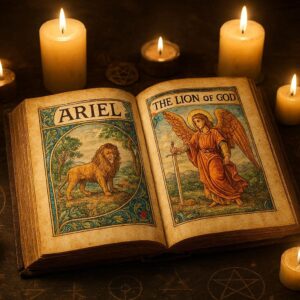
Ariel in the Hebrew Bible: A Name with Multiple Faces
The primary appearances of “Ariel” in the canonical Hebrew Bible (Tanakh) are few but intensely significant. Its meaning shifts dramatically based on context, showcasing the rich wordplay characteristic of Hebrew prophecy.
The Altar Hearth of Jerusalem (Isaiah 29:1-2, 7)
The most pivotal and complex reference is in Isaiah’s “Woe Oracle” against Jerusalem:
“Woe to Ariel, to Ariel, the city where David encamped! Add year to year; let the feasts run their round. Yet I will distress Ariel, and there shall be moaning and lamentation, and she shall be to me like an Ariel.” (Isaiah 29:1-2, ESV)
Here, Ariel is explicitly identified with Jerusalem, specifically the city of David. The prophet delivers a stern message of impending siege and divine judgment. The crucial wordplay lies in the word Ariel itself (אֲרִיאֵל), which Isaiah appears to derive from ‘ari’el (אֲרִיאֵל), combining ’ari (lion) and ’el (God). However, a more direct and contextually powerful link is to the word ’ari’el (אֲרִיאֵל) meaning “altar hearth.”
In ancient Israelite worship, the ’ari’el was the flat, raised hearth of the altar of burnt offering (Ezekiel 43:15-16), the place where the sacrificial fire continuously burned. Isaiah’s prophecy is terrifyingly vivid: Jerusalem, the city chosen by God, will become like its own altar—a place of consuming fire, slaughter, and sacrifice. The city that should have been the center of pure worship will instead become a site of devastating judgment. The feasts (verse 1) will not prevent this fate; they will culminate in a horrific, sacrificial siege.
The Dual Symbolism of Ariel in Isaiah 29
| Symbol | Meaning for Jerusalem | Prophetic Outcome |
|---|---|---|
| Altar Hearth (’Ari’el) | Place of sacrifice and consuming fire. | The city will become a scene of slaughter and destruction during siege. |
| Lion of God (’Ari-’El) | Symbol of strength, royalty, and God’s protection. | Its strength will fail; its God will fight against it, making it helpless. |
| City of David | Center of covenant, worship, and divine promise. | Its rituals are empty; it faces judgment for its hypocrisy and blindness (Isa 29:13-14). |
Yet, Isaiah’s prophecy does not end in ashes. The chapter famously pivots to a promise of redemption (Isaiah 29:17-24). The nations that besiege Ariel will themselves be swept away like chaff (Isaiah 29:5-8). Thus, Ariel’s suffering is not final but purgative, leading to a future restoration where “those who err in spirit will come to understanding, and those who murmur will accept instruction.”
The Poetic Symbol: Ariel as Lion of God
While Isaiah emphasizes the “altar hearth,” the literal components of the name—’ari (lion) + ’el (God)—are undeniable. This creates a powerful, paradoxical image. Jerusalem, the “Lion of God,” is a title of immense privilege and strength, evoking the tribe of Judah (Genesis 49:9) and the Davidic king. Yet, in Isaiah’s oracle, this lion is being subdued by its own Master. The name becomes an ironic lament: the mighty lion is reduced to a smoldering altar.
In other poetic and prophetic books, the lion imagery for God’s people or their enemies is common (e.g., Numbers 23:24, Jeremiah 2:15). Ariel, as a compound name, uniquely encapsulates this attribute as an intrinsic identity of the holy city itself—an identity that can be a source of either triumph or terrible accountability.
The Enigmatic City (Ezra 8:16) and the Moabite Stone
A second, obscure reference appears in Ezra 8:16, where “Ariel” is the name of a leading figure (likely a title or a personal name) sent to secure ministers for the Temple. This suggests that by the post-exilic period, “Ariel” could be used as a proper name, perhaps one evoking the sanctity of the Jerusalem altar.
Furthermore, outside the Bible, the Moabite Stone (Mesha Stele, c. 840 BCE) mentions a place called ’r’l, which some scholars cautiously associate with Ariel. If connected, it indicates the name had geographical usage in the region, possibly meaning “Lion of God” or “Hearth of God” as a place name, long before Isaiah’s poetic adaptation.
Ariel in Apocryphal and Mystical Traditions
Beyond the canonical texts, Ariel’s identity expands dramatically in intertestamental literature and Jewish mysticism.
The Guardian of the Hidden
In the Book of Enoch (1 Enoch), Ariel appears among the angelic beings, often associated with the earth, Jerusalem, or the natural world. He is sometimes depicted as an angel who presides over punishment (paralleling the Isaiah theme) or as a regent of the waters.
The most significant development is in the Sibylline Oracles and other apocalyptic texts, where Ariel is interpreted as an alternative name for Jerusalem. This solidifies the interpretive tradition from Isaiah 29 and carries it into eschatological visions of the end times, where the fate of Ariel/Jerusalem is central to cosmic redemption.
Esoteric Interpretations in Jewish Mysticism
In the vast tapestry of Kabbalah and later Jewish mystical thought, Ariel’s stature grows. He is frequently enumerated among the archangels or powerful angelic princes. His domain is multifaceted:
-
Angel of Nature and the Earth: He is often seen as the spirit of the earth, the winds, and wild creatures—a logical extension of the “lion” imagery connecting him to the untamed, primal forces of creation.
-
Angel of Punishment and Justice: Reflecting his Isaiah role, he is sometimes the executor of divine judgments.
-
Guardian of the Sacred City: In some traditions, he remains the specific angelic protector of Jerusalem, a celestial counterpart to its earthly reality.
-
Connection to the Divine Chariot (Merkabah): In esoteric commentaries on Ezekiel’s vision, Ariel is occasionally associated with the lion-faced living creatures (hayyot), linking him directly to the throne-chariot of God.
These mystical interpretations transform Ariel from a symbolic title for a city into a distinct, powerful celestial entity, mediating between the divine will and the physical world, particularly the Land of Israel.
Ariel in Christian Theology and Interpretation
The early Church Fathers and subsequent Christian theologians inherited the Jewish scriptural and interpretive traditions surrounding Ariel, recontextualizing them through a Christological lens.
Christological Readings: The Lion of Judah
Christian exegetes, beginning with figures like Jerome, powerfully connected Ariel to Jesus Christ. The “Lion of God” or “Lion of Judah” title from Genesis 49:9-10 and Revelation 5:5 was seen as the ultimate fulfillment of the Ariel symbol.
-
The True Altar Hearth: Jesus becomes the ultimate and final ’ari’el—the true altar of sacrifice, whose body on the cross is the consummate offering that takes away the sin of the world. The judgment that fell on Jerusalem-as-Ariel prefigured the judgment borne by Christ as the sin-bearer for humanity.
-
The Divine Lion-King: The mighty, royal aspect of the lion is fully realized in the resurrected and ascended Christ, the conquering King from the line of David. The weakness and judgment prophesied for Ariel-Jerusalem are overcome in the person of the Messiah.
Ecclesiological and Eschatological Dimensions
Ariel also informed Christian understanding of the Church and the end times:
-
The Church as Spiritual Ariel: Following the pattern of 1 Peter 2:5, which calls believers a “spiritual house,” the Church as the New Jerusalem could be understood as the new “Ariel”—a community built on the true altar (Christ), offering spiritual sacrifices.
-
Eschatological Focus on Jerusalem: Prophetic and dispensationalist Christian thought retains a strong focus on the literal city of Jerusalem in the end times. Isaiah 29 is often read as having a dual fulfillment—in the ancient Assyrian/Babylonian sieges and in a future, final conflict before the messianic age. Thus, “Ariel” remains a potent code name for Jerusalem in the theater of apocalyptic prophecy.
Cultural and Literary Legacy: From Shakespeare to Modernity
The name Ariel escaped purely religious confines to become a fixture in Western art and literature, most famously in Shakespeare’s The Tempest. Shakespeare’s Ariel is an “airy spirit,” a powerful, shapeshifting entity bound to serve Prospero. While not directly drawn from biblical commentary, Shakespeare likely encountered the name in contemporary occult and magical grimoires where Ariel was listed as a spirit of the air and earth—a direct inheritance from the mystical traditions. This literary incarnation cemented Ariel in the popular imagination as a symbol of ethereal power, freedom, and connection to the natural elements.
In modern fantasy literature, film, and art, the name often carries these connotations—denoting a spirit, an angel, or a character with a mystical, nature-oriented power, a distant but recognizable echo of the “Lion of God” who rules the wild places.
Archaeological and Historical Correlations
While no archaeological find explicitly labels ancient Jerusalem “Ariel,” the concept finds haunting resonance in the city’s history. The siege destruction layers from the Babylonian conquest (586 BCE) uncovered in the City of David excavations—with evidence of widespread burning and violence—provide a stark archaeological testimony to the fulfillment of Isaiah’s prophecy: Jerusalem did indeed become a smoldering ’ari’el, an altar hearth of judgment.
Furthermore, Hebrew seals and bullae (clay stamp impressions) from the First Temple period bearing the name “Ariel” (as a personal name) have been found, confirming its usage in Judahite society, likely as a theophoric name expressing devotion to the God of Israel (’El).
Contemporary Spiritual Applications
For modern believers and spiritual seekers, the layered meanings of Ariel offer profound insights:
-
A Warning Against Empty Ritual: The judgment on Ariel-Jerusalem was due to a religion of mouth and tradition, not heart (Isaiah 29:13). It serves as a timeless call to authentic faith over hollow observance.
-
The Promise of Redemptive Suffering: Ariel’s story is one of purging and eventual restoration. It offers a template for understanding hardship as a potentially purifying fire, leading to a deeper dependence on God.
-
The Majesty and Mystery of God: As both consuming fire and mighty lion, the symbolism points to a God who is both awe-inspiringly holy and powerfully protective. He is Lord of the altar and Lord of the wild.
-
A Symbol of Hope for Restoration: The ultimate promise for Ariel is transformation and peace (Isaiah 29:17-24). It anchors hope that no matter how dire the judgment, God’s covenantal purposes for His people will prevail.
Conclusion: The Enduring Roar
From Isaiah’s ominous prophecy to its mystical angelic forms and its Christological culmination, Ariel remains a profound biblical symbol of God’s severe mercy, transformative judgment, and unwavering commitment to His purposes. It encapsulates the destiny of Jerusalem, the nature of true sacrifice, and the power of the divine Lion who alone brings ultimate victory and peace. The roar of Ariel, across millennia, still speaks.
Frequently Asked Questions (FAQs)
Q1: Is Ariel a male or female angel in the Bible?
A: In the original biblical text (Isaiah 29), Ariel is not an individual angel but a symbolic name for Jerusalem, a city grammatically feminine in Hebrew. In later mystical traditions (Kabbalah, grimoires), Ariel is almost universally depicted as a male archangel or spirit.
Q2: What is the difference between Ariel and Uriel?
A: They are distinct figures. Ariel (Lion of God) is associated with earth, nature, Jerusalem, and judgment. Uriel (Light of God or Fire of God) is traditionally an archangel of wisdom, prophecy, and divine light, often depicted as a guide and interpreter. Their roles and etymologies are different.
Q3: Why did Shakespeare choose the name Ariel for his spirit?
A: Shakespeare was likely influenced by Renaissance occultism and grimoires (like the Heptameron) where Ariel is listed as a powerful spirit of the air and earth, capable of controlling winds and storms—perfect for the magical servant in The Tempest.
Q4: Is praying to the angel Ariel biblically sound?
A: Mainstream Christian and Jewish theology strongly discourages praying to angels. The biblical focus is on worship and prayer directed to God alone (e.g., Colossians 2:18, Revelation 19:10). Angels are seen as God’s messengers and servants, not intercessors for prayer.
Q5: How is Ariel connected to modern Jerusalem?
A: For many Jews and Christians who take a prophetic/literal view of scripture, “Ariel” remains a spiritual and poetic title for the city of Jerusalem. It is sometimes used in modern Israeli context as a male first name and appears in institutional names, consciously evoking its ancient heritage.