Imagine a world without color—a monotonous, gray-scale existence. Now, open the pages of the Bible. You are instantly transported into a vividly chromatic universe: the deep blues of the firmament, the scarlet thread of Rahab, the fiery red of sacrificial blood, the radiant white of transfiguration garments, the royal purple of a mocking robe, and the emerald green rainbow encircling the throne of God. Color is not merely decorative in Scripture; it is revelatory. It is a fundamental language in the divine lexicon, a silent yet profound vehicle for communicating spiritual truths, moral conditions, and the very nature of God and humanity. From the intricate weaving of the Tabernacle curtains to the apocalyptic visions of Revelation, colors serve as God’s symbolic code, weaving a tapestry of meaning that spans the entirety of the biblical narrative. This exhaustive exploration seeks to decode that covenant of color, offering a detailed, scholarly, and spiritually enriching journey through the divine spectrum as revealed in the Holy Scriptures.
The Methodology of Meaning: Understanding Biblical Symbolism
Before delving into specific hues, it is crucial to establish the hermeneutical (interpretive) framework. Biblical color symbolism is not arbitrary, nor is it a precise, rigid scientific code where a color always means one thing. Its meaning is derived from a confluence of factors:
-
Context is King: The single most important rule. The meaning of a color is determined by its immediate narrative, poetic, or prophetic context. Red in a battle scene differs from red in a ritual setting.
-
Cultural & Historical Resonance: The symbolic weight of a color in the ancient Near Eastern and Mediterranean world informs its biblical usage. Purple’s association with royalty, for instance, was rooted in the exorbitant cost and rarity of the Tyrian purple dye.
-
Canonical Connection: Symbols gain depth through repetition and development across the biblical canon. The “white stone” in Revelation 2:17 echoes the Urim and Thummim of the High Priest’s breastplate, creating intertextual resonance.
-
Typology: Colors often point forward to Christ and the New Covenant. The red blood of the Passover lamb is a type of the sacrificial blood of Christ.
-
Material Reality: Often, the symbolism springs from the physical source of the pigment—ochre for red, a specific mollusk for purple, lapis lazuli for blue—linking the symbol to the tangible world God created.
With this framework in mind, we can begin our chromatic exploration.
White: Purity, Divinity, and Triumph
White stands as the most consistently positive color in the Bible, representing an uncompromised state of purity, holiness, victory, and divine manifestation.
-
Divine and Angelic Manifestation: White is the color of divine radiance. Daniel sees the Ancient of Days with clothing “white as snow” and hair “like pure wool” (Daniel 7:9). At the Transfiguration, Jesus’s face “shone like the sun, and his clothes became as white as the light” (Matthew 17:2), revealing His uncreated, divine glory. Angels routinely appear in gleaming white garments (Matthew 28:3; John 20:12; Acts 1:10), signifying their celestial origin and purity.
-
Purification and Forgiveness: The prophet Isaiah delivers the profound promise: “‘Though your sins are like scarlet, they shall be as white as snow; though they are red as crimson, they shall be like wool’” (Isaiah 1:18). Here, white is the state of the soul cleansed by God’s forgiveness. In Psalm 51:7, David pleads, “Wash me, and I will be whiter than snow.”
-
Victory and Resurrection: In Revelation, white is the color of conquest and eternal reward. The faithful of Sardis who have not soiled their garments will “walk with me [Jesus] dressed in white, for they are worthy” (Revelation 3:4). The twenty-four elders around the throne are clothed in white (Revelation 4:4), and the great multitude that has come out of the great tribulation have “washed their robes and made them white in the blood of the Lamb” (Revelation 7:9, 14). The rider on the white horse in Revelation 19:11 is the triumphant Word of God, Faithful and True, leading the armies of heaven.
-
Righteous Acts: The fine linen, “bright and clean,” worn by the Bride of Christ (the church) in Revelation 19:8 is explicitly stated to represent “the righteous acts of God’s holy people.”
Thus, white embodies the ultimate goal: the spotless purity of God, imputed to the believer through Christ’s sacrifice, resulting in eternal victory.
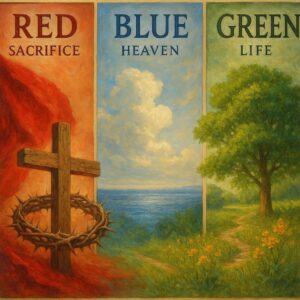
Red: Blood, Sacrifice, and Atonement
Red is the color of visceral life and costly redemption. Its primary symbol is blood, the vital fluid that represents both life and death.
-
The Blood of Sacrifice and Atonement: This is the central theme. From the first sacrifice to cover Adam and Eve’s sin (Genesis 3:21) to the blood of the Passover lamb marking the doors in Egypt (Exodus 12:13), blood signifies a substitutive death that turns away judgment. Leviticus 17:11 states the principle unequivocally: “For the life of a creature is in the blood, and I have given it to you to make atonement for yourselves on the altar; it is the blood that makes atonement for one’s life.” The red of the countless altar sacrifices points unerringly to the ultimate sacrifice: the “precious blood of Christ, a lamb without blemish or defect” (1 Peter 1:19).
-
Human Sin and Guilt: While blood cleanses, red can also symbolize the stain of sin itself, as seen in the Isaiah 1:18 passage contrasting scarlet sins with white wool. Esau’s trade of his birthright for “some red stew” (Genesis 25:30) hints at the impulsive, fleshly nature of his decision.
-
War and Judgment: Red is the color of battlefields. Nahum’s vision of God’s avenging armies includes “scarlet uniforms” (Nahum 2:3). In Revelation, the second horseman rides a fiery red horse, symbolizing violent conflict and war that takes peace from the earth (Revelation 6:4).
-
Earthly Origin: The name “Adam” (adamah) is linguistically connected to the word for “red earth,” highlighting humanity’s humble, physical origins (Genesis 2:7).
Red, therefore, tells the story of a profound problem (sin and death) and its even more profound solution (sacrificial blood), culminating in the Cross.
Blue: Heaven, Covenant, and Command
Blue, specifically the vibrant “blue of the sky” (tekhelet in Hebrew), is the color of transcendence, divine origin, and enduring faithfulness.
-
The Heavenly Realm: Blue directly points to the heavens, God’s dwelling place. In the vision of God on Sapphire throne (Exodus 24:10), the blue stone symbolizes the firmament. It serves as a constant visual reminder that the laws and worship of Israel are not earthly inventions but have their source in the heavenly realm.
-
The Covenant Reminder: God commanded the Israelites to attach a blue cord to the tassels (tzitzit) on the corners of their garments (Numbers 15:38-40). The explicit purpose was visual: “You will have this tassel to look at and so you will remember all the commands of the Lord…and be holy to your God.” The blue cord connected the mundane act of getting dressed to the transcendent reality of the covenant.
-
Priestly and Sacred Objects: Blue was a dominant color in the Tabernacle and Temple fabrics, always intertwined with gold, purple, and scarlet. The veil separating the Holy Place from the Most Holy Place was of blue, purple, and scarlet yarn (Exodus 26:31). The ephod of the High Priest prominently featured blue (Exodus 28:31). Blue coverings were used for transporting the sacred Ark and other utensils (Numbers 4:6-12).
-
Divine Authority: As the color of heaven’s authority, blue reinforces that the instructions given are from God Himself.
Blue acts as a theological anchor, lifting Israel’s gaze—and ours—from the earthly to the heavenly, from the temporary to the eternal covenant.
Purple: Royalty, Priesthood, and Wealth
Purple (and often paired with violet or purple-blue) was the most expensive dye in the ancient world, produced painstakingly from the murex snail. Its symbolism flows directly from its material cost and rarity.
-
Secular Kingship and Imperial Power: Throughout the ancient world, purple was the mark of sovereignty. In the Bible, it denotes royal status. The kings of Midian wore purple (Judges 8:26). Mordecai was honored with a robe of purple in the Persian court (Esther 8:15). In the New Testament, the Roman soldiers mock Jesus’s claim to kingship by dressing him in a purple robe (Mark 15:17; John 19:2).
-
Divine Kingship and Priesthood: More significantly, purple is used in the service of the true King. God commands its use in the Tabernacle fabrics and the High Priest’s garments (Exodus 28:5-6). This signifies that Aaron and his sons are priests of the heavenly King. In Revelation, the figure worthy of power and wealth is clothed in purple—the “great prostitute” of Babylon, who parodies true royalty (Revelation 17:4; 18:16), and ironically, also the true King, as purple is included in the description of the New Jerusalem’s glorious radiance (Revelation 21:19-20? – jasper is clear, not purple; but the city’s beauty is multi-hued).
-
Extreme Wealth and Commerce: Lydia, a convert of Paul in Philippi, was a “dealer in purple cloth” (Acts 16:14), indicating her high social and economic status. The merchants of Babylon in Revelation lament the loss of their market for “purple cloth” (Revelation 18:12).
Purple uniquely bridges the spiritual and material, representing both the supreme authority of God and the corrupting allure of worldly power and luxury when divorced from Him.
Scarlet & Crimson: Sin, Luxury, and Redemption
A subset of red with its own distinct connotations, scarlet (shani) and crimson (tola) carry a potent duality: deep sin and luxurious worldly splendor, both ultimately addressed by redemption.
-
The Stain of Sin: As noted in Isaiah 1:18, sins are “like scarlet” and “red as crimson.” The depth and fastness of these dyes made them a perfect metaphor for ingrained, glaring transgression.
-
Worldly Magnificence: Simultaneously, scarlet was a color of beauty and luxury. The curtains of the Tabernacle (Exodus 26:1) and the garments of the wealthy (2 Samuel 1:24, Proverbs 31:21) utilized scarlet. It represented the best the world had to offer.
-
The Scarlet Thread of Redemption: This duality finds stunning resolution in the symbolism of the scarlet thread. Rahab the prostitute is saved from the destruction of Jericho by binding a scarlet cord in her window (Joshua 2:18, 21). This cord echoes the blood of the Passover lamb and signifies her faith and inclusion in God’s people. Later Jewish tradition also held that the scarlet thread used in Temple rituals would turn white on the Day of Atonement as a sign of God’s forgiveness—a tradition some connect to Isaiah’s prophecy. Most profoundly, the thread appears in the lineage of Christ itself: Tamar gives birth to Perez, marking him with a scarlet thread (Genesis 38:28-30), and he becomes an ancestor of David and Jesus (Matthew 1:3).
Scarlet, therefore, encapsulates the biblical narrative: from the glaring reality of sin and the allure of the fallen world, to the miraculous thread of grace that runs through history, culminating in a redemption so powerful it can make scarlet white.
Gold: Divine Nature, Glory, and Kingship
Gold, untarnishing and intrinsically valuable, is the metal of the divine. It symbolizes God’s immutable nature, His manifest glory, and righteous kingship.
-
The Nature of God and Heaven: Gold’s incorruptibility mirrors God’s perfection and eternity. The New Jerusalem is of “pure gold, as pure as glass” (Revelation 21:18). The streets are gold so transparent it’s like crystal (Revelation 21:21). This represents a reality where divine purity is all-pervading.
-
Divine Glory and Presence: In the Tabernacle and Temple, gold was used extensively in the Most Holy Place: the Ark of the Covenant was overlaid with pure gold (Exodus 25:10-11), as were the walls of Solomon’s Temple (1 Kings 6:20-22). This created a space ablaze with reflected light, symbolizing the overwhelming, glorious presence of God (Shekinah).
-
Righteous Kingship and Deity of Christ: The gifts of the Magi included gold, fitting for a king (Matthew 2:11). The seven golden lampstands in Revelation 1:12 represent the churches, shining with a derived, reflected glory under Christ’s care. The bowls full of incense, held by the elders, are golden (Revelation 5:8), representing the prayers of the saints. Christ himself is described with feet like “fine brass burned in a furnace” (Revelation 1:15), a form of refined, glowing gold-bronze, indicating His glorious, judging nature.
-
Warning: Idolatry and False Worship: The negative counterpart is the golden calf (Exodus 32), where gold, intended to point to God, is fashioned into an idol. Gold can symbolize misplaced worship and wealth that leads away from God (Jeremiah 10:4, Revelation 18:16).
Gold points unswervingly to the worth, glory, and eternal nature of God. It is the material that most adequately, yet still inadequately, attempts to reflect His sublime essence.
Silver: Redemption, Truth, and Refinement
Silver, while precious, often holds a more transactional or utilitarian symbolism compared to gold’s divine associations.
-
Redemption Price: Silver is the metal of redemption. In the Mosaic law, a person could be dedicated to God by paying a redemption price in silver shekels (Leviticus 27:1-8). Every Israelite counted in the census had to pay a half-shekel as “atonement money” for his life, a ransom to the Lord (Exodus 30:11-16). This foreshadowed Christ’s redemptive work, though Peter clarifies we were redeemed “not with perishable things such as silver or gold…but with the precious blood of Christ” (1 Peter 1:18-19).
-
Refinement and Purity: The process of refining silver is a powerful metaphor for God’s purifying work in a person’s life. “The crucible for silver and the furnace for gold, but the Lord tests the heart” (Proverbs 17:3). “You have tested us, O God; you have refined us like silver” (Psalm 66:10). Malachi prophesies that the coming messenger will be “like a refiner’s fire” (Malachi 3:2-3).
-
The Foundation of the World: In a fascinating architectural metaphor, Proverbs 8 describes Wisdom (often associated with Christ) being present at creation, where God “marked out the foundations of the earth” (Proverbs 8:29). While not explicitly silver, the concept of a measured, valued foundation connects to the use of silver sockets in the Tabernacle.
-
Utilitarian Value and Commerce: Silver was common currency (the infamous “thirty pieces of silver” in Matthew 26:15). It represents worldly wealth and trade, which is neutral in itself but can be used for good (building the Tabernacle, Exodus 35:24) or evil (Judas’s betrayal).
Silver speaks of the costly process of redemption, the necessary refinement of the soul, and the foundational truths upon which God’s work is built.
Green: Life, Vitality, and Flourishing
Green is the color of organic, created life in its healthy, God-sustained state.
-
Spiritual Vitality and Blessing: The righteous person is “like a tree planted by streams of water…whose leaf does not wither” (Psalm 1:3). This verdant, evergreen state symbolizes a life nourished by God’s Word. “I am like a green olive tree in the house of God” (Psalm 52:8). Green pastures are where the Good Shepherd leads His sheep (Psalm 23:2).
-
Physical Creation and Provision: Green is the color of grass, herbs, and trees—the very fabric of the living world God declared “good” (Genesis 1:11-12, 30). It represents God’s faithful provision through the cycles of nature (Genesis 8:22).
-
Temporal Nature of Flesh: In its fragility, green also reminds us of human transience. “All people are like grass, and all their glory is like the flowers of the field; the grass withers and the flowers fall” (1 Peter 1:24, quoting Isaiah 40:6-8). Our physical life, though vibrant, is temporary compared to the eternal Word of God.
-
The Emerald Rainbow: In John’s apocalyptic vision, the one seated on the throne has the appearance of “jasper and ruby,” and “a rainbow that shone like an emerald encircled the throne” (Revelation 4:3). This green-hued rainbow, an echo of God’s covenant with Noah, surrounds His judgment seat, perhaps signifying that His eternal, life-giving covenant undergirds His sovereign rule.
Green is the chromatic signature of life itself—both its glorious, God-dependent flourishing and its humble, temporary nature—always pointing back to the Creator as the source of all vitality.
Black: Judgment, Famine, and the Unknown
Black, the absence of light, predominantly symbolizes negativity: judgment, despair, famine, and the obscurity of the unknown.
-
Famine and Desolation: Black is the color of scorched earth and mourning. In Revelation, the third horseman rides a black horse and carries scales, and a voice cries out, “Two pounds of wheat for a day’s wages, and six pounds of barley for a day’s wages, and do not damage the oil and the wine!” (Revelation 6:5-6). This vividly depicts famine and extreme economic hardship. Joel describes a coming judgment as a day of “darkness and gloom, a day of clouds and blackness” (Joel 2:2; Zephaniah 1:15).
-
Mourning and Affliction: Sackcloth, made of coarse black goat hair, was the garment of mourning, penitence, and lament (Revelation 6:12). Job, in his suffering, says, “My skin grows black and peels” (Job 30:30).
-
Mystery and the Unknown: Black can represent that which is hidden from human understanding. “He made darkness his covering, his canopy around him—the dark rain clouds of the sky” (Psalm 18:11). God’s ways can be inscrutable, a “deep darkness” (Job 37:19). However, even this darkness is not absolute separation: “darkness is as light to you” (Psalm 139:12).
-
Cosmic Signs: The sun turning black is an apocalyptic sign of cosmic judgment (Revelation 6:12; Joel 2:31).
Black serves as a solemn reminder of the consequences of sin, the reality of divine judgment, and the fragility of life apart from God’s sustaining light.
The Interplay of Colors in Prophetic Visions
The most complex use of color occurs in prophetic literature, particularly in Ezekiel, Daniel, and Revelation. Here, colors are not isolated symbols but combine to form overwhelming, multi-sensory visions.
-
Ezekiel’s Visions: Ezekiel sees four living creatures with the appearance of “burning coals of fire” (red/orange) and lightning, beside wheels of “beryl” (likely a yellow-green gem). The expanse over their heads has the “awesome gleam of crystal” (clear/white/blue) (Ezekiel 1:4-28). This riot of color conveys the overwhelming, fiery, dynamic, and terrifying holiness of God’s mobile throne-chariot.
-
Daniel’s Statue: King Nebuchadnezzar’s dream of a statue with a head of gold, chest of silver, belly of bronze, legs of iron, and feet of iron mixed with clay presents a color-coded timeline of empires, declining in value but increasing in strength, until finally shattered by God’s eternal kingdom (Daniel 2:31-45).
-
The Apocalypse of John: Revelation is a masterpiece of chromatic theology. We see:
-
The Son of Man: Hair white as snow, eyes like flaming fire (red/gold), feet like burnished bronze, voice like rushing waters (Revelation 1:14-15).
-
The Four Horsemen: White (conquest), Red (war), Black (famine), Pale Green (chloros—sickly green, representing death) (Revelation 6:1-8).
-
The Great Prostitute: Dressed in purple and scarlet, adorned with gold, jewels, and pearls (Revelation 17:4).
-
The New Jerusalem: Has the glory of God, its radiance like a “most precious jewel, like a jasper, clear as crystal” (Revelation 21:11). The foundations are adorned with twelve gemstones in a spectrum of colors (Revelation 21:19-20), and the city itself is of pure gold.
-
In prophecy, colors become the vocabulary for describing the indescribable, painting eschatological truths on a canvas that transcends human language.
Colors in the Tabernacle & Temple: A Divine Blueprint
The Tabernacle (and later the Temple) was a microcosm of the cosmos and a roadmap to God. Its color scheme was divinely mandated (Exodus 25-28, 35-40) and rich with meaning.
Symbolism of Colors in the Tabernacle
| Element | Colors/Materials | Primary Symbolic Meaning |
|---|---|---|
| The Curtains & Veils | Blue, Purple, Scarlet, and Fine Linen (white), with cherubim. | The heavens (blue), royalty (purple), sacrifice (scarlet), and purity (white) guarding the way to God. The veil symbolized the separation caused by sin. |
| The High Priest’s Garments | Fine Linen (white), Gold, Blue, Purple, Scarlet. | Mediator between God (gold, blue) and man (white), of royal (purple) and sacrificial (scarlet) office. The ephod’s stones represented the 12 tribes. |
| The Ark of the Covenant | Acacia wood overlaid with pure gold. | Humanity (wood) perfectly indwelt by divinity (gold). The mercy seat was the place of atonement. |
| The Golden Lampstand | Pure, hammered gold. | The Spirit of God (oil) giving light (truth) to God’s dwelling. Also, Israel as a light to the nations. |
| The Bronze Altar | Acacia wood overlaid with bronze. | The place of judgment (bronze) upon sin, where substitutionary sacrifice (blood/red) was made. |
The progression was intentional: one entered through the white, blue, purple, and scarlet gate into the outer court (bronze altar for sacrifice), moved into the Holy Place (gold lampstand, table of showbread, altar of incense—all gold or overlaid), and only the High Priest, once a year, passed through the blue, purple, and scarlet veil into the gold-covered Most Holy Place. This was a tangible journey from sacrifice and purification (white/bronze/red), through consecrated service (gold), into the glorious presence of God (pure gold).
Cultural & Historical Context of Biblical Pigments
Understanding the physical source of these colors deepens our appreciation.
-
Blue (Tekhelet): From a secretion of the Murex trunculus snail. Thousands of snails were needed for a small amount of dye, making it extraordinarily precious. Its exact hue (sky-blue to purple-blue) is still debated.
-
Purple & Scarlet (Argaman & Shani): Also from murex snails (for true purple) and the kermes insect or madder root (for scarlet/crimson). The Phoenician city of Tyre built its wealth on the purple dye trade.
-
White: From naturally white, bleached, or chalked linen.
-
Red: From ochre soils, madder root, or the aforementioned insects.
-
Gold & Silver: Mined and refined through laborious processes. Gold from Ophir and other locations was renowned (1 Kings 9:28).
The sheer cost and labor involved in producing these dyes and metals made the Tabernacle an object of immense value, reflecting the supreme worth of the God it housed.
Conclusion: A Tapestry of Divine Revelation
The biblical meaning of colors is not a simple dictionary but a dynamic, contextual, and profound narrative device. From the scarlet stain of sin to the white purity of forgiveness, from the blue reminder of heaven’s covenant to the golden glow of divine presence, and from the green vitality of spiritual life to the black despair of judgment, colors form an essential thread in the tapestry of Scripture. They engage our senses to illuminate spiritual truths, showing us a God who communicates not only in words and laws but in the very fabric of His creation and sanctuary. This chromatic covenant reveals a faith that is visceral, tangible, and stunningly beautiful—a faith where the ultimate promise is that our redeemed lives will shine with the multifaceted, brilliant light of the New Jerusalem, where every color finds its perfect source and fulfillment in the unapproachable light of God Himself.
Frequently Asked Questions (FAQs)
1. Does the Bible assign “meanings” to colors like modern color psychology?
No, the Bible does not provide a systematic color guide. Meanings are derived from consistent usage in context, historical culture, and theological development across the biblical narrative. It’s more about symbolic association than fixed definition.
2. What is the most important color in the Bible?
While all are significant, white and red (blood) are arguably the most theologically central. White represents the goal: holiness and victory. Red represents the means: sacrificial blood for atonement. The entire arc of salvation moves from the red of the Cross to the white garments of the redeemed.
3. Why are blue, purple, and scarlet so often grouped together?
This triad (often with fine white linen) appears in the Tabernacle fabrics and priestly garments. Together, they present a holistic picture: Blue (heavenly origin), Purple (royal/kingship), Scarlet (sacrificial blood), and White (purity). They summarize the mission of the Messiah: the King from Heaven who would offer Himself as a pure sacrifice.
4. What does the “pale green” horse of Revelation mean?
The Greek word is chloros (from which we get “chlorophyll”). In this context, it does not mean healthy green but a sickly, corpse-like, pale green or ashen color. It represents Death, riding behind Famine (the black horse), and is given authority over a fourth of the earth.
5. How can I apply an understanding of biblical colors to my personal faith?
It enriches your reading, helping you see deeper layers in familiar passages. Meditating on, for example, the promise of scarlet sins becoming white as snow can make the doctrine of justification powerfully personal. It also turns the world into a gallery of divine symbols, where a blue sky can serve as a reminder of God’s faithful covenant.