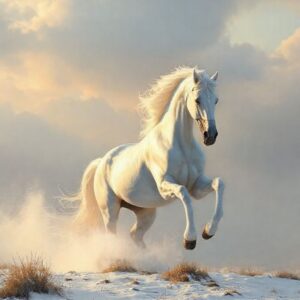
Imagine a vast, open plain under a sky of infinite blue. From the horizon, a figure emerges—a creature of breathtaking power and impossible grace. Its coat is not merely white, but seems to emit a light of its own, a living embodiment of the moon’s glow and the sun’s radiance fused into one majestic being. This is the white horse, an image that has captivated the human spirit for millennia, galloping freely through our collective dreams, our most sacred texts, and the deepest corridors of our mythic imagination. It is more than an animal; it is a symbol, a messenger, a key.
To encounter the white horse, whether in waking life, in the reverie of a dream, or within the pages of an ancient scripture, is to be touched by something transcendent. It is an archetypal force that speaks a universal language, bypassing the intellect to resonate directly with the soul. This profound symbol carries a dual nature—it represents both the power of the earthly realm, the raw, untamed force of nature, and the purity of the spiritual realm, the unblemished state of higher consciousness. It is the bridge between what we are and what we aspire to become.
This article is an odyssey—a detailed exploration of this magnificent symbol across time, culture, and consciousness. We will journey through the apocalyptic visions of John of Patmos, ride alongside the final avatar of Vishnu, decipher the cryptic messages in our dreams through a Jungian lens, and sit in council with Celtic goddesses and Siberian shamans. Our quest is to understand not just what the white horse represents, but what it invites: a call to personal victory, spiritual purification, and the courageous ascent towards our own highest potential. Prepare to saddle up for a deep, transformative ride into the spiritual meaning of the white horse.
Chapter 1: The Archetypal Steed – Foundations of Power, Freedom, and Purity
To comprehend the unique power of the white horse, we must first understand the foundational symbolism of the horse itself and the color white. They are two distinct streams of meaning that, when merged, create a potent and transformative spiritual concept.
The Horse as a Universal Symbol
Since its domestication, the horse has been humanity’s most powerful partner. Its symbolism is consequently rich and multifaceted:
-
Power and Vitality: The horse is raw, physical power incarnate. Its muscular form, its speed, and its stamina made it the engine of ancient civilizations, essential for agriculture, travel, and warfare. Spiritually, this translates to life force energy, virility, and the dynamic power to move forward in life.
-
Freedom and Liberation: A horse running wild across a plain is one of the most enduring images of untamed freedom. It represents the spirit’s desire to break free from constraints, limitations, and societal shackles. It is the urge for independence and self-determination.
-
Travel and Journey: As a primary means of transportation for centuries, the horse naturally symbolizes journeys. On a spiritual level, this becomes the “journey of the soul”—the progression through life, the path towards enlightenment, or the shamanic voyage between worlds.
-
Instincts and Desires: The horse is also a symbol of our non-physical, instinctual nature—our passions, emotions, and primal desires. An untamed horse can represent chaotic, uncontrolled instincts, while a well-trained steed signifies mastered and directed energy.
The Color White: Transcendence and Primordial Light
Across virtually every culture, the color white holds a sacred status.
-
Purity and Innocence: White is the color of untouched snow, of a blank canvas, of a bride’s gown. It symbolizes purity of heart, innocence, and a state free from moral blemish or corruption.
-
Light and Illumination: White contains all colors of the visible spectrum. It is the color of the full light of day, representing enlightenment, clarity, truth, and the illumination of consciousness. It banishes the darkness of ignorance.
-
The Divine and Transcendence: In many traditions, divine figures are depicted clothed in or emanating white light. It is the color of the transcendent realm, the absolute, the primordial source from which all creation emanates. It represents perfection, completion, and the sacred.
-
New Beginnings: As the color of a clean slate, white signifies new starts, peace, and potential.
The Synthesis: The White Horse as a Divine Conduit
When we combine these potent symbols, the white horse emerges as a uniquely powerful archetype. It is not merely a horse that happens to be white. It is the essence of horse-power—its vitality, freedom, and journeying spirit—purified, elevated, and sanctified by the color of transcendence.
-
The Tamed Instinct: It represents our primal instincts and life force (the horse) brought under the guidance of a higher, purified consciousness (the white). It is the integration of the shadow and the light, where our raw power is directed toward spiritual ends.
-
The Guided Journey: It symbolizes a soul’s journey that is not aimless, but directed toward enlightenment, truth, and liberation. It is the vehicle that carries the hero or the seeker on their sacred quest.
-
The Manifested Divine Will: The white horse often appears as the chosen mount of gods, saviors, and heroes. It represents the power of the divine acting in the world, the manifestation of spiritual will through a powerful, earthly vehicle.
In essence, the white horse is the perfect symbol for the embodied spirit—the infusion of the material world with divine light and purpose. It is the promise that power can be righteous, that freedom can be enlightened, and that the journey of life can lead to a sacred destination.
Chapter 2: Messiahs and Apocalypse: The White Horse in Abrahamic Traditions
The white horse makes some of its most dramatic and influential appearances in the texts and traditions of Judaism, Christianity, and Islam, where it is inextricably linked to themes of messianic deliverance, divine judgment, and the final victory of good over evil.
The Book of Revelation: Conquest, Christ, and Controversy
The most famous biblical white horse is found in the New Testament’s Book of Revelation, a text rich in complex and often terrifying symbolism. Here, the white horse appears twice, and its interpretation has been a subject of theological debate for centuries.
-
The First Seal: The Rider on the White Horse (Revelation 6:1-2)
-
“I watched as the Lamb opened the first of the seven seals… I looked, and there before me was a white horse! Its rider held a bow, and he was given a crown, and he rode out as a conqueror bent on conquest.”
-
This rider is the first of the infamous Four Horsemen of the Apocalypse. His identity is highly ambiguous. Is he Christ, or a false imitation? The white color and the crown suggest righteousness and victory, which align with Christ. However, the bow (a weapon of war without arrows mentioned) and the phrase “conqueror bent on conquest” have led many interpreters to see him as a symbol of militaristic conquest, false prophecy, or the Antichrist—a deceptive power that mimics Christ’s appearance but not his true nature. This duality immediately establishes the white horse as a symbol of immense power that can be wielded for vastly different ends.
-
-
The Second Appearance: The Faithful and True Rider (Revelation 19:11-16)
-
This is a far less ambiguous and more triumphant vision. The heavens open, and a rider called “Faithful and True” appears on a white horse. His eyes are like blazing fire, he wears many crowns, and his robe is dipped in blood. He is the “Word of God” and leads the armies of heaven, also on white horses, to strike down the nations and rule with an iron scepter.
-
Here, the white horse is unambiguously the steed of the returned and victorious Christ. It symbolizes:
-
Righteous Judgment: This is not random conquest, but the execution of divine justice.
-
Triumph over Evil: The final victory over the beast, the false prophet, and the forces of darkness.
-
The Purity of Divine Wrath: The violence is purified by its source and purpose—it is the necessary cleansing of creation.
-
The Church Victorious: The armies on white horses represent the saints, the faithful who share in Christ’s ultimate victory.
-
-
The juxtaposition of these two riders creates a profound theological tension, highlighting that the symbol of the white horse is not simplistic. It represents a potent force of conquest and victory, which can be either a deceptive, earthly power or the ultimate, divine power of God’s kingdom.
The Four Horsemen: The Enigma of the First Rider
The table below summarizes the Four Horsemen, highlighting the complex and debated nature of the first, white-horsed rider.
The Four Horsemen of the Apocalypse
| Horseman | Horse Color | Symbol Held | Traditional Interpretation | Spiritual Meaning (Alternative View) |
|---|---|---|---|---|
| First Horseman | White | Bow, Crown | Conquest, False Messiah, Pestilence | The Spirit of Conquest; the unstoppable, often deceptive, spread of an ideology or power. |
| Second Horseman | Red | Great Sword | War, Bloodshed | The direct and violent conflict that follows conquest; the removal of peace. |
| Third Horseman | Black | Scales | Famine, Scarcity | Economic injustice and the scarcity that results from war and misrule. |
| Fourth Horseman | Pale (Green) | None (Followed by Hades) | Death | The ultimate consequence of the preceding three: physical and spiritual death. |
White Steeds in Islamic Eschatology and Sufi Mysticism
In Islamic tradition, while not as centrally prominent as in Revelation, white horses also hold significant eschatological and mystical value.
-
The Mahdi and Jesus: In some Islamic eschatological narratives, the Mahdi (the guided one) and Jesus (Isa) will return at the end of times to defeat the false messiah (Al-Masih ad-Dajjal). They are often depicted as riding white horses, symbolizing their purity, legitimacy, and divine mandate in the final battle against evil.
-
Al-Buraq: The most significant equine figure in Islam is Al-Buraq, the miraculous steed that carried the Prophet Muhammad from Mecca to Jerusalem and through the heavens during the Isra and Mi’raj (the Night Journey). While traditionally described as a white animal, smaller than a horse but larger than a donkey, often with a woman’s face and a peacock’s tail, it is universally depicted in art as a beautiful white horse. Al-Buraq represents the ultimate spiritual vehicle—a being of pure light that can traverse the dimensions, carrying the prophet from the earthly realm to the divine presence. In Sufism, this journey becomes an allegory for the soul’s ascent to God.
-
Sufi Symbolism: For Sufis, the white horse symbolizes the purified soul (Nafs al-Mutma’inna) that has been tamed and trained to carry the rider (the spirit) towards union with the Divine. The unruly, lower self (the dark horse) must be mastered so that the white steed of the tranquil soul can emerge.
Chapter 3: Dharma and Victory: The Celestial Charger in Eastern Traditions
Moving East, the white horse retains its majestic and sacred status, but its role is adapted to the unique philosophical and theological landscapes of Hinduism, Buddhism, and Chinese spirituality.
Hinduism: Kalki Avatar and the Dawn of Satya Yuga
In Hindu eschatology, the white horse is the central symbol for the end of the current dark age and the beginning of a new cycle of light.
-
The Kalki Avatar: Lord Vishnu, the preserver in the Hindu trinity, is believed to descend to Earth in ten avatars (Dashavatara) to restore cosmic order (Dharma). The tenth and final avatar, who is yet to appear, is Kalki. Prophecies describe him as a mighty warrior riding a blazing white horse, often named Devadatta (God-given).
-
The Symbolism of Kalki’s Steed:
-
The Destroyer of Darkness: Kalki’s purpose is to end the Kali Yuga, the age of strife, ignorance, and conflict. The white horse, in its radiant purity, is the direct antithesis of this spiritual darkness. Its light dispels the gloom of adharma (unrighteousness).
-
The Sword of Discrimination: Kalki is often depicted wielding a flaming sword. The white horse is the power and vehicle that carries this sword of discrimination (Viveka) which severs truth from falsehood, good from evil.
-
Cyclical Regeneration: The white horse does not just symbolize destruction, but the necessary destruction that precedes creation. Its ride across the world purges it of corruption, making way for the new Satya Yuga, the Age of Truth and Purity. The horse itself is the agent of this cosmic reset.
-
Buddhism: Kanthaka, the Companion of Enlightenment
In the life story of Siddhartha Gautama, the historical Buddha, a white horse named Kanthaka plays a poignant and crucial role.
-
The Great Renunciation: Prince Siddhartha was kept in a palace of luxury, shielded from the sufferings of the world. When he finally witnessed the “Four Sights” (an old man, a sick man, a corpse, and a holy man), he was filled with a yearning to find the cause and end of suffering. That very night, he resolved to renounce his royal life. He left the palace silently, accompanied only by his loyal charioteer, Channa, and his beloved white horse, Kanthaka.
-
Symbolic Meaning of Kanthaka:
-
The Vehicle of Renunciation: Kanthaka represents the physical and mental strength that enables the great renunciation. He carries Siddhartha away from the attachments of the material world (the palace) and into the forest of ascetic seeking.
-
The Tamed Senses: In Buddhist psychology, the horse is often a metaphor for the senses, which are wild and unruly. Kanthaka, as a noble, well-bred, and white steed, symbolizes the prince’s already highly disciplined nature. His strength is now being directed towards a spiritual goal.
-
Loyalty and Sacrifice: Legend says that after carrying Siddhartha safely across the river, Kanthaka died of a broken heart, but was reborn in a heaven. This adds a layer of poignant sacrifice, showing that even the vehicles and supports on the spiritual path must ultimately be transcended to achieve full enlightenment. Kanthaka’s white color signifies the purity of the Buddha’s intention and the noble nature of his quest.
-
The Flying Horse in Chinese and Tibetan Symbolism
-
The Chinese Celestial Horse (Tianma): In Chinese mythology, the Tianma is a divine, winged horse that flies through the heavens. It is a symbol of speed, power, and the connection between heaven and earth. A white Tianma would amplify these qualities, representing unimpeded progress, good fortune, and the blessings of the celestial realm. It is an omen of success and the fulfillment of one’s destiny.
-
Tibetan Windhorse (Lungta): The concept of the Windhorse is central to Tibetan Buddhism and Bon traditions. “Lungta” translates to “windhorse,” and it represents the vital life force energy (lung) that carries good fortune and well-being. It is the fundamental energy of the human soul. Prayer flags are printed with the image of the Lungta carrying the “Three Jewels” on its back. As the flags flutter in the wind, the prayers and the energy of the Lungta are disseminated into the world. A white Windhorse symbolizes a purified and elevated life force, carrying the individual towards spiritual advancement and positive conditions.
Chapter 4: Myths, Mares, and Mystics: The White Horse in European and Shamanic Lore
Beyond the major world religions, the white horse gallops powerfully through the myths, folklore, and shamanic traditions of Europe and other indigenous cultures, often associated with sovereignty, the Otherworld, and spiritual travel.
Celtic Epona and Rhiannon: Sovereignty and the Otherworld
The Celtic world held horses in exceptionally high esteem, and white or pale horses were particularly sacred.
-
Epona: The Horse Goddess: Epona was a pan-Celtic goddess whose name derives from the Gaulish word for horse (epos). She was a protector of horses, donkeys, mules, and their riders, but her domain extended far beyond. She was a goddess of fertility, abundance, and sovereignty. The king’s right to rule was often symbolically tied to the land, represented by a goddess, and the horse was a key symbol of this sacred marriage. A white horse would be the ultimate symbol of this pure, legitimate, and prosperous sovereignty. Epona was also a psychopomp, guiding souls to the afterlife on her steed.
-
Rhiannon of the Mabinogion: In the Welsh epic, Rhiannon is a powerful Otherworldly figure who first appears riding a dazzling white horse. She is graceful, magical, and cannot be caught by ordinary pursuit. Her white horse signifies her noble and divine nature, her connection to the realm of Faerie, and her role as a bestower of true sovereignty upon her husband, Pwyll.
The Unicorn: A Related Archetype of Purity and Spirit
While not a horse, the unicorn is a closely related archetype that shares and intensifies the symbolism of the white horse. Typically depicted as a white, horse-like creature with a single spiral horn on its forehead, the unicorn represents:
-
Extreme Purity and Innocence: It was said that only a virgin could capture a unicorn, as it was drawn to absolute purity.
-
The Spirit (The Horn): The single horn is a powerful phallic and spiritual symbol, representing the penetrating power of the spirit, divine masculine energy, and the sword of spiritual truth. It is also a symbol of the “Third Eye” or spiritual illumination.
-
Elusiveness and Grace: The unicorn cannot be tamed by the ordinary world, symbolizing the elusive nature of the divine spirit that can only be approached through innocence and spiritual purity.
The white horse and the unicorn often overlap in the collective unconscious, both serving as symbols of an elevated, almost unattainable, state of grace and spiritual power.
Shamanic Journeys: The Horse as a Psychopomp
In shamanic traditions across Siberia, Central Asia, and the Americas, the drum is often called the “shaman’s horse.” The rhythmic beating of the drum induces a trance state, allowing the shaman’s consciousness to journey from the Middle World (ordinary reality) to the Lower World or Upper World (non-ordinary reality).
-
The Spirit Horse: The shaman’s consciousness is envisioned as riding a spirit animal, very often a horse, on these journeys. A white spirit horse would be a particularly powerful and pure vehicle, capable of traveling to the highest spiritual realms.
-
Functions of the Shaman’s Steed:
-
To Retrieve Information: To find the cause of an illness or to gain knowledge from the spirit world.
-
To Retrieve Lost Soul Parts: To find and bring back parts of a person’s soul that may have been lost due to trauma (soul retrieval).
-
To Guide the Dead: To act as a psychopomp, safely guiding the souls of the deceased to the afterlife.
-
In this context, the white horse is the ultimate tool of spiritual travel, a trusted companion that enables the shaman to navigate the invisible realms for healing, wisdom, and the maintenance of cosmic balance.
Chapter 5: The Psyche’s Landscape: The White Horse in Dreams and Modern Psychology
When the white horse appears in our dreams, it is a direct message from the unconscious. Modern depth psychology, particularly the work of Carl Jung, provides a powerful framework for interpreting this potent symbol.
A Jungian Perspective: The Self, Anima, and Individuation
For Jung, the horse is a fundamental archetype representing the non-human psyche, our instinctual nature, and the vital force of life. The white horse, specifically, is a symbol of the Self—the archetype of wholeness and the regulating center of the psyche.
-
The Self: The appearance of a magnificent white horse in a dream can signify that the process of individuation (the journey toward psychological wholeness) is well underway. The Self is emerging, integrating the conscious ego with the unconscious. The white horse is the guiding image of this total, purified personality.
-
The Animus/Anima: The horse can also represent the contrasexual soul-image. A white stallion might appear in a woman’s dream as a positive animus figure (the inner masculine), symbolizing spiritual power, purpose, and the capacity for active consciousness. For a man, a white mare could represent a positive connection to the anima (the inner feminine) in its most purified form, connecting him to intuition and deep emotion.
-
The Guiding Instinct: The white horse can represent a purified and guiding instinct. It is not a wild, chaotic force, but a deep, intuitive knowing that is leading the dreamer in the right direction. It is the call to follow one’s true path.
Common Dream Scenarios and Their Interpretations
-
Riding a White Horse: This is a powerful symbol of being in control of your life force and spiritual energy. You are successfully directing your power (the horse) with conscious will and purity of intent (the white). It suggests confidence, mastery, and progress on your life’s path.
-
Seeing a White Horse in the Distance: The white horse as a symbol of potential. It represents an invitation from the Self, a call to begin the spiritual journey or to embrace a higher aspect of yourself that you have not yet integrated. It may feel alluring yet distant, indicating that the dreamer recognizes the goal but may feel unsure how to reach it.
-
A Wild or Untamed White Horse: This suggests that the divine or spiritual energy is present within you, but it is not yet integrated or under conscious control. There is a powerful potential for transformation, but it may feel overwhelming or chaotic. The task is to “tame” this energy—not to destroy it, but to form a relationship with it.
-
A White Horse Leading You: This is a classic image of being guided by your higher Self or by a spiritual force. You are being asked to trust your intuition and follow this guiding energy, even if the path is not entirely clear. It is a profoundly positive dream, indicating protection and direction from the depths of your own psyche.
-
A Dead or Injured White Horse: This can be a disturbing dream, pointing to a feeling that your spiritual vitality, your sense of freedom, or your connection to your higher purpose has been wounded or is blocked. It is a call to attend to your spiritual life, to heal what has been damaged, and to rekindle your inner fire.
The Shadow Horse: When the Symbol Carries a Warning
While predominantly positive, the white horse can, in certain contexts, carry a shadow aspect, echoing the ambiguous first horseman of Revelation.
-
Spiritual Arrogance: A white horse can symbolize a “holier-than-thou” attitude, a kind of spiritual pride where one believes they are purer or more enlightened than others. The whiteness here is not true purity, but a facade.
-
The Unintegrated Self: If the power of the horse is overwhelming, it can represent an inflation of the ego. The individual might identify with the divine symbol (the Self) and believe they are the Self, rather than being in service to it. This can lead to delusions of grandeur.
-
Deceptive Guidance: In rare cases, a white horse that leads one astray could symbolize a deceptive spiritual path or a seductive but ultimately false doctrine.
Chapter 6: Integration and Ascension: Embodying the White Horse Energy
Understanding the symbol is the first step; learning to integrate its energy into our daily lives is the ultimate goal. How can we “saddle up” and work with the power of the white horse?
Practices for Connecting with the White Horse Totem
If you feel a connection to the white horse, consider these practices:
-
Meditation and Visualization: In a quiet meditation, visualize a vast, beautiful landscape. Call upon the image of a white horse. Do not force it; allow it to appear. Observe its condition, its demeanor, and whether it approaches you. Simply sit with its energy. You can visualize yourself riding it, feeling the wind and the power, directing it with intention.
-
Journaling Prompts:
-
“Where in my life do I need to harness more power and vitality (the horse) with purity of intention (the white)?”
-
“What spiritual journey am I being called to undertake?”
-
“What aspects of my instincts or desires feel ‘wild’ and need to be integrated and purified?”
-
“What does ‘victory’ mean to me on a spiritual level?”
-
-
Creative Expression: Draw, paint, or sculpt a white horse. As you create, imbue it with the qualities you wish to cultivate: freedom, power, purity, guidance. This act of creation forges a powerful symbolic connection in your psyche.
-
Time in Nature: Spend time with horses if possible. Observe their strength, grace, and social nature. Even watching videos of wild white horses (like the Camargue horses of France) can help connect you to the symbol’s raw energy.
The White Horse as a Guide for Life’s Transitions
The white horse is an ideal guide during times of profound change:
-
Beginning a New Chapter: As a symbol of new beginnings and purity, call upon the white horse when starting a new job, moving to a new home, or beginning a new relationship. It can help you approach the situation with a clean slate and positive energy.
-
Spiritual Seeking: When you feel a call to deepen your spiritual practice or explore new philosophical territories, the white horse is your vehicle. It represents the journey itself and the enlightened goal.
-
Overcoming Challenges: When facing a great difficulty, the white horse offers the energy of the victorious warrior. It reminds you that you have the inner strength and purity of purpose to overcome obstacles and emerge triumphant.
Summary of Symbolic Meanings
The Multifaceted Symbolism of the White Horse
| Domain | Core Symbolism | Key Associations |
|---|---|---|
| Universal/Archetypal | Purified Power, The Guided Journey | Freedom, Power, Vitality, Purity, Light, Transcendence |
| Christianity | Divine Conquest, Righteous Judgment | Christ’s Return, The Word of God, Victory over Evil, (Ambiguous) Conquest |
| Hinduism | Cosmic Reset, Destruction of Ignorance | Kalki Avatar, The End of Kali Yuga, Dawn of Satya Yuga, Restoration of Dharma |
| Buddhism | Renunciation, Spiritual Vehicle | Siddhartha’s Great Departure, Tamed Senses, The Path to Enlightenment |
| Celtic Lore | Sovereignty, Otherworld Connection | Goddesses Epona & Rhiannon, Kingship, Fertility, The Faerie Realm |
| Shamanism | Spiritual Travel, Psychopomp | The Shaman’s Drum, Journeying between Worlds, Soul Retrieval |
| Psychology (Jungian) | The Self, Wholeness, Guiding Instinct | Individuation, Integration, The Positive Animus/Anima, Intuitive Guidance |
Conclusion: The Eternal Ride
The white horse is a timeless beacon of spiritual potential.
It represents the sacred marriage of raw power and enlightened consciousness.
To heed its call is to embark on the ultimate journey toward the victorious Self.
Frequently Asked Questions (FAQs)
1. I dreamt of a white horse. Is it always a good omen?
While overwhelmingly positive, context is key. A calm, majestic, or rideable white horse is a very positive symbol of spiritual guidance and personal power. A wild, aggressive, or injured white horse may indicate that this powerful energy is not yet integrated or is being blocked, calling for inner attention and healing.
2. What is the difference between a white horse and a unicorn in spiritual terms?
They exist on a spectrum. The white horse is generally a symbol of purified power and journeying—it is power (the horse) sanctified and directed (the white). The unicorn intensifies the aspect of purity and spirit. Its horn represents the penetrating power of spirit itself. The unicorn is often seen as more elusive and mystical, while the white horse is a more active and dynamic force.
3. How is the white horse related to the concept of the “pale horse” of Death in Revelation?
They are distinct but related symbols of apocalypse. The white horse (first seal) represents Conquest—the initiating force of the end-times, often deceptive. The pale horse (fourth seal) is explicitly named Death and represents the final consequence. The pale horse’s color (chloros, meaning greenish-pale, like a corpse) signifies sickness and decay, a stark contrast to the vibrant, luminous white of the other horses.
4. Can the white horse be a personal totem or spirit animal?
Absolutely. If you feel a strong, recurring connection to the white horse in dreams, art, or life, it may be a powerful totem for you. As a spirit animal, it signifies a call to lead with integrity, embrace your personal power with purity of heart, and courageously embark on your unique spiritual path. It brings the gifts of freedom, victory, and the strength to travel far on your life’s journey.
5. What should I do if I feel scared of the white horse in my dream?
Fear often arises from the sheer power of the archetype. The ego can be frightened by the immense energy of the Self. Do not run. In subsequent meditations or visualizations, try to approach the horse with respect and calmness. Observe it from a distance. The fear often dissipates as you build a relationship with the symbol, realizing it is a part of your own wholeness and not an external threat.