In the hushed stillness of a morning garden or the dappled light of a sacred grove, few sights can arrest the human spirit quite like the unveiling of a peacock’s tail. It is a moment of pure, unadulterated magic. A rustle of iridescent feathers, a shift in posture, and suddenly, the world is framed by a living, breathing galaxy of shimmering blues, emerald greens, and bronzes, each feather tipped with a luminous, watchful eye. This breathtaking display is more than a mere courtship ritual or a feat of natural beauty; it is a profound spiritual statement, a silent sermon written in color and light.
The peacock, or Pavo cristatus, has strutted through the myths, religions, and art of human civilization for millennia. It is a creature that seems to exist simultaneously in our world and in a realm of pure symbol. It is a bridge between the earth and the heavens, a living emblem of the cosmos itself. To understand the peacock is to learn a new language—a language where beauty is a form of wisdom, where vision is a form of protection, and where the soul’s true colors are meant to be displayed with unapologetic pride. This article is an invitation to delve deep into the spiritual resonance of this magnificent bird. We will journey across continents and epochs, from the ancient temples of India to the catacombs of Rome, from the philosophical schools of Greece to the dreamscapes of modern seekers, to unravel the multifaceted spiritual meanings of the peacock. We will discover why this bird is universally revered as a symbol of resurrection, integrity, all-seeing vision, and the immortal beauty of the soul.
2. A Tapestry of Sacred Symbolism: The Peacock Across Cultures
The peacock’s spiritual significance is not the product of a single culture but a convergent revelation, a theme that has emerged independently across the globe. This universality suggests that the peacock embodies archetypal energies that speak directly to the human psyche.
Hinduism: The Mount of Gods and the Slayer of Serpents
In the rich tapestry of Hindu mythology, the peacock holds a position of immense honor and power. It is the celestial vehicle, or vahana, of Lord Kartikeya (also known as Murugan or Skanda), the god of war, victory, and wisdom. This association is deeply symbolic. A warrior god riding a peacock signifies that true strength is not brutish but beautiful, strategic, and rooted in spiritual integrity. The peacock’s ability to mesmerize and slay serpents (representing ego, ignorance, and base desires) mirrors the soul’s battle against its own lower nature, aiming for spiritual victory.
Furthermore, the peacock is intimately linked with Lakshmi, the goddess of wealth, fortune, and prosperity, and Saraswati, the goddess of knowledge, music, and the arts. The bird’s beauty and grace resonate with Lakshmi’s blessings of abundance, while its association with the “eyes” on its feathers symbolizes the discernment and wisdom granted by Saraswati. The peacock’s dance is also believed to foretell the coming of rain, a vital source of life and abundance, further cementing its connection to the cycles of creation and sustenance.
Buddhism: The Emblem of Compassion and Awareness
In Buddhism, the peacock is a symbol of wisdom and compassion. Its diet, which includes poisonous plants and snakes, is a powerful metaphor for the Bodhisattva’s vow: to engage with the “poisons” of the world—greed, hatred, and delusion—and transform them into the enlightened qualities of wisdom and compassion. The peacock does not fear poison; it consumes and transmutes it, just as a spiritual practitioner learns to work with the challenges of life to foster growth.
The Mahamayuri Vidyarajni, or the “Peacock Wisdom Queen,” is a important figure in Buddhist tantra. She is a protector deity who cures ailments and dispels poisons and negativities. Her mount is the peacock, perfectly embodying this transformative power. The peacock’s radiant feathers, fanned out in a display of majestic beauty, represent the unfolding of enlightened qualities and the all-encompassing, compassionate gaze of the Buddha that sees the suffering of all beings.
Christianity: A Symbol of Resurrection and the All-Seeing Church
In early Christian art and symbolism, found in the catacombs and basilicas, the peacock was a potent emblem of immortality and the Resurrection of Christ. This symbolism arose from an ancient belief, popularized by writers like St. Augustine, that the flesh of the peacock did not decay. Thus, the bird became a perfect natural symbol for the incorruptible, resurrected body of the faithful and the promise of eternal life.
The “hundred eyes” on the peacock’s tail were also reinterpreted as the all-seeing eye of God and, by extension, the vigilance of the Church. It symbolized the omniscience of the Divine and the watchfulness required of the Christian soul. In this context, the peacock served as a beautiful reminder of the eternal life that awaits beyond physical death and the ever-present, protective gaze of the Divine.
Greco-Roman Mythology: The Eyes of the Stars and the Voice of the Heavens
In Greek and Roman mythology, the peacock is inextricably linked to the goddess Hera (Juno in Roman myth). The story tells of Argus Panoptes, a giant with one hundred eyes who was tasked by Hera to guard the nymph Io. Hermes, at the behest of Zeus, lulled Argus to sleep and slew him. Grieving for her faithful servant, Hera took his hundred eyes and placed them upon the tail of her sacred bird, the peacock, so that they might watch forever.
This myth imbues the peacock with multiple layers of meaning. It is a symbol of the vault of heaven, with the “eyes” representing the stars. It signifies watchfulness, royalty (as Hera was Queen of the Gods), and the cosmic order. The peacock’s raucous cry was also considered significant—a warning of impending rain or, symbolically, a disruptive voice that shatters illusion and demands attention.
Persian & Babylonian Lore: The Guardian of the Royal and the Cosmic Tree
In ancient Persia, the peacock was a symbol of royalty and was often depicted flanking the Tree of Life, a cosmic axis connecting heaven, earth, and the underworld. This imagery positioned the peacock as a guardian of immortality and divine knowledge. The two peacocks represented the dualistic forces of the cosmos—good and evil, light and dark—in a state of balance, eternally guarding the source of life.
This motif was absorbed into later Islamic art and architecture, where peacocks are frequently seen in palace gardens and mosaics, symbolizing paradise, incorruptibility, and the radiant power of the divine. The Peacock Throne of the Mughal emperors in India is one of the most famous historical examples of this royal association.
Ancient Egyptian Beliefs: A Symbol of Solar Power and the Afterlife
While not as prevalent as in Asian cultures, the peacock’s symbolism found its way into Egyptian thought, often through trade and cultural exchange. The bird’s radiant, sun-like appearance when its tail is fanned led to associations with solar deities. The “eyes” on the feathers were linked to the all-seeing eye of Horus, a symbol of protection, royal power, and good health. The peacock’s perceived incorruptibility also resonated with the Egyptian obsession with the afterlife, making it a subtle symbol of the soul’s immortality and its journey through the Duat (the underworld).
Far Eastern Traditions: Beauty, Dignity, and Peace
In China and Japan, the peacock is admired for its beauty, dignity, and noble bearing. It was associated with the goddess Guan Yin (Kannon in Japan), the Bodhisattva of compassion and mercy, mirroring its Buddhist symbolism. In Chinese culture, the peacock’s feather was a mark of high rank and was used in official “mandarin” hats. The bird symbolized beauty, refinement, and the harmonious embrace of both positive and negative elements, as it could eat poisonous plants without harm. Its display was also seen as a dance of peace and prosperity.
Native American and Mesoamerican Perspectives: Connection to Rain and Spirit
Although peacocks are not native to the Americas, some Native American traditions that encountered them through trade or in menageries incorporated them into their spiritual worldview. Often, the peacock was seen as a rain-bringer, its dance and display mirroring the movements of a thunderstorm and the opening of its feathers resembling a cloud heavy with rain. Its vibrant colors connected it to the Spirit World, seen as a messenger or a manifestation of a powerful, colorful spirit.
The Peacock’s Spiritual Symbolism Across Cultures
| Culture/Religion | Deity/Figure Associated | Core Spiritual Meanings |
|---|---|---|
| Hinduism | Kartikeya, Lakshmi, Saraswati | Victory over ego, wisdom, prosperity, discernment, spiritual awakening |
| Buddhism | Mahamayuri Vidyarajni | Compassion, wisdom, transformation of poison (suffering) into enlightenment |
| Christianity | The Church, The Faithful | Resurrection, immortality, incorruptibility, the all-seeing eye of God |
| Greco-Roman | Hera (Juno) | Royalty, the starry heavens, watchfulness, the voice of warning |
| Persian/Islamic | Guardians of the Tree of Life | Royalty, paradise, cosmic balance, immortality, divine knowledge |
| Chinese | Guan Yin | Beauty, dignity, peace, nobility, compassion, harmony |
3. The Anatomy of Spirit: Deconstructing the Peacock’s Symbolism
To fully grasp the peacock’s spiritual power, we can deconstruct its physical attributes, each of which holds a profound key to its meaning.
The Peacock’s Feather: The Universe is Watching
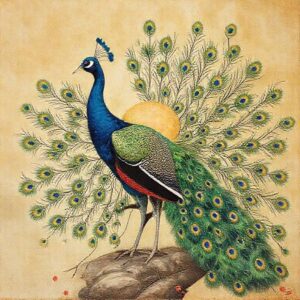
The single most powerful symbol of the peacock is its tail feather, specifically the iridescent eye-spot, or ocellus. This is not a passive decoration; it is an active spiritual emblem.
-
The Third Eye and Perception: The ocellus is a direct representation of the “third eye” or the Ajna chakra in yogic philosophy. This is the center of intuition, foresight, and spiritual perception. A peacock feather reminds us to look beyond superficial reality and perceive the deeper, spiritual truths that underpin our existence.
-
Cosmic Consciousness: The pattern of the fanned tail, with its myriad of eyes, can be seen as a map of the cosmos. Each “eye” represents a star, a galaxy, or a point of conscious awareness within the unified field of existence. It symbolizes the interconnectedness of all things and the idea that the macrocosm is reflected in the microcosm.
The “Evil Eye” and Protective Qualities
Across many cultures, from the Mediterranean to the Indian subcontinent, the peacock feather is used as a powerful talisman against the “evil eye”—a curse or negative energy caused by jealousy or ill will. The belief is that the “eyes” on the feather will reflect and ward off malicious glances and negative intentions before they can cause harm. This makes the peacock a potent symbol of spiritual protection, creating a shield of awareness around the individual.
The Vibrant Colors: A Spectrum of Spiritual Virtues
The peacock’s plumage is not painted with pigments but is a product of structural coloration—microscopic structures that reflect light, creating an iridescent sheen that changes with the angle of view. This is a profound spiritual lesson.
-
Iridescence as Illusion and Truth: The shifting colors teach us about Maya, the illusory nature of the material world. What appears one moment as blue can shift to green or gold the next, reminding us that reality is fluid and perception is subjective. True spiritual sight sees beyond these shifting appearances to the unchanging light source behind them.
-
The Alchemy of Color: The specific colors carry their own meanings:
-
Blue (Head and Neck): Connected to the throat chakra (communication, truth) and the divine, representing spiritual communication, serenity, and the vastness of the heavens.
-
Green (Body): Associated with the heart chakra, representing growth, healing, compassion, and the lushness of the heart’s capacity for love.
-
Gold/Bronze: Symbolizes solar energy, vitality, prosperity, and the radiant light of the soul.
-
The Crest: Antenna to the Divine
The crown-like crest on the peacock’s head is a clear symbol of royalty, nobility, and a connection to higher realms. It acts like a spiritual antenna, tuning into divine frequencies and higher knowledge. It reminds us to “keep our crown on”—to maintain our personal sovereignty, dignity, and connection to spirit, regardless of our circumstances.
The Voice: A Call to Discernment
The peacock’s call is often described as loud, harsh, and startling. Spiritually, this represents a call to awaken. It is a disruptive sound that shatters complacency, illusion, and ignorance. When the peacock “speaks,” it is a message to pay attention, to listen to our intuition, and to be discerning about the sounds and messages we allow into our lives. It is the voice of warning and the herald of a spiritual truth that may be uncomfortable but necessary.
The Dance: The Divine Performance of Creation
The peacock’s courtship dance is one of the most spectacular displays in the animal kingdom. Spiritually, this dance represents the divine play of creation, the Lila of the universe. It is a performance of pure joy, self-expression, and the desire to create and attract beauty. The dance teaches us that we are co-creators with the Divine. Our lives are our dance, and we are meant to express our unique soul’s beauty with confidence and passion, attracting the experiences and relationships that resonate with our highest vibration.
4. The Peacock Spirit Animal & Totem: A Guide for Your Soul
When an animal consistently appears in your life, in dreams, or in meditation, it may be acting as a spirit guide, offering its wisdom and energy to support you on your path.
Is the Peacock Your Spirit Animal?
You may have a peacock spirit animal if you identify with the following:
-
You are on a path of reclaiming your personal power and self-confidence.
-
You have a deep desire to express yourself creatively and authentically, without fear of judgment.
-
You are learning to see the beauty in all aspects of life, including your own “shadow self.”
-
You are highly intuitive and perceptive, often knowing things without knowing how you know.
-
You are called to walk with dignity, integrity, and a sense of personal nobility.
-
You are undergoing a powerful transformation, “digesting” a painful experience and turning it into wisdom.
The Peacock Totem: Born for Self-Expression and Integrity
If you are born under the influence of the peacock totem (often linked to certain birth times or astrological signs in shamanic traditions), your core life themes revolve around visibility, integrity, and beauty. You are here to shine your light brightly and to demonstrate that true strength lies in authenticity. You may be a natural artist, healer, or leader who inspires others through your example of self-respect and vibrant self-expression. The challenge for the peacock totem is to avoid vanity, arrogance, and the need for external validation, remembering that the true display is for the self and the Divine, not for the applause of the crowd.
The Peacock Power Animal: Calling on its Energy
You can call upon the peacock as a power animal when you need:
-
Protection: When you feel vulnerable to negative energy, gossip, or jealousy. Visualize a shield of peacock feathers around you.
-
Clarity of Vision: When you need to see a situation for what it truly is, beyond illusion and deception.
-
Confidence: Before a job interview, a performance, or any situation where you need to present your best self.
-
Resilience: When you are going through a difficult time and need the strength to transform “poison” into “medicine.”
-
Connection to Spirit: When you wish to enhance your meditation and connect with higher wisdom and cosmic consciousness.
5. The Peacock in Dreams: Messages from the Subconscious
Dreaming of a peacock is a powerful and auspicious sign from your subconscious. The specific context is crucial for interpretation:
-
A Peacock Displaying its Tail: A call to embrace your uniqueness and show your true colors to the world. It can also indicate that a period of prosperity, happiness, and recognition is on the horizon.
-
A Peacock with Closed Tail: This may suggest that you are hiding your talents or your true self. It’s a message to prepare for your moment to shine.
-
A Losing or Damaged Feather: May indicate a temporary feeling of vulnerability or a perceived loss of beauty or power. It can be a call to look inward for validation.
-
A Peacock Calling: A warning to pay attention to your intuition. Something in your waking life requires your discernment and awareness.
-
Feeding a Peacock: Suggests you are nurturing your self-esteem, creativity, and spiritual gifts.
-
A White Peacock: An extremely potent symbol of spiritual awakening, divine connection, and purity of soul. It represents the highest form of spiritual vision and the transcendence of the ego.
6. Modern Spiritual Applications: Integrating Peacock Wisdom Today
The peacock’s wisdom is not confined to ancient texts; it is profoundly relevant for our modern spiritual journeys.
Peacock Energy in Meditation and Visualization
Incorporate the peacock into your meditation practice:
-
The Peacock Posture (Mayurasana): In yoga, the Peacock Pose is a powerful arm balance that builds core strength and concentration, symbolizing the bird’s ability to “digest” challenges.
-
Third Eye Activation: Gently place a peacock feather on your forehead over your third eye during meditation. Visualize its eye opening, radiating a brilliant, indigo light that expands your intuition and perception.
-
Transmutation Visualization: Imagine yourself as a peacock. See yourself consuming a problem or negative emotion (like a snake). Watch as your spiritual body transforms this poison into the radiant, colorful feathers of wisdom, compassion, and strength that you then display to the world.
Peacock Symbols in Your Sacred Space
Placing peacock feathers or images in your home or altar can invoke its energy.
-
Home/Office Entrance: A feather by the door acts as a protective talisman, warding off negative energy from entering.
-
Creative Space: In a studio or office, it encourages self-expression and the confidence to share your work.
-
Bedroom: Promotes restorative sleep and can protect against nightmares.
-
Meditation Altar: Serves as a focal point for connecting to cosmic consciousness and developing intuition.
7. Conclusion: Integrating the Peacock’s Radiance
The peacock is a master symbol of spiritual alchemy, teaching us to walk with beauty through the challenges of life. It is the embodiment of resurrection, showing us how to rise again with greater wisdom and vibrance. It is the guardian of vision, reminding us to see with the eyes of the soul. And it is the dancer of creation, inviting us to unfurl our unique gifts in a glorious display for the healing of ourselves and the world.
8. Frequently Asked Questions (FAQs)
Q1: Is seeing a peacock a good omen?
A: Yes, across nearly all traditions, encountering a peacock, whether in person or in a significant dream, is considered a very positive omen. It signifies upcoming good luck, prosperity, protection, and spiritual growth.
Q2: What does it mean if I keep finding peacock feathers?
A: Finding peacock feathers is a powerful sign that you are being guided and protected by spirit. It is a direct message to embrace your authenticity, trust your intuition, and know that you are safe to express your true self. It’s a gift from the universe, encouraging you on your path.
Q3: What is the difference between a peacock spirit animal and a totem animal?
A: A spirit animal is a guide that comes to you for a specific period or situation in your life to teach you a particular lesson or provide its energy. A totem animal is an energy that you are born with, representing your core personality traits, life lessons, and innate strengths.
Q4: Why is the peacock associated with vanity and pride in some Western contexts?
A: This is a later, more superficial interpretation that emerged from observing the bird’s dramatic display without understanding its deeper spiritual context. In spiritual terms, the peacock’s “pride” is not egoic vanity but a divine expression of self-knowing, integrity, and the joy of being exactly who one is meant to be.
Q5: How can I honor the peacock energy in my daily life?
A: You can honor peacock energy by:
-
Wearing colors that make you feel confident and beautiful.
-
Speaking your truth with clarity and kindness (using your “voice”).
-
Engaging in creative pursuits that allow your soul to express itself.
-
Practicing discernment and trusting your gut feelings.
-
Carrying or wearing a peacock feather as a reminder of your spiritual protection and inherent nobility.