In the hushed stillness of a garden, a butterfly alights on a bloom, its wings a mosaic of color and pattern. In the dark of night, a cricket’s chirp creates a rhythm that seems to beat in time with the earth itself. Beneath our feet, an ant carries a burden ten times its weight, a model of unwavering determination. We often swat, step over, or simply ignore the world of insects, viewing them as pests, nuisances, or, at best, simple parts of the ecosystem. But what if we have been overlooking some of the most potent spiritual messengers on the planet?
Since the dawn of human consciousness, insects have crawled, flown, and burrowed their way into our myths, our dreams, and our sacred texts. They are archetypal symbols, miniature powerhouses of meaning that carry profound lessons for those willing to look closely. They represent transformation, community, productivity, shadow work, and the delicate balance between life and death. This article is an invitation to shrink your perspective, to enter the microcosm where the antennae of a moth can detect the faintest spiritual frequencies and the hive mind of the bee can teach us about cosmic order. We will embark on a journey to decode the secret language of the insect world, uncovering how these tiny beings are not merely living in our world, but are actively whispering its deeper truths to us. Prepare to see the familiar buzz and crawl in a radically new, illuminating light.
1. The Philosophical Framework: Why Do Insects Carry Spiritual Meaning?
Before we delve into the specific symbolism of individual insects, it’s crucial to understand the foundational principles that make them such powerful spiritual conduits. Their significance is not arbitrary; it is rooted in their very nature, biology, and the roles they play in the grand tapestry of life.
The Microcosm-Macrocosm Connection
The ancient Hermetic principle of “As above, so below; as below, so above” posits that the patterns of the cosmos are reflected in the smallest parts of reality, and vice versa. Insects are the ultimate expression of the “below.” A single anthill is a complex civilization with castes, roles, communication, and architecture. A beehive is a masterpiece of sacred geometry and collective purpose. By studying these micro-societies, we gain insights into the functioning of our own societies, our families, and even our internal psychic structures. The ant’s tireless work ethic mirrors the universal law of cause and effect (karma). The butterfly’s metamorphosis is a perfect allegory for the soul’s journey through death and rebirth. When we observe an insect, we are looking at a miniature, simplified, yet profoundly accurate model of a universal principle.
Insects as Archetypes in the Collective Unconscious
Pioneering psychologist Carl Jung introduced the concept of the collective unconscious—a reservoir of shared, inherited psychic structures and symbols common to all humanity. These are the archetypes. Insects, due to their ancient presence on Earth and their ubiquitous nature across all human habitats, have become deeply embedded as archetypal images. The “Transformative” archetype is perfectly embodied by the butterfly. The “Trickster” can be seen in the elusive mosquito or the persistent fly. The “Creator/Weaver” is the spider. When we encounter these insects in life or dreams, they are not just random events; they are manifestations of these deep, primal archetypes, calling us to engage with the energies they represent.
Lessons from the Hive: Interconnectedness and Systems
Perhaps the most critical lesson the insect world offers is that of interconnectedness. No insect is truly solitary; each plays a vital role in a larger system. Bees and butterflies are pollinators, directly responsible for the propagation of flora. Decomposers like certain beetles and flies break down dead matter, returning nutrients to the soil and enabling new life. This teaches us that no individual, no matter how small or seemingly insignificant, exists in a vacuum. Our actions, like the ripple of a butterfly’s wing, have consequences throughout the system. The hive mind of bees and ants demonstrates a different model of consciousness—one that is not centralized but distributed, where the well-being of the collective is paramount. In an age of hyper-individualism, this is a potent spiritual reminder of our responsibility to the whole.
2. The Great Transformers: Butterflies, Moths, and Dragonflies
This category of insects represents the most dramatic and inspiring forms of change, teaching us about the beauty, mystery, and necessity of personal evolution.
The Butterfly: Alchemy of the Soul and Joyful Transformation
The butterfly is, without question, the most universally recognized symbol of transformation. Its life cycle is a perfect spiritual allegory:
-
The Egg: Represents the birth of an idea, a potential, or a new beginning.
-
The Larva (Caterpillar): This is the stage of earthly, material existence. The caterpillar’s sole purpose is to consume and grow, representing a phase of life where we gather experiences, knowledge, and resources. It is a necessary, but often cumbersome, stage.
-
The Chrysalis (Pupa): This is the stage of profound, internal transformation. From the outside, it appears as stillness, dormancy, or even death. But inside, a miraculous process of histolysis occurs—the caterpillar essentially dissolves into a soupy substance, and from this primordial soup, the imaginal cells begin to form the structures of the butterfly. Spiritually, this represents the “dark night of the soul,” a period of retreat, introspection, and inner alchemy where our old self must “dissolve” to make way for the new. It is a sacred death.
-
The Butterfly: The emergence signifies rebirth, resurrection, and the attainment of a higher state of being. The butterfly is light, colorful, and takes to the air, representing freedom, joy, and a spiritual perspective.
Spiritual Message: When a butterfly appears, it is a powerful sign that you are in, or are about to enter, a profound period of transformation. It encourages you to embrace the process, even the difficult “chrysalis” stage, trusting that a beautiful new version of yourself is being formed. It is a reminder to find joy in your evolution and to share your unique colors with the world.
The Moth: The Sacred Pull of the Inner Light and Lunar Wisdom
Often seen as the butterfly’s darker cousin, the moth carries an equally profound, though more mysterious, symbolism. While the butterfly is diurnal and solar, the moth is nocturnal and lunar. Its most famous behavior—flying towards a flame—is its core spiritual lesson.
This is not a mindless suicide; it is a powerful metaphor for the soul’s yearning for spiritual illumination. The flame represents the Divine, Truth, or the inner light of consciousness. The moth’s journey teaches us about faith, surrender, and the irresistible pull we feel towards that which will ultimately transform us. It is a symbol of seeking, even when the path is dark and the destination is unknown.
The moth is also a master of camouflage and is drawn to the moon, connecting it to intuition, dreams, and the hidden realms of the subconscious. It asks us to trust our inner guidance, to navigate by our own internal “moonlight,” and to be drawn to what is authentically luminous, even if it is not as bright as the sun.
Spiritual Message: The moth appears when you are being called to listen to your inner voice and follow your spiritual longing, however faint it may seem. It is a guide for shadow work, encouraging you to explore the hidden parts of yourself and to have the courage to be drawn to your true light, even if it means undergoing a transformative “burning away” of the old.
The Dragonfly: Illusion, Wisdom, and the Realm of Emotion
The dragonfly, with its iridescent wings and breathtaking aerial agility, is a creature of two worlds: water and air. It begins its life as a nymph, living underwater for up to two years. This aquatic stage represents the realm of the subconscious, emotions, and the world of dreams and illusions. When it finally emerges, it sheds its aquatic form and takes to the air, representing the realm of mental clarity, insight, and truth.
The dragonfly’s ability to move with incredible speed and precision in all directions symbolizes the power of a nimble mind and the ability to see beyond surface appearances. Its multifaceted eyes, which can see nearly 360 degrees, represent the ability to see through illusion and perceive the deeper truths of a situation.
Spiritual Message: The dragonfly is a messenger of wisdom and a call to break free from self-created illusions. It asks you to emerge from the “water” of your emotional turmoil and gain a higher, clearer perspective. It signifies a time of mental and emotional maturity, where you can see the full picture and understand the true nature of reality. It is a reminder to be adaptable and to bring lightness and joy to your life.
3. The Master Builders: Ants, Bees, and Wasps
This group of insects teaches us the spiritual principles of hard work, community, structure, and the power of collective effort.
The Ant: The Virtue of Diligence, Planning, and Teamwork
The ant is a global symbol of diligence, patience, and strength. Observing an ant colony reveals a masterclass in organization, long-term planning, and selfless contribution to the community. Spiritually, the ant teaches several core lessons:
-
Discipline and Hard Work: The ant works tirelessly, not because it is forced to, but because it is its nature. This represents the spiritual principle of “right action”—performing our duties with dedication and without attachment to immediate rewards.
-
Preparation and Foresight: The ant gathers food in the summer to prepare for the winter. This is a powerful metaphor for the law of accumulation—small, consistent efforts, over time, lead to great security and abundance. It warns against procrastination and encourages strategic planning for the future.
-
Strength in Community: An ant alone is vulnerable, but a colony is a formidable force. The ant teaches that we achieve more through cooperation than through solitary competition. It reminds us of our responsibility to the “colony”—be it our family, workplace, or society.
Spiritual Message: When the ant spirit is active in your life, it is a call to get organized, to work diligently towards your goals, and to trust that your consistent efforts will build a secure future. It also asks you to consider the strength of your community and how you can contribute more selflessly.
The Honeybee: Community, Sacred Geometry, and the Sweetness of Life
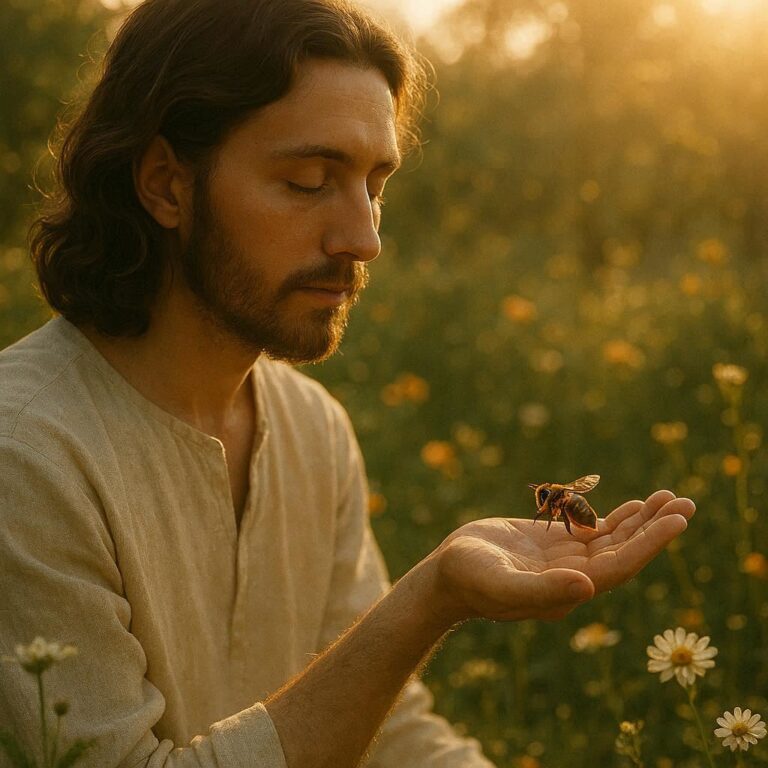
The honeybee is one of the most spiritually revered insects. Its symbolism is rich and multifaceted, touching on community, divine order, and the rewards of harmonious labor.
-
The Hive Mind: The bee colony operates as a single superorganism. The queen represents the divine feminine, the heart and soul of the community. The workers represent dedicated service, and the drones have their specific role. This symbolizes a perfectly balanced society where each individual’s purpose serves the whole.
-
Sacred Geometry: The hexagonal honeycomb is a marvel of natural engineering. It is the most efficient shape in nature, using the least material to create the strongest structure. This connects the bee to the underlying mathematical order of the universe, to divine intelligence, and the principle of efficiency and grace in creation.
-
Pollination and Sweetness: The bee pollinates flowers, facilitating the creation of new life. It then transforms the nectar into golden honey. This is a profound spiritual metaphor: the bee teaches us to “pollinate” our ideas through interaction and then to “make honey”—to distill our experiences, even the bitter ones, into the sweet wisdom of life.
Spiritual Message: The bee calls you to become an active, productive member of your community. It encourages you to find your unique “buzz” or gift and to offer it in service. It is also a reminder to seek the divine order in your life, to create structures that are both efficient and beautiful, and to always find a way to turn your life’s experiences into something sweet and nourishing.
The Wasp: Efficient Action, Personal Power, and the Shadow of Aggression
Wasps are often feared, but their spiritual meaning is potent. Unlike the bee, which is a communal gatherer, the wasp is a solitary or semi-communal predator and a master builder (of paper nests). Its energy is about focused action, personal power, and efficiency.
-
Action and Assertiveness: The wasp does not wait for opportunities; it actively hunts and seizes them. Spiritually, it represents the need to be assertive, to take decisive action towards your goals, and to stop being passive.
-
Mastery and Architecture: The wasp creates intricate nests from chewed wood pulp, demonstrating incredible skill and resourcefulness. This symbolizes the ability to build your life from the raw materials available to you, using your personal power and intelligence.
-
The Shadow: Aggression and Sting: The wasp’s sting is a defense mechanism, but it can be deployed aggressively. This represents the shadow side of personal power: anger, aggression, and the tendency to “sting” others when feeling threatened. The wasp asks you to reflect on how you use your power. Are you using it to build and provide, or to dominate and harm?
Spiritual Message: The appearance of a wasp is a call to embrace your personal power and take bold, efficient action. It tells you to stop waiting and to start building the life you want. However, it comes with a warning: to be mindful of your aggression and to ensure your power is used constructively, not destructively.
4. The Messengers of the Unseen: Spiders, Crickets, and Fireflies
These insects connect us to the mystical, the creative, and the luminous aspects of existence, often acting as bridges to the unseen world.
The Spider: The Weaver of Fate and the Web of Life
While technically an arachnid, the spider’s spiritual significance is so profound it demands inclusion. The spider is the ultimate symbol of the Creator, the Weaver of Destiny. Across cultures, from the Navajo’s Spider Woman to the West African Anansi, the spider is a cosmic architect.
-
The Web: The spider’s web is a perfect circle with a spiral, connecting it to the mandala and the cycles of life. It represents the interconnectedness of all things. The spider sits at the center, sensitive to the vibrations on every strand, symbolizing the center of consciousness and the interconnected nature of reality. We are all connected in the great web of life.
-
Creativity and Manifestation: The spider creates its world out of its own substance. It spins silk from its body and weaves it into a complex, functional, and beautiful structure. This is a powerful metaphor for our ability to create our reality through our thoughts, words, and actions. We are the weavers of our own lives.
-
The Patterns of Fate: The spider is often seen as the weaver of the tapestry of fate. It reminds us that the past, present, and future are interconnected. It encourages us to be mindful of the “threads” we are spinning today, for they become the web of our tomorrow.
Spiritual Message: The spider invites you to consciously create your life. It asks you to consider the web you are weaving through your relationships and actions. Are you creating a web of beauty and strength, or one of entanglement? It is a call to embrace your creative power and to understand your position at the center of your own universe.
The Cricket: Luck, Intuition, and the Music of the Home
In many Asian cultures, crickets are kept in ornate cages as bringers of good luck and prosperity. Their chirp, a signature sound of warm evenings, is their primary spiritual offering.
-
The Music of Intuition: The cricket’s song is not heard with the ears alone; it is felt. It represents the inner voice, intuition, and the subtle rhythms of the soul. Its appearance suggests that you need to listen more closely to your inner guidance.
-
Domestic Harmony and Luck: Traditionally, a cricket in the house was considered a sign of good fortune and a protector of the home. Its song was believed to bless the household with harmony and abundance. It symbolizes the warmth, comfort, and music of a happy home.
-
Cycles and Communication: The cricket’s chirping follows natural rhythms. This connects it to the cycles of nature and the importance of clear, rhythmic communication.
Spiritual Message: When you hear or see a cricket, it is a reminder to trust your intuition and to bring more music and harmony into your personal space. It is a sign of impending good fortune and a call to communicate clearly and from the heart.
The Firefly: Inner Light, Inspiration, and Hope in Darkness
The firefly, or lightning bug, is a creature of pure magic. Its ability to generate its own cold light in the darkness makes it one of the most hopeful and inspiring spiritual symbols.
-
Illumination from Within: The firefly does not need an external source to shine; it carries its own light. This is a profound metaphor for our inner light, our soul, our unique gifts and talents. The firefly reminds us that our true power comes from within, not from external validation.
-
Inspiration and Creativity: The blinking, mesmerizing light of the firefly is a symbol of creative inspiration that flashes in the darkness of the unconscious mind. It represents those “aha!” moments of genius and insight that illuminate our path.
-
Hope and Guidance: In the deepest darkness, the tiny, persistent light of the firefly is a beacon of hope. It signifies that no matter how dark things seem, your inner light can guide you and attract the right people and opportunities.
Spiritual Message: The firefly is a call to let your inner light shine. It encourages you to trust your own inspiration and to be a beacon of hope for yourself and others. It reminds you that even the smallest light can pierce the greatest darkness.
5. The Challengers and Shadow Guides: Beetles, Mosquitoes, and Flies
Not all spiritual messages are comfortable. These insects often represent the challenges, annoyances, and shadow aspects we must face to grow.
The Scarab Beetle: Solar Symbolism, Resurrection, and Self-Creation
In ancient Egypt, the scarab (dung beetle) was one of the most sacred symbols. Its behavior, rolling a ball of dung across the ground, was seen as a mirror of the sun god Khepri rolling the sun across the sky. Thus, the lowly dung beetle became a powerful solar symbol of resurrection, transformation, and self-generation.
-
Transformation from Waste: The scarab takes waste, the most base material, and uses it to create new life (it lays its eggs in the dung ball). This is the ultimate alchemical symbol: the ability to transform the “dung” of our lives—our challenges, traumas, and mistakes—into fuel for growth and rebirth.
-
Self-Creation: The young scarab emerges from the dung ball, seemingly self-created. This connects it to the concept of autopoiesis—a system that creates itself. The scarab teaches that we are the authors of our own destiny, capable of rising from our own “muck” to become something new and whole.
-
Cycles and Resurrection: The scarab was placed over the heart of mummies to ensure resurrection in the afterlife. It is a potent symbol of the eternal cycle of death and rebirth.
Spiritual Message: The scarab beetle appears when you are being called to a profound level of self-creation. It asks you to confront the “waste” in your life—be it negative thought patterns, toxic relationships, or past failures—and to alchemize it into the fuel for your rebirth. You have the power to roll your own “sun” across the sky.
The Mosquito: Boundaries, Energy Vampirism, and Persistent Annoyances
The mosquito is universally disliked, and its spiritual meaning reflects this. It is a messenger of boundaries and energy dynamics.
-
Energy Vampirism: The mosquito survives by taking the blood of others. Spiritually, it represents people, situations, or habits that “suck” your energy, leaving you feeling drained and irritated. An encounter with a mosquito is a stark reminder to check your energetic boundaries.
-
Persistent Annoyances: The mosquito’s high-pitched whine is a symbol of the small, persistent irritations in life that can drive us to distraction. It asks: What is “buzzing” around you, preventing you from finding peace? What minor issue do you need to address before it “bites”?
-
The Need for Protection: The most practical response to a mosquito is to use protection—repellent, nets, etc. Spiritually, this translates to strengthening your psychic and emotional shields through practices like grounding, meditation, and clear communication.
Spiritual Message: The mosquito is not a welcome guide, but a necessary one. Its appearance is a loud, buzzing alarm to fortify your boundaries. It asks you to identify who or what is draining your energy and to take decisive action to protect your vital life force.
The Fly: Persistence, Decay, and the Necessary Role of the “Shadow”
The fly is perhaps the most challenging insect to find spiritual meaning in, as it is associated with decay, disease, and filth. However, in many shamanic traditions, nothing is without meaning, and the “lowliest” creature often holds the most potent medicine.
-
Persistence: The fly is incredibly persistent and adaptable. It can find a way into almost any space. Spiritually, this can be reframed as a lesson in tenacity and the ability to thrive in difficult circumstances.
-
The Alchemy of Decay: Flies are decomposers. They are attracted to what is rotting and breaking down. This makes them powerful, if unsettling, symbols of shadow work. The fly asks you to confront what is “rotting” in your psyche—the repressed emotions, the shame, the unresolved trauma—so that it can be broken down and transformed. Decay is a necessary part of the cycle of rebirth; without it, there can be no new growth.
-
Breaking Illusions: The fly’s compound eye sees the world in a fractured way. It can symbolize the need to break apart our illusions and see the gritty, unvarnished truth of a situation, no matter how unpleasant.
Spiritual Message: The fly is a guide to the underworld of your own soul. Its appearance is a call to do the dirty work of shadow integration. It asks you to stop avoiding the decaying, messy parts of yourself and your life, and to allow them to be broken down so that their nutrients can fuel your future growth. It is the ultimate teacher of finding value in what we reject.
6. Insect Encounters, Dreams, and Totems: A Practical Guide
Understanding the general symbolism is one thing; applying it to your personal life is another. Here is a guide to interpreting your own experiences with the insect world.
When an Insect Crosses Your Path: Interpreting Recurring Encounters
A one-time sighting might be a gentle nudge, but a recurring encounter is a message that demands your attention. Ask yourself these questions:
-
What is the insect? Refer to the symbols above for its core meaning.
-
What is its behavior? Is it building (ant), flying erratically (fly), or moving in a straight line (dragonfly)? Behavior refines the message.
-
What is the context? Where are you? What were you thinking about? The context personalizes the message. A butterfly in a garden during a time of grief is a powerful sign of transformation and hope.
-
What is your emotional reaction? Your feelings are a key to interpretation. Fear of a wasp might indicate a fear of your own power or assertiveness. Annoyance at a fly might point to an unresolved “shadow” issue you are avoiding.
Insects in Dreams: A Dive into the Subconscious
Dreams are the language of the subconscious, and insects in dreams are powerful symbols of our deepest thoughts, fears, and potentials.
-
Being Chased or Swarmed: This often represents feeling overwhelmed by small, nagging problems or anxieties in your waking life.
-
Talking to an Insect: The insect may be a direct messenger from your higher self or subconscious. Listen to what it says.
-
Transforming into an Insect: This can indicate a profound personal transformation is underway or a desire to escape a current situation.
-
A Dead Insect: Can symbolize the end of a nagging problem or, conversely, the loss of a positive quality (e.g., a dead butterfly could mean a stifled creativity).
Discovering Your Insect Totem and Working with Its Energy
An insect totem is a spirit guide in the form of an insect. You don’t choose it; it chooses you, often through recurring encounters, a powerful dream, or a deep, inexplicable fascination.
To connect with your insect totem:
-
Research: Deeply study the insect you feel drawn to.
-
Meditate: Visualize the insect and ask it to reveal its message for you.
-
Create an Altar: Place images, figures, or found parts (like a shed exoskeleton or a feather) on a small dedicated space.
-
Embody its Qualities: If your totem is the ant, focus on being more disciplined and organized. If it is the dragonfly, practice seeing situations from a higher perspective.
7. Conclusion: Listening to the Whispering Hive
The insect world is a vibrant, living library of spiritual wisdom, offering timeless lessons on transformation, community, creation, and shadow. From the butterfly’s joyful metamorphosis to the fly’s grim work of decomposition, each insect plays a sacred role in the great web of life, and each has a unique message for the human soul. By learning their symbolic language, we open a channel of communication with the natural world and, in turn, with the deepest parts of ourselves. The next time an insect crosses your path, pause before you react. Look closer. Listen. You may just hear the faint, whispering voice of the universe, offering guidance one tiny, intricate step at a time.
Frequently Asked Questions (FAQs)
Q1: Is it bad luck to kill a spider?
A: In many spiritual traditions, killing a spider is considered to disrupt the web of fate and creativity it represents. It is generally advised to gently capture and release it outside, honoring its role as a weaver and seeing its presence as a potential message.
Q2: A bee keeps coming to my window. What does this mean?
A: A bee at your window is a strong message from the spirit of the bee. It could be a call to “make honey”—to create something beautiful and nourishing from your current experiences. It can also be a reminder to live a life of productivity and community, or a sign that abundance (“the sweet life”) is on its way. Pay attention to what you were thinking about when it appeared.
Q3: I have a recurring nightmare about insects. What should I do?
A: Recurring insect nightmares often point to unresolved anxiety or a “swarm” of small problems in your waking life that you feel is overwhelming you. Start a dream journal and write down every detail. Then, in your waking life, make a list of all the minor stresses and address them one by one. This practical action can often resolve the symbolic nightmare.
Q4: How can I find out what my insect spirit animal is?
A: Your insect totem often reveals itself through repetition and resonance. Notice which insects you see frequently, which you feel drawn to, or which appear in your dreams. Meditate on the insect you’re curious about and see if its symbolic meanings strongly align with your current life challenges and lessons.
Q5: Are moths really a symbol of death?
A: While in some cultures moths are associated with souls of the departed, their primary symbolism is not death itself, but transformation and the soul’s journey towards the light. They represent a symbolic death of the ego as it is drawn to the transformative flame of spiritual truth, which is a positive, if challenging, process.