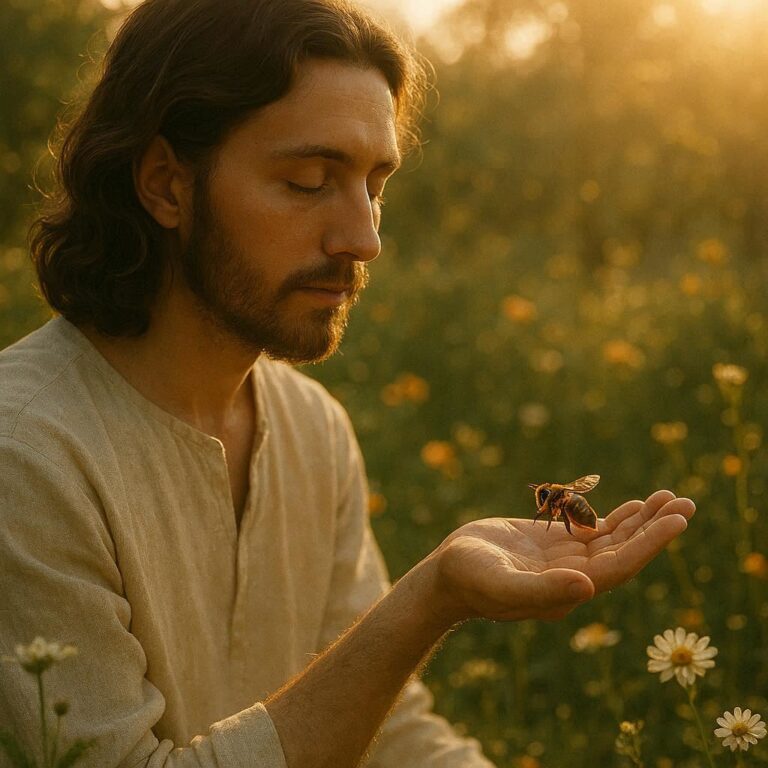
Imagine you are carrying a burden you were never meant to carry. The weight has become so familiar it feels like a part of you—a dense core of anxiety, striving, and the unshakable sense that you are not quite enough. You have tried everything: more discipline, more knowledge, more achievement. Yet, the fundamental ache remains. Then, in a moment you did not engineer and cannot explain, something shifts. It might happen while watching a sunset, in the silent space between thoughts during meditation, or in the midst of a profound loss. A wave of peace, entirely unearned, washes over you. A forgiveness you do not deserve floods your heart. A clarity you could not have forced illuminates your mind. This is not the result of your effort. It is a gift. This is the touch of grace.
Grace is the most beautiful and mysterious force in the spiritual universe. It is the cosmic kindness that tips the scales in favor of transformation when our own strength has failed. It is the silent partner to our striving, the divine “yes” that answers our heartfelt “please.” To speak of grace is to venture into the territory of the sublime, to acknowledge that there is a benevolent intelligence at work in the cosmos that operates not on the economy of merit, but on the currency of love. This article is an invitation to explore this profound mystery. We will journey through its definitions across spiritual traditions, dissect its manifestations in human life, grapple with its paradoxical relationship with free will, and ultimately, discover how we can move from seeking grace to embodying it. This is not a search for a theological abstraction, but for the very substance that can make our lives a masterpiece of meaning and connection.

2. Defining the Indefinable: What is Spiritual Grace?
Before we can map its terrain, we must attempt to define this elusive star. Spiritual grace resists neat, academic categorization because it is not a concept to be understood as much as an experience to be known. It is the flavor of the sacred, the texture of the numinous as it touches the human soul.
Beyond Mere Elegance: A Shift in Context
In common parlance, “grace” refers to physical elegance, poise, or courteous goodwill. We speak of a dancer moving with grace or a leader showing grace under pressure. While these are beautiful qualities, spiritual grace operates on a fundamentally different plane. It is not an attribute we cultivate through practice, but a power that cultivates us. It is not something we do; it is something we receive and, in receiving, are fundamentally altered. The core differentiator is its nature as an unmerited gift. It is given, not earned. It flows from a source of abundance, not as a reward for good behavior or spiritual accomplishment.
Core Components of the Grace Experience
While definitions vary, several key components consistently emerge when individuals describe an encounter with grace:
-
Unearned and Unasked For: Grace often arrives unexpectedly. It is a surprise, a benevolent interruption of our predictable cause-and-effect reality. We may have been praying or meditating for it, but its arrival, its timing, and its form feel like a gift, not a transaction.
-
Transformative: Grace is not merely a pleasant feeling; it is a transformative power. It effects a change in our being—healing a deep wound, shattering a limiting belief, igniting a compassion we didn’t know we possessed, or granting a peace that “passes all understanding.”
-
Liberating: At its heart, grace liberates. It frees us from the karmic chains of our past mistakes, from the tyranny of our egoic minds, and from the illusion of separation. It is a force that unshackles the soul.
-
Connective: An experience of grace invariably brings with it a sense of profound connection—to the Divine, to all of humanity, to nature, to life itself. It dissolves the walls of the separate self.
-
Empowering: Contrary to making one passive, true grace empowers. It fills us with a strength that is not our own, enabling us to face challenges, extend forgiveness, and love in ways that were previously impossible.
3. Echoes of the Sacred: Grace in World Spiritual Traditions
The concept of grace is a golden thread running through the tapestry of the world’s spiritual traditions. While the language, metaphors, and theological frameworks differ, the core recognition of a benevolent, transformative power from a higher source is remarkably universal.
Christianity: The Foundation of Unmerited Favor
In Christianity, grace is the central pillar of salvation. The Apostle Paul eloquently defines it as a gift from God, antithetical to human works: “For it is by grace you have been saved, through faith—and this is not from yourselves, it is the gift of God—not by works, so that no one can boast” (Ephesians 2:8-9). This “unmerited favor” is the loving-kindness of God, freely given to humanity through the person of Jesus Christ. It is what forgives sins, reconciles humanity to God, and empowers believers to live a holy life. Key concepts include:
-
Prevenient Grace: The grace that “comes before,” awakening the soul to its need for God and drawing it toward faith.
-
Justifying Grace: The grace that pardons and accepts the believer, granting a new status as a child of God.
-
Sanctifying Grace: The ongoing, transformative grace that works within the believer to heal the soul and foster growth in love and holiness.
Hinduism: The Guru’s Prasāda and Divine Descent
In Hinduism, grace, or Prasāda (also spelled Prasad), is a multifaceted concept. Literally meaning “clearness, brightness, graciousness,” it most commonly refers to food or other offerings that have been ritually presented to a deity and are then distributed to devotees as a tangible form of divine grace. On a deeper level, Prasāda is the grace-consciousness that flows from the guru to the disciple, illuminating the mind and heart. Furthermore, the concept of Avatar—the descent of God into human form (like Krishna or Rama)—is the ultimate expression of divine grace, a voluntary act by the Divine to restore cosmic order and uplift humanity out of compassion.
Buddhism: The Compassionate Activity of the Buddhas
While early Buddhism emphasized personal effort through the Noble Eightfold Path, the concept of grace became more pronounced in Mahayana Buddhism. Here, the Bodhisattvas and Buddhas are beings of immense compassion who actively work for the liberation of all sentient beings. They generate a store of “merit” through their virtuous deeds and vow to transfer this merit to others. The grace of the Buddha is not an external force saving you without your participation, but rather a powerful, compassionate “pull” from the other shore, responding to the sincere “push” of the devotee’s own practice. Reciting the name of Amitabha Buddha in Pure Land Buddhism, for instance, is an act of relying on his “other-power” (grace) for rebirth in the Pure Land, where enlightenment is easier to attain.
Islam: The All-Encompassing Rahma of Allah
In Islam, the primary attribute of God (Allah) is Rahma, often translated as mercy, compassion, and grace. Two of Allah’s most frequently invoked names are Ar-Rahman (The Entirely Merciful) and Ar-Rahim (The Especially Merciful). This Rahma is all-encompassing, the very reason for creation. The Quran states, “My mercy encompasses all things” (7:156). While Islam strongly emphasizes righteous action and submission to God’s will, the ultimate hope for Paradise and forgiveness rests upon this boundless grace of Allah. It is God’s grace that guides the seeker, accepts repentance, and grants eternal bliss, far exceeding what any human could strictly merit.
Sikhism: The Nadar of the Formless One
Sikh theology places grace, or Nadar (also called Kirpa or Prasad), at the absolute center of spiritual life. Liberation is impossible without the grace of the Formless God (Waheguru). The first words of the Sikh scripture, the Guru Granth Sahib, are “Ik Onkar Sat Nam,” meaning “There is One God, whose Name is Truth.” Realizing this Truth is the goal, and it can only be achieved through God’s Nadar. Human effort is still necessary—this is the doctrine of “Gurprasad” (grace received through the Guru)—but the effort itself is seen as a consequence of grace. The seeker must strive, but the awakening, the ultimate gift, is always a bestowal.
Taoism: The Uncontrived Flow of Wu Wei
Taoism offers a unique perspective on grace through the principle of Wu Wei, often translated as “non-action” or “effortless action.” It is the art of aligning with the Tao, the natural, spontaneous flow of the universe. To act with Wu Wei is to act without egoistic striving, force, or resistance. It is to move like water—yielding, adaptable, and powerful in its softness. This alignment with the Tao is a state of grace. The universe supports your actions; things happen through you, not solely by you. It is the grace of being in the right place at the right time, not by frantic calculation, but by serene attunement to the cosmic current.
Indigenous Wisdom: Grace as Reciprocity with the Animated World
While not always articulated with the same theological language, Indigenous spiritualities worldwide operate on a principle that can be understood as grace: the principle of sacred reciprocity. The world is alive, ensouled, and filled with spiritual presences. Life is a gift from the Creator and the Earth. In return, humans offer prayers, songs, rituals, and respect. This reciprocal relationship is a graceful exchange. When a hunter respectfully takes the life of an animal, that animal is seen as having offered itself as a gift (grace). The subsequent prayers and ceremonies are an act of giving back, maintaining the balance. Grace, here, is the continuous, life-sustaining flow of gifts within a conscious, interconnected cosmos.
The Many Faces of Grace: A Cross-Traditional Overview
| Tradition | Key Term for Grace | Source of Grace | Primary Expression |
|---|---|---|---|
| Christianity | Charis (Grace) | God / Holy Spirit | Unmerited favor, salvation through Christ |
| Hinduism | Prasāda, Kripa | Deity, Guru | Sanctified food, guru’s blessing, divine descent (Avatar) |
| Buddhism | (Transfer of) Merit, Karuna | Buddhas, Bodhisattvas | Compassionate activity, vow to save all beings |
| Islam | Rahma (Mercy) | Allah (God) | All-encompassing mercy, guidance, forgiveness |
| Sikhism | Nadar, Kirpa | Waheguru (God) | Divine glance, gift of the Name, guidance of the Guru |
| Taoism | Wu Wei (Alignment) | The Tao | Effortless action, spontaneous flow with nature |
| Indigenous | Reciprocity | Creator, Earth, Spirits | Gift of life, sustenance, and harmonious exchange |
4. The Anatomy of a Miracle: How Grace Manifests in Human Experience
Grace is not a theoretical concept confined to holy books; it is a living reality that intervenes in human lives in tangible, often breathtaking, ways. Its manifestations are as diverse as life itself.
Sudden Awakening and Epiphany
Perhaps the most dramatic manifestation of grace is the moment of spiritual awakening or satori. After years of seeking, study, and struggle, the seeker hits a wall. Then, in a flash—often when the mind has finally exhausted itself—a radical shift in perception occurs. The separate self is seen as an illusion, and a unified, loving consciousness is revealed as one’s true nature. This is not an intellectual conclusion but a direct knowing, gifted by grace. The seeker did not create this awakening; it happened to them.
Synchronicity and Meaningful Coincidence
Carl Jung defined synchronicity as an “acausal connecting principle,” a meaningful coincidence of inner and outer events that are not linked by cause and effect. Finding the perfect book you need at a random stall, meeting a pivotal person at the exact right moment, or having a dream that provides a solution to a real-world problem—these are often experienced as grace. They are whispers from the universe, signs that we are part of a larger, intelligent pattern that is conspiring in our favor.
Unexpected Strength in the Midst of Suffering
Many people who have endured profound trauma, loss, or illness report experiencing a “strength that was not their own.” A mother caring for a terminally ill child, a survivor navigating immense grief, an individual facing a terrifying diagnosis—they often speak of being carried by a power beyond themselves. This is not denial or stoicism, but a palpable infusion of grace that allows them to bear the unbearable with a dignity and peace that defies logical explanation.
The Gift of Forgiveness and Reconciliation
Holding a grudge can feel like drinking poison and expecting the other person to die. The weight of resentment is a heavy burden. The decision to forgive, especially in cases of deep betrayal, can feel humanly impossible. Yet, sometimes, a moment arrives where the bitterness simply melts away. It is not a rational decision but a release. This is the grace of forgiveness. It liberates the forgiver even more than the forgiven. Similarly, the reconciliation of long-feuding family members or nations often has the hallmark of grace—a thawing of hardened hearts that no negotiation could have achieved.
Inspired Creativity and the Muse’s Kiss
Artists, musicians, writers, and inventors often describe their best work as something that “came through” them, not from them. A composer hears a symphony in a dream. A writer finds the words flowing faster than their conscious mind can think. A scientist has the solution to a complex problem appear in a moment of relaxation. This “muse” is a form of grace—an influx of creative intelligence from a deeper source. It is the experience of being used as a vessel for something beautiful to enter the world.
5. The Great Paradox: Grace, Free Will, and Personal Effort
One of the most perplexing and enduring spiritual questions is the relationship between grace and human effort. If grace is an unearned gift, does that render our striving meaningless? Are we merely passive puppets waiting for a divine handout?
Can We “Achieve” Grace? The Futility of Force
The fundamental nature of grace as a gift means it cannot be achieved, captured, or demanded. The ego, which operates on a model of achievement and control, cannot grasp grace. In fact, the very effort to “get” grace reinforces the sense of a separate self that is trying to acquire something, which is the very obstacle grace seeks to overcome. Chasing spiritual experiences for the sake of personal enlightenment is often the surest way to block their arrival.
Preparing the Vessel: The Role of Spiritual Practice
If we cannot force grace, what is the purpose of spiritual practice—prayer, meditation, service, and ethical living? The answer lies in the metaphor of preparing the vessel. We cannot make the rain fall, but we can till the soil, clear the weeds, and dig channels to receive it. Spiritual practice is the process of purifying and opening the vessel of our being. It is a gesture of sincerity, a way of saying, “I am here. I am available. I am listening.” It quiets the noisy mind, softens the hardened heart, and aligns our will with a higher will, making us receptive to the gift that is always being offered.
The Synergy of Sweat and Surrender
The dynamic between effort and grace is not one of opposition but of synergy. It is a divine dance. Our effort is the movement toward the Divine, and grace is the Divine’s infinitely greater movement toward us. The ancient dictum, “Work as if everything depends on you, and pray as if everything depends on God,” captures this paradox perfectly. We must put in the “sweat” of sincere practice, but we must simultaneously “surrender” the attachment to the outcome, trusting that the transformation we seek will be given in its own time and way. Our effort creates the conditions for recognition; grace provides the revelation.
6. Embodying Grace: The Shift from Concept to Lived Reality
The ultimate purpose of understanding grace is not just to have fleeting experiences of it, but to become a living embodiment of it. Grace is not only something we receive; it is a state of being we can inhabit.
Grace as a State of Being: Qualities of a Gracious Consciousness
When grace becomes the ground of our being, certain qualities naturally blossom:
-
Deep Trust: A fundamental trust in the benevolence of life, even amidst its difficulties.
-
Non-Judgment: Seeing oneself and others through the eyes of compassion, recognizing the shared human struggle.
-
Effortless Generosity: Giving without calculation, simply as an expression of the abundance one has received.
-
Authentic Humility: A natural humility that comes from knowing that all our gifts and strengths are, at their root, bestowed.
-
Radical Acceptance: An ability to meet life as it is, with an open heart, without frantic resistance.
The Practice of Receiving: Cultivating Openness
To embody grace, we must first become expert receivers. Our culture prizes doing and giving, but we are often terrible at receiving compliments, help, and love. Cultivating receptivity involves:
-
Mindfulness: Paying attention to the present moment, where grace is always available.
-
Gratitude: Actively noticing and giving thanks for the myriad “small graces” each day—a warm cup of tea, a kind word, the light through a window.
-
Letting Go: Releasing the need to control outcomes and manage our image. Surrendering the illusion of self-sufficiency.
The Practice of Extending: Becoming a Conduit of Grace for Others
As we learn to receive, we naturally become conduits for grace to flow to others. We become instruments of peace. This looks like:
-
Offering Unconditional Positive Regard: Seeing the inherent worth in others, regardless of their actions.
-
Listening with Full Presence: Giving someone the gift of your undivided attention, without planning your response.
-
Performing Anonymous Acts of Kindness: Allowing grace to work through you without the need for credit or recognition.
-
Holding Space for Suffering: Sitting with someone in their pain without trying to “fix” them, offering the grace of compassionate witness.
7. Grace in the Grit of Life: Finding the Sacred in the Ordinary
We need not wait for dramatic miracles to witness grace. It is woven into the very fabric of our daily existence, if we have the eyes to see.
-
Parental Love as a Mirror of Divine Grace: A parent’s love for their newborn is a powerful mirror of divine grace. The child has done nothing to earn this love; it is given freely, unconditionally, and abundantly. This love is not a reward for good behavior; it is the very ground of the child’s being. In this most human of experiences, we catch a glimpse of how the Divine might love us.
-
The Grace of a Second Chance: Every sunrise offers a new beginning. The opportunity to apologize, to try again, to choose differently—this is a daily grace. The resilience of the human spirit and the body’s capacity to heal are forms of grace built into our biology and psychology.
-
The Beauty of the Natural World as Unasked-For Gift: The staggering beauty of a starry night, the intricate pattern of a snowflake, the awe-inspiring sight of a mountain range—none of this was created for us. It is simply here, an extravagant, unasked-for gift. The mere existence of beauty, which serves no utilitarian purpose for survival, is a pure expression of cosmic grace, a testament to a reality that values more than mere function.
8. Conclusion: The Unfolding Dance of Effort and Gift
Grace is the golden thread that weaves through the tapestry of existence, the unearned gift that transforms striving into surrender, and separation into union. It is the divine whisper that assures us we are not alone in our journey. It is the force that meets our sincere effort with a boundless love, turning our preparation into revelation and our seeking into finding. To live in grace is to participate in the great, unfolding dance of the cosmos—a dance where our small, willing steps are met with an infinite, loving embrace.
9. Frequently Asked Questions (FAQs)
Q1: If grace is a free gift, why should I bother being a good person or doing spiritual practices?
A: This confuses the cause with the condition. Your goodness and practice do not cause grace—it is always freely given. However, they are vital for preparing your heart and mind to recognize and receive it. A life of integrity and practice clears the blockages (like selfishness, anger, and distraction) that prevent you from experiencing the grace that is already present. It’s like cleaning a dirty window; you don’t create the sunlight, but you allow it to flood the room.
Q2: Does grace mean that everything happens for a reason and I should just passively accept my fate?
A: Not at all. Grace is not passive resignation. It is an active partnership. It gives you the strength and wisdom to respond to life’s circumstances with courage and love, rather than just react with fear. You are still called to work for justice, heal wounds, and improve your life. Grace operates within and through your actions, empowering you to be an agent of change while holding a deep trust in a larger, benevolent pattern.
Q3: How can I tell the difference between a genuine experience of grace and just my imagination or wishful thinking?
A: The primary hallmark of a genuine grace experience is its fruit. Does it leave you with a lasting sense of peace, compassion, humility, and connection? Does it make you more loving, patient, and kind? Does it liberate you from fear and ego? Wishful thinking or ego-driven “spiritual” experiences often inflate the sense of self, create spiritual pride, or are fleeting without lasting positive change. True grace transforms your character in a sustainable way.
Q4: Why do some people seem to experience profound grace while others suffer terribly?
A: This is the mystery of suffering and the limitation of the human perspective. We cannot see the full tapestry of a soul’s journey. Grace may not always look like we expect—it can be the strength to endure suffering, the lesson learned in loss, or the compassion born from pain. It does not necessarily spare us from the challenges of human life, but it meets us within them. Furthermore, one person’s public miracle might be another’s private moment of forgiven resentment—both are profound graces, though one is more visible than the other.