Long before the written word codified human thought, before complex languages defined our cultures, we drew. We etched lines onto cave walls, daubed pigments onto rock faces, and traced patterns in the sand. These were not mere decorations; they were the first prayers, the first maps of the cosmos, the first attempts to communicate with forces greater than ourselves. This primal impulse to make marks that carry meaning beyond the literal is the very root of spiritual drawing. It is a language that bypasses the intellect and speaks directly to the soul—a universal dialect of symbol, intuition, and energy.
In our hyper-rational, digitally saturated world, this ancient practice is experiencing a profound renaissance. People from all walks of life are picking up pencils, pens, and brushes not to create gallery-worthy masterpieces, but to connect, to heal, to understand, and to grow. They are discovering that the simple act of drawing can be a form of active meditation, a powerful tool for self-discovery, and a direct line to their own inner wisdom. This article is an invitation to explore this profound and transformative realm. We will journey through the history, symbolism, and psychology of spiritual meaning drawings, providing you with the knowledge and practical guidance to unlock this potent form of expression within yourself. Prepare to see the blank page not as a void, but as a sacred space, waiting for the soul to make its mark.
Chapter 1: Beyond Aesthetics – Defining the Spiritual Drawing
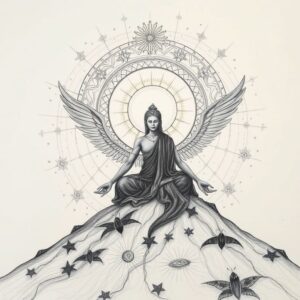
To understand spiritual drawing, we must first distinguish it from other forms of artistic expression. While a spiritual drawing can be aesthetically beautiful, its primary purpose is not decoration. Its value is measured not by technical skill alone, but by its resonance, its energy, and its capacity to facilitate a transformation in both the creator and the viewer.
What is a Spiritual Drawing?
A spiritual drawing is a visual creation born from an intention to connect with, explore, or express something beyond the material and egoic self. It is a physical manifestation of an inner process—a thought, a feeling, a prayer, a question, or a state of being. The process of creating it is often as important, if not more so, than the final product.
Key characteristics include:
-
Intention-Driven: The act begins with a conscious focus, such as “I want to connect with my inner peace,” or “I seek clarity on this life decision.”
-
Process-Oriented: The artist is immersed in the act of creation, often entering a meditative or flow state where self-judgment recedes.
-
Symbolically Rich: It frequently employs universal or personal symbols that carry deep, multi-layered meanings.
-
Energetically Charged: Many practitioners report feeling that the drawing holds a specific energy or vibration, imbued during its creation.
The Difference Between Religious Art and Spiritual Drawing
This is a crucial distinction. Religious art is often created within a specific doctrinal framework, depicting established figures, stories, and symbols from a particular faith tradition. Its purpose can be devotional, didactic, or ceremonial. A painting of the Virgin Mary in a church, created according to specific iconographic rules, is religious art.
Spiritual drawing, while it can incorporate religious symbols, is inherently personal and non-dogmatic. It is about an individual’s direct experience of the sacred, the transcendent, or the deep Self. It is an exploratory practice rather than a declarative one. A person might draw their own personal interpretation of a “guiding light” or “source energy” that may not align with any specific religion, but holds profound meaning for them. It is spirituality experienced from the inside out, and then expressed visually.
Intention: The Catalyst of Spiritual Art
Intention is the engine of spiritual drawing. It is the conscious seed from which the entire creative process grows. Without a clear intention, drawing remains a technical or recreational activity. With intention, it becomes a sacred ritual.
Setting an intention can be simple. Before you put pen to paper, take a moment to center yourself. You might:
-
Silently state a question you are holding (e.g., “What do I need to release?”).
-
Focus on a quality you wish to cultivate (e.g., “I draw in the energy of courage.”).
-
Dedicate the drawing to a person or a cause.
-
Simply set the intention to “listen” to what your inner self wants to express.
This initial act focuses your mind and energy, turning the drawing session into a co-creative dialogue with your deeper consciousness.
Chapter 2: The Sacred Alphabet – Universal Symbols and Their Meanings
Symbols are the vocabulary of the soul’s language. They are containers for complex ideas and energies, capable of conveying meaning that transcends literal explanation. When we use these symbols in our drawings, we tap into a collective unconscious—a shared reservoir of archetypal knowledge that spans cultures and millennia.
The Mandala: Universe, Wholeness, and the Self
The word “mandala” is Sanskrit for “circle.” It is one of the most powerful and universal spiritual symbols, representing the universe, wholeness, and the journey toward the center of one’s own being. Psychologist Carl Jung saw the mandala as a representation of the Self—the integrated, complete psyche.
-
Structure: Typically radial, emanating from a central point and expanding outward with intricate, symmetrical patterns.
-
Spiritual Meaning: The journey from the outer circumference to the center symbolizes the path from the external ego to the inner divine core. Creating a mandala is a meditative act of integration, bringing disparate parts of the self into harmony.
-
In Your Drawing: You don’t need to be a perfect geometrician. Start with a circle and let patterns, colors, and shapes emerge from the center. The act of focused, symmetrical creation is inherently calming and centering.
The Lotus: Purity, Enlightenment, and Rebirth
The lotus flower is a potent symbol in Eastern traditions, most notably in Buddhism and Hinduism. It grows in muddy, murky waters, yet it emerges pristine and beautiful, blooming untouched by the impurity of its environment.
-
Spiritual Meaning: It symbolizes the soul’s journey—rising from the “mud” of material suffering and attachment to achieve spiritual enlightenment and purity. Each stage of its growth (root, stem, bud, bloom) can represent a stage on the spiritual path.
-
In Your Drawing: Drawing a lotus can be an act of affirming your own potential for growth and transformation amidst life’s challenges. Its petals can be used to represent different virtues, chakras, or aspects of your life.
The Spiral: Evolution, Growth, and Life Force
The spiral is found everywhere in nature—from galaxies to seashells, from fern fronds to the DNA helix. It is an ancient symbol representing the journey of life.
-
Spiritual Meaning: It can signify evolution, expansion, and cosmic energy. An inward spiral represents a journey into the self, introspection, and returning to source. An outward spiral represents expression, expansion, and sharing your energy with the world. It is a symbol of process, not a fixed destination.
-
In Your Drawing: A simple spiral, drawn with mindful concentration, can be a powerful centering exercise. It can represent your personal growth path, with its cycles, twists, and turns.
The Tree of Life: Connection, Ancestry, and Personal Growth
The Tree of Life is a ubiquitous symbol across countless cultures, from Norse mythology to the Kabbalah, from Celtic traditions to modern spirituality.
-
Spiritual Meaning: It represents connection—its roots digging deep into the earth (grounding, ancestry, the subconscious) and its branches reaching for the heavens (aspiration, spirit, the conscious mind). The trunk is the Self, the conduit between the two realms. It symbolizes growth, strength, and the interconnectedness of all life.
-
In Your Drawing: Creating your own Tree of Life allows you to map your personal journey. The roots can represent your foundations (family, beliefs, past), the trunk your core strengths, and the branches your dreams, goals, and connections to the world.
The Labyrinth: Journey, Meditation, and Transformation
Unlike a maze, which is designed to confuse with dead ends, a labyrinth has a single, winding but unambiguous path to the center and back out again.
-
Spiritual Meaning: It is a metaphor for the spiritual journey—a path to your own center and back out into the world with renewed understanding. Walking or tracing a labyrinth is a form of moving meditation. It symbolizes that the path to enlightenment is not straight, but it is sure.
-
In Your Drawing: Drawing a labyrinth, especially a classical Chartres-style one, is a meticulous and calming practice. You can also create your own simplified versions as a focus for meditation.
Sacred Geometry: The Divine Architecture of Reality
Sacred Geometry is the belief that geometric patterns and ratios are the building blocks of the universe, reflecting a divine order. These forms are considered profoundly sacred and are believed to hold specific vibrational frequencies.
The Flower of Life
This complex pattern of overlapping circles arranged in a hexagonal symmetry is considered a blueprint of creation, containing the patterns of everything from atoms to galaxies.
(Image: The Flower of Life pattern, cleanly drawn.)
The Sri Yantra
A central symbol in Hindu Tantra, the Sri Yantra is composed of nine interlocking triangles surrounded by two circles of lotus petals. It represents the union of masculine and feminine divine energy and the entire cosmos.
Metatron’s Cube
This figure is derived from the Flower of Life and is said to contain all five Platonic Solids—the shapes that form the foundation of all physical reality. It is seen as a symbol of protection and balance.
A Guide to Common Spiritual Symbols in Drawing
| Symbol | Core Meaning | Common Contexts | Personal Application |
|---|---|---|---|
| Mandala | Wholeness, Universe, Self | Buddhism, Hinduism, Jungian Psychology | Meditation, Self-Integration, Finding Center |
| Lotus | Purity, Rebirth, Spiritual Awakening | Buddhism, Hinduism, Yoga | Personal Growth, Overcoming Challenges, Purity of Heart |
| Spiral | Journey, Growth, Life Force | Celtic, Native American, Universal Nature | Personal Evolution, Life Cycles, Inner Journey |
| Tree of Life | Connection, Growth, Ancestry | Kabbalah, Celtic, Norse, Universal | Mapping Personal History, Grounding, Aspirations |
| Labyrinth | Pilgrimage, Meditation, Certain Path | Medieval Christianity, Greek Myth | Contemplation, Problem-Solving, Walking a Spiritual Path |
| Sacred Geometry | Divine Order, Cosmic Blueprint | Ancient Egypt, Greece, Mystical Traditions | Connecting to Universal Energy, Creating Harmony, Focus |
| Hamsa / Evil Eye | Protection, Warding Off Negativity | Middle Eastern, North African Cultures | Creating a Talisman for Safety and Positive Energy |
| Om / Aum | Primordial Sound of Creation | Hinduism, Buddhism, Yoga | Invoking Peace, Connection to Source, Chanting Focus |
Animals and Spirit Guides in Drawing
Animals that appear spontaneously in our intuitive drawings, or that we feel drawn to depict, are often considered spirit guides or totems. They embody specific qualities and teachings.
-
Wolf: Loyalty, intuition, learning, freedom.
-
Owl: Wisdom, mystery, seeing the unseen, transition.
-
Butterfly: Transformation, rebirth, the soul.
-
Elephant: Strength, wisdom, loyalty, royalty.
-
Snake: Rebirth, healing, transformation (shedding skin), primal energy.
When an animal appears in your drawing, research its symbolic meanings and ask yourself what lesson or quality it might be bringing to your awareness.
Chapter 3: The Unseen Hand – The Psychology and Neurology of Spiritual Creation
The profound effects of spiritual drawing are not merely mystical; they have roots in psychology and neuroscience. The act of creating in this focused, intentional way engages the brain in unique and therapeutic patterns.
Carl Jung and Active Imagination: Dialoguing with the Subconscious
Carl Jung, the pioneering psychologist, developed a technique called “Active Imagination.” This is a process of engaging with the contents of the unconscious mind through dialogue, often using creative expression like drawing and writing. He would encourage patients to draw their dreams, fantasies, and emotional states without judgment, allowing the unconscious to speak its symbolic language. The drawing then becomes a tangible record of this dialogue, a meeting point between the conscious ego and the vast, unknown Self. Jung himself filled the “Red Book” with elaborate, visionary drawings that charted his own inner journey. Spiritual drawing is, in essence, a form of Active Imagination accessible to everyone.
The Flow State: Where Time Stops and Spirit Speaks
When deeply immersed in the process of drawing, especially repetitive or patterned work like a mandala, artists often enter a “flow state.” Psychologist Mihaly Csikszentmihalyi defined flow as an optimal state of consciousness where we feel and perform our best. It is characterized by:
-
Complete absorption in the activity.
-
A loss of self-consciousness.
-
A distorted sense of time (hours feel like minutes).
-
A sense of effortless control.
This flow state is neurologically similar to deep meditation. The brain’s default mode network (associated with mind-wandering and self-criticism) quietens down. In this quiet, open space, intuitive insights, creative solutions, and a deep sense of connection can arise naturally. The “unseen hand” that seems to guide the pen is the intelligence of the brain operating in this unified, holistic state.
Bilateral Stimulation: How Drawing Heals Trauma
Drawing, particularly when it involves rhythmic, repetitive motions across the page, can create bilateral stimulation—the same mechanism used in Eye Movement Desensitization and Reprocessing (EMDR) therapy, a highly effective treatment for trauma. The back-and-forth movement of the hand and the engagement of both sides of the body can help to process and integrate fragmented or traumatic memories that are stored non-verbally in the right hemisphere of the brain. This is why art therapy is so powerful; it allows for the expression and processing of experiences that are too difficult to articulate in words.
The Bridge Between the Conscious and Unconscious Mind
The conscious mind is logical, verbal, and linear. The unconscious mind is symbolic, emotional, and non-linear. Spiritual drawing builds a bridge between these two realms. The conscious mind sets the intention and guides the hand, while the unconscious mind supplies the symbols, colors, and forms. The resulting drawing is a collaborative artifact, a map of the inner landscape that can be contemplated and understood by the conscious mind. This integration is the cornerstone of psychological and spiritual wholeness.
Chapter 4: The Wellspring Within – Tapping into Your Intuitive Voice
Many people feel blocked from creative expression because they believe they “can’t draw.” This barrier is almost always the voice of the inner critic—the judgmental part of the ego that fears inadequacy. Spiritual drawing requires us to gently set this critic aside and make space for the intuitive voice.
Overcoming the Inner Critic: Embracing “Imperfection”
The goal is not photographic realism or technical perfection. The goal is authentic expression. A wobbly circle drawn with heartfelt intention holds infinitely more spiritual power than a perfectly rendered but emotionally empty technical drawing.
Strategies to quiet the inner critic:
-
Use a “Sacred Sketchbook”: Dedicate a journal solely to your spiritual drawings. Declare it a judgment-free zone from the outset. No one else ever has to see it.
-
Time-Limit Exercises: Set a timer for 2 minutes and draw a symbol. This forces you to work from instinct, not judgment.
-
Use Your Non-Dominant Hand: This immediately bypasses the brain’s learned patterns of “how to draw” and accesses a more raw, childlike, and intuitive mode of expression.
Techniques for Accessing Intuition
Meditation and Mindfulness
Begin your drawing session with a short 5-minute meditation. Focus on your breath and your intention. This clears the mental clutter and allows you to drop into a more receptive state. Continue this mindful awareness as you pick up your pen, noticing the sensations of the tool on the paper without judgment.
Automatic Drawing
Pioneered by the Surrealists, automatic drawing is a powerful technique for bypassing the conscious mind. The method is simple:
-
Relax your mind and body.
-
Let your pen rest on the paper.
-
Without any pre-planned image in mind, allow your hand to move freely. It might make scribbles, lines, or shapes. Don’t try to control it; just be a witness.
-
After a period of time (e.g., 5-10 minutes), stop and look at what you’ve created. See if any images, symbols, or patterns emerge from the “chaos.” This is a direct transcript from your subconscious.
Dream-Inspired Art
Keep a dream journal by your bed. Upon waking, jot down any images, symbols, or feelings from your dreams. Use these as the starting point for a drawing. This is a direct way to engage with the rich symbolic world of your unconscious mind.
Your Hand as a Channel
In many spiritual traditions, the artist is seen not as a creator, but as a channel for a higher energy or consciousness. This is the feeling of the drawing “coming through you” rather than being “made by you.” When you release the need to control the outcome and instead adopt an attitude of listening and allowing, you open yourself to this channeling experience. The drawing becomes a co-creation between your individual self and the vast intelligence of life itself.
Chapter 5: A Tapestry of Traditions – Spiritual Drawing Across Cultures
The use of drawing and symbolic art for spiritual purposes is a universal human phenomenon. Exploring these diverse traditions deepens our understanding and enriches our own practice.
Tibetan Sand Mandalas: Impermanence in Exquisite Detail
Perhaps one of the most profound examples of spiritual art is the Tibetan Buddhist sand mandala. Monks spend days or weeks meticulously placing millions of grains of colored sand into an incredibly intricate geometric design based on ancient scriptures. The process is a deep, uninterrupted meditation. Upon completion, after ceremonies and viewings, the mandala is destroyed in a powerful ritual, and the sand is poured into a flowing body of water. This practice is a direct, visceral teaching on impermanence (Anicca)—the fundamental truth that all conditioned things are transient. The beauty is in the process, not the possession.
Aboriginal Dot Painting: Dreamtime and Storytelling
For Aboriginal Australians, art is inseparable from spirituality. Their iconic dot paintings are far more than decorative; they are a visual language representing the “Dreamtime”—the sacred era of creation when ancestral spirits formed the land and its laws. These paintings map the land, tell creation stories, and encode sacred knowledge. The act of painting is a ritual of cultural preservation and a connection to Country and ancestry. The dots themselves can represent a multitude of things: stars, fire, seeds, or animal tracks, creating a rich, textured narrative.
Hindu Yantras: Geometric Maps of Divine Energy
In Hinduism, a Yantra is a geometric diagram, a tool for meditation and contemplation. Like the Sri Yantra, these drawings are considered precise, concentrated reservoirs of divine energy. Each line, triangle, and circle has a specific meaning and vibrational quality. By meditating upon a Yantra, the practitioner aligns their own consciousness with the cosmic principles it represents, using the visual form as a ladder to ascend to higher states of awareness.
Christian Iconography: Windows to the Sacred
In Eastern Orthodox Christianity, the creation of icons is a holy discipline, not a mere artistic pursuit. Iconographers fast and pray before and during their work, following strict canonical rules. The resulting icon is not seen as a picture of Christ or a saint, but as a “window into heaven,” a point of contact with the divine reality it represents. The flat, reverse perspective and stylized figures are designed to draw the viewer out of the material world and into a spiritual one.
Native American Symbolism: A Connection to Nature and Spirit
From the petroglyphs carved into rock to the designs on pottery and textiles, Native American cultures have a long history of using symbolic art. Animals, celestial bodies, and natural forces are depicted not as mere objects, but as spiritual beings and guides. A drawing of a bear might invoke its strength and healing powers; a zigzag line might represent lightning or spiritual energy. The art serves to maintain a sacred relationship with the natural world and the spirit world that permeates it.
Chapter 6: The Artist as Alchemist – A Practical Guide to Creating Your Spiritual Drawings
Now that we have explored the theory and history, let’s turn to the practical alchemy of creating your own spiritual drawings. This process can be broken down into three key stages.
Stage 1: Preparation – Setting the Sacred Container
The space you create in and the mindset you bring are foundational.
-
Creating a Conducive Environment: Find a quiet space where you won’t be interrupted. You might light a candle, burn some sage or incense, or play soft, instrumental music. This signals to your mind and spirit that you are entering a sacred time.
-
Choosing Your Materials with Intention: You don’t need expensive supplies. A simple sketchbook and a pen are enough. However, you may wish to choose materials that resonate with you—the earthy feel of pastels, the vibrant flow of watercolors, or the precision of fine-liner pens. Let your intuition guide you.
-
Setting a Clear Intention or Question: As discussed, take a few quiet moments. Center yourself with a few deep breaths. Silently ask your question or state your intention. You can write it at the top of the page if that helps.
Stage 2: Process – The Act of Creation
This is where you let go and allow the energy to flow.
-
Starting from the Center: For mandalas and many other spiritual drawings, beginning from a central point is powerful. It grounds the drawing and gives it a stable core from which to expand. Make a single dot and build outwards.
-
Letting the Drawing Unfold vs. Pre-Planned Design: There are two valid approaches. One is to let the drawing emerge organically, moment by moment, following your intuition (like automatic drawing). The other is to plan a specific symbol (like a Tree of Life) and then fill it in with intuitive details. Both are valid; you can experiment to see which feels right for you in the moment.
-
Working with Color Symbolism: Colors carry their own energy and meaning. While personal associations are most important, here are some common symbolic meanings:
-
Red: Passion, vitality, root chakra, grounding.
-
Orange: Creativity, joy, sacral chakra, emotion.
-
Yellow: Intellect, confidence, solar plexus chakra, power.
-
Green: Healing, heart chakra, nature, balance.
-
Blue: Communication, throat chakra, peace, truth.
-
Purple: Intuition, crown chakra, spirituality, wisdom.
-
White: Purity, protection, spirit, new beginnings.
-
Black: Mystery, the unknown, potential, protection.
-
Stage 3: Contemplation – Interpreting Your Creation
The drawing is complete, but the process is not. Now you must “read” the message.
-
Journaling Your Experience: Write down the intention you started with. How did the process feel? Were there moments of struggle or ease? Did any emotions or memories arise?
-
Analyzing Symbols, Colors, and Composition: Look at your drawing objectively.
-
Symbols: What symbols do you see? Are they universal or personal? What do they mean to you?
-
Colors: Which colors dominate? Are there colors you expected to use but didn’t? Refer to color symbolism and your own feelings.
-
Composition: Is the drawing balanced or lopsided? Is the energy flowing or blocked? Is the page full or sparse? These can reflect your inner state.
-
-
Integrating the Wisdom: The ultimate purpose of this work is transformation. What is the drawing telling you? What action does it inspire? What quality does it ask you to embody? Carry this insight with you off the page and into your daily life.
Chapter 7: Modern Manifestations – Digital Art and Spiritual Expression
In our technological age, a valid question arises: can digital art be spiritual? Can drawing on an iPad carry the same energetic charge as drawing on paper?
The answer is a resounding yes. The spirit of the work lies in the intention and process, not the medium.
-
Can a Digital Drawing Be Spiritual? Absolutely. The artist can still set an intention, enter a flow state, and channel intuitive symbols. The digital canvas becomes the sacred space.
-
New Tools for Ancient Practices: Digital tools offer unique advantages. The ability to create perfect symmetry with a click can aid in mandala creation. Layers allow for experimentation without “ruining” the original drawing. The “undo” function can help silence the inner critic, encouraging play and exploration.
-
Building Online Spiritual Communities: Platforms like Instagram and Pinterest have become hubs for artists to share their spiritual work, forming global communities where people can inspire and support each other’s journeys. A digitally shared mandala can transmit a vibration of peace to thousands of viewers, amplifying its positive impact.
The medium is simply a tool; the magic resides in the heart and mind of the artist.
Conclusion: The Infinite Line
The line drawn with spiritual intent is infinite. It connects us to our most ancient ancestors and to the future of human consciousness. It is a bridge between the seen and unseen, the known and the unknown. Through the simple, profound act of making a mark, we chart the geography of our soul, heal the wounds words cannot reach, and converse with the divine. Your hand, your paper, and your intention are the only tools you need to begin this eternal dialogue. Pick up a pen, and let your soul speak.
Frequently Asked Questions (FAQs)
1. I’m not artistic at all. Can I still benefit from spiritual drawing?
Yes, absolutely. This practice is not about technical skill but about authentic expression. In fact, letting go of the need to be “good at art” is often the first step toward a deeper, more intuitive connection. Embrace wobbly lines and “imperfect” shapes; they are often the most authentic.
2. How is this different from art therapy?
There is significant overlap. Art therapy is a formal, clinical practice facilitated by a trained therapist to address specific psychological goals and diagnoses. Spiritual drawing is a personal, exploratory practice focused on connection, meaning, and personal growth. It can be deeply therapeutic, but it is not a substitute for professional therapy when needed.
3. What should I do if disturbing images or symbols come out in my drawings?
It’s not uncommon for the subconscious to release suppressed emotions or imagery. First, do not be afraid. The drawing has safely contained this energy, bringing it to light so it can be acknowledged. Thank the image for appearing. You may want to journal about what it brings up for you. If the feelings are overwhelming, consider sharing the drawing and your experience with a trusted friend, spiritual advisor, or therapist.
4. How long should I spend on a spiritual drawing?
There is no rule. It could be a 5-minute automatic drawing or a detailed mandala worked on over several days. Let the process dictate the time. The key is to stay engaged and present for as long as the creative flow continues.
5. Can I use reference images for symbols?
Of course. Using references for universal symbols like the Flower of Life or a specific animal is a great way to learn and incorporate powerful archetypes into your work. The spiritual intention you infuse it with is what makes it your own.