The sudden, silent flutter of leathery wings against the twilight sky—a bat’s appearance is an event that rarely goes unnoticed. For some, it evokes a primal fear, a chill born from folklore and superstition. For others, it sparks a deep, intuitive curiosity. What if this creature of the night was not an omen of dread, but a profound spiritual messenger? Across the globe and throughout human history, the bat has been a powerful and paradoxical symbol, representing everything from death and darkness to rebirth, intuition, and good fortune. To encounter a bat is to be invited into a world of mystery, a call to look beyond the veil of ordinary perception and confront the hidden parts of ourselves and the universe.
This article is a journey into the heart of that mystery. We will embark on an extensive exploration of the bat’s spiritual significance, dissecting its symbolism across diverse cultures, spiritual traditions, and personal contexts. We will move beyond superficial interpretations to understand the bat as a guide for deep, personal transformation. Whether a single bat crosses your path, one enters your home, or you simply find yourself drawn to its image in dreams and meditations, this guide will provide the tools to decipher its message. Prepare to have your perceptions challenged and your spiritual understanding deepened as we unravel the enigmatic teachings of this nocturnal guardian.
1. Introduction: The Duality of the Bat
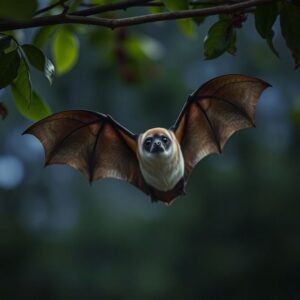
The bat is the ultimate symbol of duality, a living paradox that forces us to reconcile opposing forces. It is a mammal that flies like a bird, a creature of the night that navigates with impeccable precision, and an animal associated with death that is a vital pollinator and seed disperser, essential for the health of ecosystems. This inherent contradiction is the very source of its spiritual power. It does not allow for simple, one-dimensional interpretations. To understand the bat is to embrace complexity.
In the human psyche, the bat often becomes a screen upon which we project our deepest fears—fear of the dark, fear of the unknown, fear of death, and fear of the parts of ourselves we keep hidden (our “shadow selves”). Yet, by confronting what the bat represents, we are offered an unparalleled opportunity for growth. Its message is one of profound transformation. Just as the bat emerges from the dark cave—a universal symbol of the womb and the subconscious—it teaches us that true rebirth is always preceded by a period of darkness and introspection. It is a shamanic creature, guiding the soul through the underworld of the self to return with greater wisdom and clarity. This article will serve as a map for that journey, providing a nuanced framework to understand the bat not as a monster, but as a mentor.
2. Fundamental Symbolic Pillars of Bat Spirituality
To build a comprehensive understanding, we must first deconstruct the bat’s symbolism into its core components. These pillars form the foundation upon which all cultural and personal interpretations are built.
2.1. Transition and Rebirth: The Metaphor of the Cocoon
Perhaps the most potent spiritual lesson of the bat is its embodiment of transition and rebirth. This symbolism is deeply tied to its biology and behavior. Bats dwell in caves, which in myth and dream interpretation universally represent the subconscious mind, the womb, and a place of profound transformation. Each night, the bat colony erupts from the mouth of the cave in a spectacular exodus, only to return at dawn. This daily cycle is a powerful metaphor for the soul’s journey: venturing out into the world of experience and returning to the inner sanctum for rest and regeneration.
Furthermore, many species of bats undergo hibernation, a state of suspended animation that resembles death, followed by a reawakening in the spring. This process mirrors the archetypal hero’s journey of descent, ordeal, and return. When a bat appears, it often signals that you are in, or about to enter, a significant transitional phase. This could be the end of a relationship, a career change, a shift in personal identity, or a spiritual awakening. The bat’s message is to trust this process. The darkness is not your enemy; it is a necessary cocoon. The old self, the old ways of being, must “die” so that a new, more authentic version of you can be born. Resistance to this natural cycle only causes suffering. The bat teaches surrender and faith in the regenerative power of the universe.
2.2. Confronting and Releasing Fear
The bat is a master of the very realm we often fear the most: the night. It moves through darkness not with trepidation, but with supreme confidence, using its sophisticated echolocation to navigate unseen terrain. Spiritually, this is a direct lesson for us. The bat as a totem calls upon you to confront your deepest fears and anxieties. What are the “dark places” in your life that you are avoiding? This could be a difficult conversation, a past trauma, or a hidden aspect of your own personality that you are ashamed of.
The bat does not promise to eliminate your fears; instead, it offers a new way to navigate them. Echolocation is about sending out a signal and listening for the returning echo to build a map of the environment. Metaphorically, this translates to facing a fear, “sending out” your courage or inquiry, and “listening” to the feedback from your experience. By doing so, you build an internal map of your own psyche and your challenges. You learn that you can move through the darkness without being consumed by it. The appearance of a bat is a spiritual nudge, urging you to stop running and turn to face what frightens you. The act of facing it, of “navigating” it, is what renders it powerless and transforms it into a source of strength.
2.3. The Power of Inner Vision and Intuition
Bats are not blind, but their primary mode of navigation is echolocation—a form of seeing with sound. This ability to perceive the world through a non-visual sense is a profound spiritual metaphor for intuition and inner vision. In a world that prioritizes literal, empirical, and visible data (the “daylight” of logic), the bat reminds us of the power of the unseen.
When the bat comes into your awareness, it is often a sign that you are being called to trust your intuition over your logical mind. You may be in a situation where the “facts” are confusing or misleading, but your gut feeling is giving you a clear signal. The bat says: Listen to that inner voice. It is encouraging you to develop your psychic faculties, your clairsentience (clear feeling), and clairaudience (clear hearing). Just as the bat uses subtle vibrations to create a perfect picture of its world, you can learn to tune into the subtle energies, synchronicities, and intuitive hits that guide you on your true path. It is a call to close your eyes to the outer distractions and see with the eyes of your soul.
2.4. Illusion and Perception: Seeing Through the “Vampire” Myth
The popular culture image of the vampire bat, though based on a tiny minority of species, has heavily influenced the bat’s negative symbolism. However, from a spiritual perspective, even this can be inverted into a powerful lesson about illusion and perception. The fear of the “blood-sucking” bat is largely an illusion, a projection of our own fears of being drained by others—of toxic relationships, energy vampires, and situations that deplete our vitality.
Therefore, the bat’s appearance can be a warning to examine your life for such drains. Are there people, jobs, or habits that are “sucking your lifeblood”—your energy, joy, and time? The bat, as a creature that can see through illusion (using sonar to perceive the true form of things), empowers you to see these situations for what they truly are. It asks you to protect your energy, set firm boundaries, and release attachments to people or patterns that no longer serve your highest good. It teaches you to discern reality from the “shadows” cast by fear and misinformation.
3. A Global Tapestry: Bat Symbolism in World Cultures
To fully appreciate the bat’s spiritual meaning, we must view it through the lens of various human cultures. This global perspective reveals a rich and varied tapestry of interpretation, far more complex than the monolithic Western fear.
3.1. Eastern Symbolism: Fu for Good Fortune (China)
In Chinese culture, the bat is a potent and universally positive symbol of good fortune, happiness, and long life. This is primarily a linguistic association: the word for “bat” (蝠, fú) is a homophone for the word for “blessing” or “good fortune” (福, fú). Consequently, the image of a bat is ubiquitous in Chinese art, textiles, and architecture.
-
The Five Bats (Wu Fu): A very common motif is that of five bats, known as Wu Fu. They represent the “Five Blessings”: longevity, wealth, health, love of virtue, and a natural death. This symbol is often found surrounding the character for longevity (寿, shòu).
-
Red Bats: Red bats are considered especially auspicious, as red is the color of joy and prosperity in Chinese culture.
In this context, seeing a bat is an extremely positive omen, signaling the arrival of good luck, prosperity, and divine blessings. It is a sign to welcome abundance in all its forms.
3.2. Mesoamerican Deities: Camazotz and the Mayan Underworld
In stark contrast, the Maya of Mesoamerica revered a terrifying, death-dealing bat god known as Camazotz, whose name translates to “death bat.” In the Popol Vuh, the K’iche’ Maya creation epic, Camazotz is a guardian of the underworld (Xibalba) who decapitates one of the Hero Twins during their trials. He is depicted as a man-bat hybrid with a knife-like nose leaf.
The symbolism here is raw and primal. Camazotz represents sudden, sacrificial death, the fear of the dark, and the brutal trials of the underworld journey. However, even this fearsome deity is not purely evil. His role is initiatory. The decapitation by Camazotz is a symbolic death of the ego, a necessary step for the Hero Twins to ultimately overcome the lords of death and achieve apotheosis. Therefore, in a Mayan spiritual context, a bat encounter could be interpreted as a call to a severe but necessary initiation. It demands the “death” of an outmoded part of your ego or identity to make way for a higher state of consciousness. It is a harsh but ultimately transformative teacher.
3.3. African Folklore: The Bat as a Trickster and Wise Mediator
In various African folktales, the bat often plays the role of a trickster or a wise mediator, a role born from its ambiguous nature as a creature that is neither fully bird nor fully mammal. A common fable tells of a war between the beasts of the earth and the birds of the air. The bat, with its mammalian body and bird-like wings, switched sides depending on who was winning. When the conflict was resolved, both sides rejected the bat for its duplicity, forcing it to become a solitary, nocturnal creature.
This story carries a deep spiritual lesson about identity, duality, and the consequences of indecision. The bat becomes a symbol of the outsider, the one who does not fit neatly into societal categories. Its spiritual message in this context is to embrace your unique, hybrid nature. You do not have to choose one side or the other. Your power may lie in your ability to bridge worlds, to see from multiple perspectives. However, the story also warns against a lack of integrity and the perils of refusing to take a stand. The bat’s solitude is not a punishment, but a consequence that leads to its unique wisdom and self-reliance.
3.4. Western Ambivalence: From Christian Demonology to Modern Eco-Spirituality
The Western view of the bat is perhaps the most conflicted. In European Christian art and demonology, bats were often associated with the devil, witches, and familiar spirits. Their nocturnal habits and eerie appearance linked them to heresy, darkness, and evil. This association was cemented in Gothic literature, such as Bram Stoker’s Dracula, which forever tied the bat to the vampire myth.
However, a modern shift is underway. With the rise of ecology and a renewed interest in paganism and earth-based spirituality, the bat is being re-evaluated. It is now recognized as a crucial pollinator (for fruits like bananas, mangoes, and agave) and a natural pest controller. This has led to a new, eco-spiritual symbolism: the bat as a guardian of the natural balance, a symbol of interdependence, and a reminder of the hidden networks that sustain life. In this modern context, seeing a bat can be a call to environmental consciousness, to honor the often-unseen forces that support our existence, and to find the sacred in the “dark,” wild, and untamed parts of nature and ourselves.
Summary of Bat Symbolism Across Cultures
| Culture/Region | Primary Symbolism | Key Interpretation of an Encounter |
|---|---|---|
| Chinese | Good Fortune, Blessings, Longevity | A very positive omen; expect prosperity, joy, and abundance. |
| Mesoamerican | Death, Initiation, Ego-Dissolution | A call to a profound personal transformation; the “old you” must die for the “new you” to be born. |
| African | Duality, Mediation, The Trickster | Embrace your unique identity; you are a bridge between worlds. A warning against duplicity. |
| Western (Traditional) | Evil, Darkness, The Devil | Confronting fear, shadow, and projected evil. A call to reclaim your power from superstition. |
| Western (Modern) | Ecology, Interdependence, Rebirth | A call to environmental awareness and honoring the unseen forces that sustain life. |
4. Context is Key: Interpreting Your Specific Bat Encounter
The general and cultural symbolism provides the dictionary, but the specific context of your encounter provides the sentence. Where, when, and how you see a bat dramatically refines its message.
4.1. Seeing a Single Bat by Day vs. by Night
A bat is a nocturnal creature, so its appearance during the day is highly unusual and therefore carries significant spiritual weight.
-
Bat by Day: This is a powerful sign that you are being called to pay attention now. It can indicate that something hidden is trying to come to light. A truth you’ve been avoiding, a part of your personality you’ve suppressed, or an opportunity that is not yet obvious is demanding your awareness. It can also be a warning against being “out of your element”—perhaps you are forcing a situation or acting in a way that is not authentic to your true nature. The message is to look deeper and be prepared for revelations.
-
Bat by Night: This is the bat in its natural element. Its message is more aligned with its core themes: trust your intuition, navigate the darkness with faith, and embrace the process of transition. It is a confirmation that you are on the right path, even if that path is currently unclear or challenging.
4.2. The Potent Sign of a Bat Entering Your Home
A bat entering your living space is one of the most intense and personal encounters. The home is a sacred space, a symbol of your inner world, your psyche, and your sense of security. A bat crossing this threshold is a direct incursion into your personal life.
Spiritually, this almost always signifies that a major transformation is occurring at the very core of your being. It is a call for deep inner work. The “darkness” the bat represents is no longer outside; it is inside your own “house.” This could relate to:
-
Shadow Work: The need to confront repressed emotions, traumas, or aspects of your personality you have disowned.
-
A Violation of Boundaries: A sign that your energetic or personal boundaries have been breached, and you need to reclaim your space.
-
A Spiritual Awakening: The bat can be seen as a spirit guide forcefully entering your awareness to initiate a rapid and profound shift in consciousness.
While the experience can be frightening, the spiritual invitation is to welcome this guide. Safely and humanely help the physical bat back outside, but consciously invite its spiritual lessons to remain.
4.3. The Rarity and Significance of a White Bat
Albino or leucistic bats are exceptionally rare in nature, making a sighting of a white bat a profoundly mystical event. White, across virtually all spiritual traditions, symbolizes purity, divinity, higher consciousness, and ascension. It is the color of the crown chakra, connecting us to the divine source.
Combining the color white with the bat’s symbolism of rebirth creates a potent message of spiritual rebirth. Seeing a white bat suggests that you are undergoing or are about to undergo a transformation of the highest order. It is a purification of the spirit, a shedding of all lower vibrations and karmic baggage. This is a powerful confirmation from the universe that you are aligning with your soul’s highest purpose. It is a blessing and a sign of immense spiritual grace, indicating that your journey through the “dark night of the soul” is leading you to a state of profound light and enlightenment.
4.4. Encountering a Dead Bat
Finding a dead bat can be a startling experience, but its spiritual meaning is not necessarily negative. Death, in the symbolic language of the spirit, is almost always about endings and transitions.
A dead bat can signify:
-
The End of a Transformation: The difficult period of transition and rebirth is complete. The “old you” has officially died, and it is time to step into your new life.
-
A Stifled Intuition: It may be a warning that you are ignoring your inner voice or intuitive guidance, causing that faculty to “die” from neglect.
-
Release from Fear: The death of the symbol of fear can mean you are finally releasing a long-held fear or anxiety.
-
A Need for Grounding: The bat is a creature of the air (spirit) and the underworld (subconscious). Its death could be a message that you have become too ungrounded and need to bring your focus back to the physical world and your body.
The key is to reflect on what is ending or has recently ended in your life to understand the specific message.
4.5. Repeated Encounters and the Concept of Animal Totems
When a particular animal appears to you repeatedly—in physical form, in dreams, in art, or in conversation—it is a strong indication that it is your animal totem or spirit guide trying to get your attention. If bats are consistently showing up in your life, it is a call to deeply study and integrate their energy.
A bat totem is a powerful guide for those who walk a path of deep transformation, shamans, healers, therapists, and anyone who works with the subconscious mind. It grants the gifts of:
-
Navigating Crisis: The ability to remain calm and find your way through intense personal challenges.
-
Psychic Perception: A natural talent for intuition, dream work, and perceiving unseen energies.
-
Rebirth: The resilience to continually shed old skins and reinvent yourself throughout your life.
To honor a bat totem, you might study its biology, meditate on its image, or create art that honors its spirit. The more you acknowledge it, the more its wisdom will flow through you.
5. The Bat as a Spirit Animal and Power Animal
The terms “spirit animal” and “power animal” are often used interchangeably, but a subtle distinction can be made. A spirit animal is a lifelong guide that reflects your core personality and spiritual path. A power animal is a temporary guardian that comes to lend its specific energy during a particular challenge or phase of life.
5.1. Characteristics of a Bat Spirit Guide
If the bat is your spirit animal, you are likely a person who is comfortable with transition and introspection. You may have a natural affinity for the night, finding peace and creativity in the quiet hours. You are highly intuitive, perhaps even psychic, and you can sense things that others miss. You are not afraid to explore the darker aspects of life and the human psyche, and you may find yourself drawn to helping others through their own “dark nights.” You understand that endings are necessary for new beginnings, and you possess a deep, innate resilience.
5.2. When the Bat Chooses You: Life Phases and Calling Its Energy
You don’t choose a power animal; it chooses you. The bat’s energy is most likely to appear in your life when:
-
You are going through a major life change (divorce, moving, career shift).
-
You need to confront a deep-seated fear or phobia.
-
You are developing your intuitive or psychic abilities.
-
You are feeling lost or in the “dark” about a life direction and need to trust an unseen path.
-
You are doing deep shadow work or therapy.
You can also consciously call upon the energy of the bat as a power animal through meditation and visualization when you need its specific strengths.
5.3. Rituals and Meditations to Connect with Bat Energy
-
Cave Meditation: Visualize yourself entering a safe, warm cave. Sit in the darkness, not as a void, but as a nurturing space. Feel the presence of the bat colony hanging peacefully above you. Ask for their wisdom. What do you need to release? What is being reborn within you? Listen in the silence.
-
Echolocation Visualization: When faced with a problem, close your eyes. Imagine sending out a pulse of light or sound from your heart, like a bat’s sonar. Let this pulse travel out and map the situation, returning to you with information not based on logic, but on pure, intuitive knowing.
-
Dream Journaling: Since bats are creatures of the subconscious, pay close attention to your dreams after setting an intention to receive guidance from your bat totem. Keep a journal by your bed.
6. The Bat in Dreams: A Subconscious Journey
Dreams are the native language of the subconscious, and the bat is a native creature of that realm. Its appearance in dreams is always significant.
6.1. Common Bat Dream Scenarios and Their Interpretations
-
Being Chased by Bats: This classic fear dream indicates you are running from a part of yourself—your shadow, your intuition, or a truth you don’t want to face. The message is to stop running and turn to face what pursues you.
-
A Bat Flying Around You: This can symbolize an idea or insight trying to get your attention. It may feel unsettling, but it is not necessarily hostile. Pay attention to new thoughts or revelations.
-
A Bat Biting You: This is a powerful symbol of initiation. Something is “sinking its teeth” into you, forcing a change. It can also relate to feeling that your energy is being drained by someone or something (“energy vampire”).
-
Transforming into a Bat: This represents a desire for or an experience of profound personal freedom and a shift in perspective. You are gaining the ability to see your life from a higher, more detached vantage point.
6.2. Analyzing the Emotional Landscape of the Dream
The single most important factor in interpreting a bat dream is your emotional reaction within the dream.
-
Fear: Points to unresolved fears and resistance to change.
-
Curiosity/Wonder: Suggests you are open to the bat’s message and are ready to explore your subconscious.
-
Awe/Power: Indicates you are successfully integrating the bat’s energy and embracing your own power of transformation.
7. Integrating the Bat’s Wisdom: A Practical Guide for Personal Transformation
Understanding the symbolism is one thing; living it is another. How can you practically apply the bat’s teachings to your daily life?
7.1. Navigating a Personal Metamorphosis
If you are in a period of intense change, consciously invoke the bat.
-
Create a “Cocoon”: Give yourself permission to retreat. Spend time alone in quiet contemplation. Reduce social obligations. This is your cave.
-
Journal the Process: Write about what is ending and what is beginning. The bat teaches that death and rebirth are two sides of the same coin. Honor the death of the old.
-
Practice Surrender: Repeat the mantra, “I trust the process of my transformation. I am safe in the darkness, for it is the womb of my rebirth.”
7.2. Honing Your Intuitive and Psychic Faculties
The bat is a master of non-physical perception.
-
Start Small: Each day, pause before making a small decision (e.g., which route to take) and ask your intuition. Don’t think, just feel. Act on the first feeling you get.
-
Meditate in the Dark: Spend 10 minutes meditating in a completely dark room. Without visual stimuli, your other senses, including your intuition, will become heightened.
-
Pay Attention to Synchronicities: The bat’s world is built on returning echoes. Notice the “echoes” in your life—repeated numbers, words, or symbols. They are your soul’s echolocation at work.
7.3. Shadow Work with the Bat as a Guide
The bat is the ultimate guide for shadow work—the process of acknowledging and integrating the disowned parts of ourselves.
-
Identify Your Shadow: What qualities in others trigger a strong negative reaction in you? Often, what we despise in others is a disowned part of ourselves.
-
Dialogue with Your Shadow: In a journal, write a conversation with this disowned part (e.g., your “anger,” your “laziness,” your “selfishness”). Ask it what it needs and what it is trying to protect you from. The goal is not to act it out, but to understand and integrate its energy, thereby robbing it of its destructive power.
8. Conclusion: Embracing the Nocturnal Guide
The bat, in its silent, graceful flight through the liminal space between dusk and dawn, is a master teacher of the unseen realms. It is a symbol not of fear, but of the profound courage required to face the darkness within and without. It is a herald not of death, but of the inevitable and beautiful rebirth that follows. It is a guide not to superstition, but to the deep, intuitive knowing that lies beyond the five senses. To see a bat is to receive an invitation—a call to transform, to trust the journey even when the path is unseen, and to ultimately discover that our greatest power is often born from our willingness to navigate the dark.
9. Frequently Asked Questions (FAQs)
Q1: I’m terrified of bats. Does this change the spiritual meaning if I see one?
A: Your fear is an important part of the message. The bat’s appearance is a direct challenge to that specific fear. Its spiritual meaning becomes intensely personal: it is calling you to confront and understand what you are so afraid of. The message of transition and intuition is still present, but the primary lesson for you is one of overcoming fear and reclaiming your power.
Q2: Is seeing a bat a bad omen or a sign of death?
A: While in some cultural contexts like the Mesoamerican, it can symbolize a symbolic death of the ego, it is almost never a literal prediction of physical death. Its core meaning is transformation. Seeing change as “bad” is a matter of perception. The bat signals the end of one phase and the beginning of another, which can be painful but is ultimately necessary for growth. In many other cultures, like the Chinese, it is a direct omen of good fortune.
Q3: What should I do physically if a bat enters my house?
A: Spiritually, welcome its message. Physically, remain calm. Open a window or door to the outside and turn off the lights in the room, leaving a light on outside. The bat will usually fly out on its own. If it lands, you can carefully cover it with a small box, slide cardboard underneath, and release it outside. Always avoid direct handling to protect both you and the bat.
Q4: How is the bat different from other nocturnal spirit animals like the owl?
A: The owl is a predator associated with wisdom, knowledge, and seeing through deception. Its wisdom is often cerebral and detached. The bat’s wisdom is more visceral and internal. It is about navigating the subconscious and emotional darkness, rebirth, and using a non-visual, intuitive sense (echolocation) rather than the owl’s sharp physical sight. The owl sees in the dark; the bat becomes the dark to navigate it.
Q5: Can the bat be a symbol for community?
A: Absolutely. Most bat species are highly social, living in massive colonies. This adds another layer to their symbolism: interdependence, communication, and the power of the collective. While their spiritual message is often about personal transformation, it can also remind us that we transform within a community and that supporting each other is crucial for survival and navigation.
10. Additional Resources
-
Books on Animal Symbolism:
-
Animal Speak by Ted Andrews
-
The Dictionary of Symbolism by Hans Biedermann
-
Spirit Animals for the Journey by Stephanie Rose Bird
-
-
Scientific and Conservation Resources:
-
Bat Conservation International (batcon.org)
-
Understanding bat biology and ecology deepens spiritual respect.
-